
Domenico’s Rise and Confession
I Know This Much Is TrueDomenico builds status and a family in America while reproducing the violence and silence he inherited, then attempts too late to reckon with the cost of his choices.
increasing Bearing strength in each event
 decreasing
Bearing strength in each eventdecreasingA Child Marked by Disaster
A Child Marked by Disaster
Family, loss, and ambition
Domenico grew up in Giuliana, Sicily, in a family shaped by the destruction of his maternal grandparents’ land during an eruption of Mount Etna. His mother, Concettina, survived a childhood catastrophe that left a scar on her hand, and her stories made survival seem inseparable from loss.
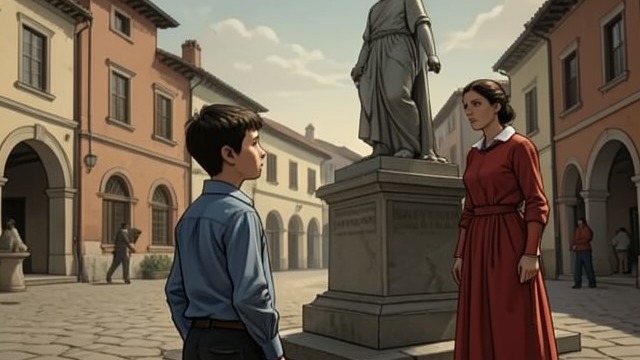
Domenico remembered himself as special from childhood. A village statue’s reported tears and a priest’s encouragement led his family to send him to religious school, where he excelled and learned to imagine himself as a man destined for more than mine work.
Forced into the family role
After his brother Vincenzo disgraced the family, Domenico was pulled from his studies and made to work as a stonemason. His father, Giacomo, treated obedience as a son’s law; Domenico accepted the burden while resenting the loss of his religious ambitions.
The experience strengthened his belief that hard work and discipline entitled him to advancement. It also taught him to regard the people who depended on him as responsibilities to manage, rather than equals whose needs might contradict his plans.
A New Country and New Status
A New Country and New Status
Arrival and labor
Domenico and his brothers sailed from Sicily to New York in steerage and then settled in Three Rivers, where they found work at American Woolen and Textile. The voyage deepened his resolve never to return to the poverty and humiliation he had left behind.
At the mill, he rose from laborer to boss dyer through relentless work. His ability to outproduce other workers gave him status, but he used that standing to resent and belittle those he judged less industrious, including Nabby Drinkwater.
Building the house
Domenico saved carefully and bought land on Hollyhock Avenue. With Pasquale’s labor, he constructed a large duplex that he regarded as proof that he had fulfilled his promise to himself and his family.
The house represented security and achievement, but it also became an extension of his authority. Domenico expected others to respect his rules, serve his plans, and acknowledge that he had earned a place above them.
Marriage Under His Rule
Marriage Under His Rule
Choosing Ignazia
Domenico married Ignazia after a bargaining process that turned her into a bride he believed he had acquired. He recognized her resistance and her attachment to another man, but treated those feelings as obstacles to overcome rather than as reasons to reconsider the marriage.
Their life together was marked by coercion, suspicion, and imposed sexual obligations. When a doctor warned that another pregnancy could endanger Ignazia’s life, Domenico continued to see his desires and authority as more important than her safety.
Loss and rejection
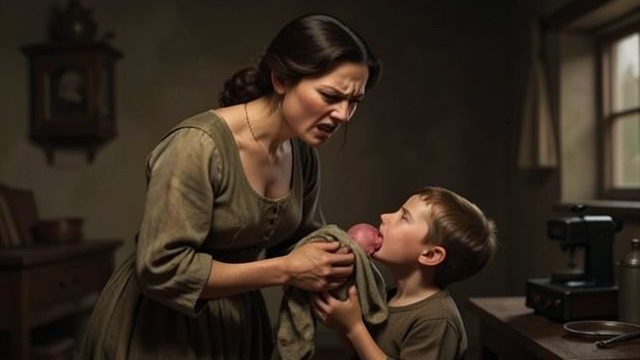
Ignazia gave birth to twins, a boy and a girl. The boy was stillborn, and Domenico secretly baptized him with dishwater and oil, fearing for the child’s soul and acting without a priest.
He became convinced that the surviving girl, Concettina, was not his child and resented her cleft lip as evidence of supposed betrayal. Rather than acknowledge his grief or uncertainty, he directed blame and cruelty toward his wife and daughter, deepening the damage inside the family he had built.
The Prison of a Family Secret

The Prison of a Family Secret
Control and separation
Domenico forced Ignazia into a household where he controlled money, movement, and the terms of their marriage. He rejected the possibility of baptism for Concettina and kept the family apart from the priest and community that might have offered help.
His mother-in-law, also named Concettina, lived under his contempt and eventually died after falling through the ice at Rosemark’s Pond. The account Domenico later gave presented the death as an accident, but the family’s silences leave its circumstances uncertain.
A life built on concealment
Domenico’s control over his household mirrored the secrets he preserved about his own past and his family’s relationships. He neither reconciled with his wife nor allowed the household to speak openly about its grief, leaving his daughter to grow up under his suspicion and authority.
His later autobiographical project would expose some of this history, but it would not become a straightforward confession. Even while describing his life, Domenico continued to portray himself as the injured, exceptional man at its center.
The Late Confession
The Late Confession
Writing a life story
Near the end of his life, Domenico hired Angelo Nardi to record and transcribe his history, then dismissed him and finished much of the manuscript himself. He presented the project as a guide for Italian youth, but its pages reveal his obsession with reputation, grievance, and his own greatness.
The manuscript also records his injuries and losses: his father’s death, his brothers’ fates, and his estrangement from his mother and daughter. His written account is revealing precisely because it cannot be separated from the self-justifying voice through which he tells it.
An unfinished legacy
Domenico died in the backyard while reading his pages, which scattered through the yard. His daughter gathered them, preserving the story even though she never read it herself.
Decades later, Dominick recovered and read the manuscript, encountering a family history that complicated his inherited picture of Domenico as a hero. The manuscript did not resolve every secret, but it helped Dominick see how pride, harm, and silence could pass from one generation to another.
Domenico’s childhood in Giuliana before 1898
1901 through Domenico’s rise at American Woolen and Textile
1916 through the birth of Domenico’s children
after Concettina’s birth through the 1925 drowning
the summer of 1949 and Domenico’s final day
