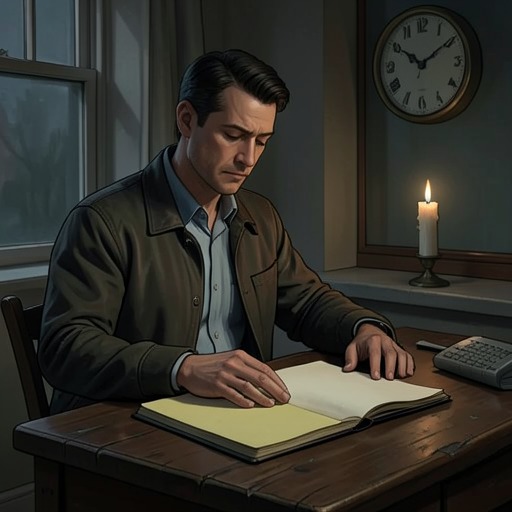
Concettina Tempesta Birdsey
I Know This Much Is TrueConcettina Tempesta Birdsey, whom her sons call Ma, is a mother whose presence in the novel is reconstructed chiefly through Dominick Birdsey’s memories. Her care once held the twins together in shared rituals; Thomas Birdsey’s illness divided their childhood, and Ma’s death left Dominick with the fear that no one could take her place in Thomas’s life. Her story also reaches backward into the family’s uncertain history, where Dominick tries to understand the cruelty she endured and the secrets attached to her parentage.
Identity and Family History
A memorial inscription records Concettina Tempesta Birdsey’s dates as 1916–1987. At Thomas Birdsey’s funeral, Dominick tells Father LaVie that Ma had breast cancer and that she and Thomas had been exceptionally close. Her place in the family is therefore defined not only by being the twins’ mother, but by a particular closeness with the son whose illness made him dependent on care and whose future most troubled her.
Dominick’s later reading of Domenico Tempesta’s history unsettles his understanding of Ma’s origins. He wonders whether she was really the daughter of an Irishman and, if so, whether Domenico Tempesta was the twins’ grandfather at all. The thought does not resolve into a discovery: Dominick questions how it could account for twins with different fathers, and his own resemblance to the man in the sepia photographs Ma had saved from a burning house pulls him back toward uncertainty. The rescued photographs become a fragile counterweight to conjecture, preserving a family likeness without settling the family’s history.
Dominick also forms a tentative explanation for Domenico Tempesta’s treatment of Ma. He suspects that Domenico Tempesta may have disowned her, believed she belonged to someone else, and punished her for her mother’s supposed sins. His recollection invokes humiliations involving a cigarette and a plate of fried eggs, and he wonders whether Domenico Tempesta beat his wife as well. These are Dominick’s inferences, not a settled account of Ma’s parentage or of every event in her childhood. Their importance lies in the way he attempts to connect her suffering to the family’s concealed past.
Motherhood and the Twins’ Childhood
In Dominick’s earliest remembered scene, he is four and has to nap alone. Before Thomas Birdsey became ill, Ma would lie between the boys on the spare-room bed and tell stories about two animal friends: Thomas as a little rabbit and Dominick as a little monkey who was always getting into things. The story ritual gave the twins a shared imaginative world, with Ma physically between them as its center.
That arrangement changes when Thomas becomes sick. Ma takes his temperature, brings him medicine and ginger ale, and moves him into the spare room so he can rest. Dominick is given books to look at until he falls asleep. He knows the letters m for Ma and t for Thomas, but the small lesson also records how illness has reorganized the household around Thomas’s needs. Ma’s attentiveness is real; so is the four-year-old’s experience of being left alone while his brother receives care.
The separation gives rise to a child’s guilty act and crude attempt to shift blame. Dominick has scribbled on the pictures in his books, but when Ma asks who did it, he says Thomas did. He labels his brother bad, then describes drawing pictures for him through the separation. Thomas cannot answer because his throat hurts and he needs rest. In the memory, the boys’ bond persists across a door, but Ma’s care cannot prevent illness from making them inhabit different rooms and different versions of childhood.
Care, Fear, and the Household
Another remembered scene complicates the tenderness of the shared bedtime stories. Dominick recalls being made to stay downstairs as a lookout while Ma and Thomas were upstairs, listening for Ray Birdsey and watching for danger. He resents the role and the food Ma leaves as a bribe; he wants her to come downstairs and love both boys. The detail does not cancel her care for them. It shows how protection, secrecy, and fear could shape the household’s ordinary routines, and how a child could experience even a protective arrangement as exclusion.
Dominick remembers the scene with its specific domestic details: gray, drizzly weather, his Old Yeller sweatshirt, beef stew simmering on the stove, and the butterscotch pudding and canned whipped cream Ma had left him. The remembered supper makes the emotional conflict concrete. Care arrives as food and as watchfulness, but the boy still feels assigned a position outside the intimacy he wants. His recollection preserves both sides of Ma’s presence: the mother who provides and protects, and the mother whose attention, divided by Thomas’s illness and the household’s tensions, cannot make Dominick feel included.
Death and Its Afterlife
Ma’s death precedes Thomas’s. At Thomas’s funeral, Dominick describes how she had worried herself sick about what would happen to him after she was gone. The concern is borne out by Dominick’s own later insistence that Thomas feel safe and comfortable with Dr. Willis Ehlers, and his effort to have Dr. Patel contact Dr. Willis Ehlers so he can get his brother out of the hospital. Dominick takes responsibility with an intensity he recognizes as connected to being Thomas’s twin; Ma’s earlier fear survives in that sense of obligation, though it does not explain all of his choices.
At the funeral, Father LaVie reads a psalm that Thomas had recited many times and imagines Ma and Thomas reunited in Heaven, with their burdens lifted. Dominick registers the service’s consoling picture against the blunt fact of two coffins. The scene offers no return to the living household Ma once organized. Instead, it makes visible the separate losses that have accumulated around her: the mother who feared leaving Thomas, the son who dies after her, and Dominick, left to carry both memories.
Narrative Role
Ma is known through acts that recur across Dominick’s recollections: lying between the twins to tell them stories, bringing medicine and ginger ale, leaving food, saving family photographs, and worrying about Thomas’s future. The objects and routines give her remembered character substance without making her a narrator in her own right. Her life reaches the reader through Dominick’s childhood impressions, his adult conjectures about her family history, and his account of her anxiety at the end of her life.
That structure keeps tenderness and uncertainty together. The childhood memories show Ma as a source of care, but also register the loneliness and resentment that accompanied Thomas’s illness and the household’s fear. The later doubts about her parentage and her father’s treatment of her remain doubts, not answers. What becomes clear is the inheritance of concern: Ma’s fear that Thomas would be left without protection is taken up by Dominick, even as the family’s silences make it impossible for him to know every truth about the past he is trying to protect.