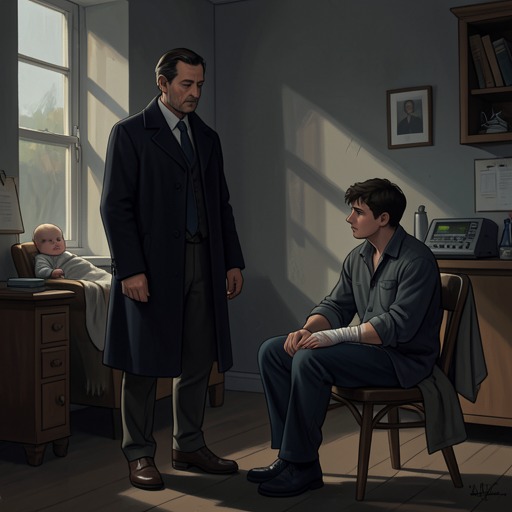
Dessa Constantine
I Know This Much Is TrueDessa Constantine is a Greek-American woman whose relationship with Dominick Birdsey is shaped by both deep affection and painful breaches of trust. She meets him as a young adult seeking independence from her family, and later builds a life with him that is transformed by the death of their daughter Angela Birdsey and Dominick’s secret vasectomy. Their separation makes the costs of his anger and concealment explicit; their eventual reconciliation finds Dessa no longer afraid of him and extends their care beyond their marriage to children and friends in need.
Identity and Early Relationship
Dessa introduces herself to Dominick as Greek on both sides of her family: her father is Greek-American, and her mother is an immigrant. At the time they meet, she is twenty-one, a senior at Boston College studying early childhood education. She works as a waitress and at a Head Start program. Her father would prefer her to work in the family car dealership, but she wants to seek work beyond her relatives and experience a measure of independence. That choice helps establish a recurring tension in her life: affection for family does not mean surrendering her own judgment or direction.
Dominick first speaks with her while they are at a lifeguard tower, where they share a book and a joke. He remembers falling in love with her during that conversation. Their ease together contrasts with the guardedness and defensive habits he learned in his own household. Dessa is frank about her past, including two serious relationships with older men who had made her feel foolish and unsafe. She tells Dominick that she values his shyness and inexperience, and that she feels safe with him. Her account gives safety particular weight: she has encountered hostility from men, including an earlier partner, Julian, who assaulted her and broke her wrist. She also describes the insecurity she can feel while waitressing, where drinking men may become hostile and encourage one another.
Marriage, Loss, and Separation
The death of Angela, three weeks and three days after her birth in May 1983, becomes the defining grief of Dessa and Dominick’s marriage. Dominick is the one who finds the baby, having returned home after oversleeping and deciding to go back inside to kiss her. He remains grateful that Dessa was spared the discovery, but that gratitude does not mean the couple grieves in the same way. Dessa joins a support group for parents whose babies have died; Dominick finds its gatherings difficult and cannot continue attending. Their different responses leave them close to the same loss but increasingly alone within it.
Dessa anticipates how difficult Angela’s first birthday will be and plans a trip to Greece and Sicily. She resigns from her day-care job and hopes Dominick will travel with her, using the life-insurance money they received after Angela’s death. He refuses, calling the use of the money for travel sick, while concealing the deeper reason for his refusal: he fears the possibility of another pregnancy and the loss of control he associates with being confined together on a ship. Dessa goes without him. Dominick marks the birthday by arranging a vasectomy, without telling her. His decision turns private fear into a consequential unilateral act.
When Dessa later tells him that she is frightened, Dominick mistakes the source of her fear and discloses the operation. She responds with shock and anger. In the weeks that follow, ordinary domestic routines become signs of the rupture: she cleans closets, cooks without eating, hires a carpet cleaner, and strips wallpaper from Angela’s room. Calls with her sister and a friend from the support group accompany her decision. On a Saturday in July, she tells Dominick she is leaving. He argues that the procedure might be reversible, but Dessa identifies the larger problem as his anger and the blame he has directed toward her throughout their grief. Her diagnosis reframes the vasectomy: it is not an isolated disagreement about having another child, but an expression of a longer pattern that has damaged their marriage.
Conflict, Respect, and Reconciliation
Dessa’s relationship with Dominick is not defined only by loss. Earlier, after a serious conflict between them, they drive to The Falls to talk, make up, and resume their relationship. But affection does not erase the need for boundaries. In a later confrontation, she makes clear that Dominick’s desire does not excuse his violation of her consent. The episode forces him to confront the difference between wanting her and treating her as a person with the right to refuse. Her directness contests the assumption that intimacy makes coercion harmless.
Years later, Dessa supports Thomas Birdsey when his release from Hatch is under review. Of the twelve people approached for letters to the Review Board, only two agree; hers is one of those letters. Her action demonstrates a continuing connection to Dominick’s family even after the marriage has broken down. She does not need to erase the history of hurt in order to act on her concern for Thomas.
Dessa and Dominick later begin seeing each other regularly at the children’s hospice. When she invites him to a University of Connecticut women’s basketball game, he accepts despite his initial disdain for the sport. Their renewed closeness develops through shared time rather than a claim that the past has vanished. When Dessa agrees to try again, she tells him she still loves him and is no longer afraid of him. That distinction makes the reconciliation meaningful: it acknowledges both continued attachment and a change in the conditions of their relationship.
Care and Later Life
At the hospice, Dessa holds and rocks a boy named Nicky, whom she describes as a large, sturdy child, and asks Dominick to take him because her leg has gone numb. Dominick reaches down and lifts the child into his arms. The small exchange presents care as practical and shared: Dessa has been holding the child, recognizes her own limit, and makes room for another person to help. The scene also echoes her earlier work in early childhood education while placing that impulse within a life marked by the loss of her own baby.
Dessa’s later friendship with Joy develops from a chance encounter into a sustained bond. Joy remembers seeing Dessa and Angie Constantine at a shopping mall, following them to the food court, and wishing she could be Dessa’s friend. During Joy’s final year, the wish becomes real. Dessa and Joy become close, and Dessa’s connection with Joy also deepens her relationship with Tyffanie. She and Tyffanie take to each other from the start, before their outings to women’s basketball games and before Tyffanie begins living with Dessa and Dominick. After Joy dies in March 1997, the friendship and the care that grew around it remain part of the family life Dessa and Dominick have rebuilt.
The house on Hollyhock Avenue, once vacant, is eventually converted into the Concettina T. Birdsey Women and Family Shelter. Dessa and Dominick help advance the project after discussing the lack of a local shelter for women escaping with children; the nearest emergency option had been in Easterly. The renovation joins Dessa’s personal history of loss and difficult intimacy to a public form of care. Her arc does not resolve grief by making it disappear. Instead, it shows her repeatedly turning toward relationships—first with Dominick, later with Joy and Tyffanie, and finally with families seeking refuge—while retaining the ability to name harm and to insist on safety.