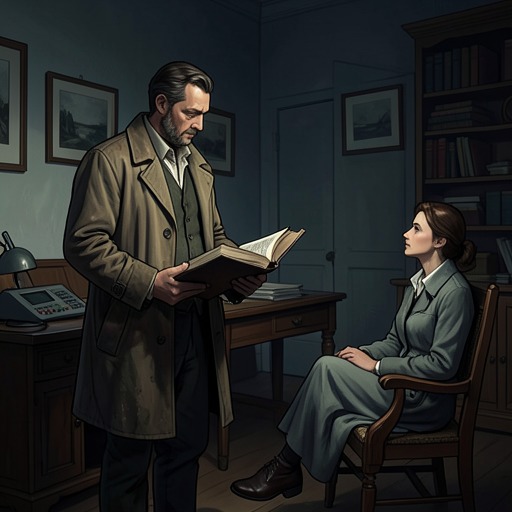
Domenico Tempesta’s death and the scattering of his manuscript
I Know This Much Is TrueDomenico Tempesta’s death and the scattering of his manuscript form a single episode in the family’s history: while his life story was nearing completion, he died alone at his worktable, and its pages were blown across the yard. Ma’s account of finding him and gathering the papers turns the manuscript into more than a record of his past. Its survival is bound to the daughter who recovered it and to the descendants who later tried to understand what it contained.
The manuscript and its making
The manuscript was a substantial but materially mixed document. When Dominick later encountered it inside a manila envelope, it consisted of a small number of typewritten pages, including originals and carbon copies, followed by handwritten sheets in blue fountain-pen ink. The envelope had been wrapped around a coverless dictionary and secured with an elastic band. Those details give the family history a physical form: not a finished book, but loose and varied pages that had to be kept together.
Its production had already been difficult. Domenico devised a system involving a stenographer, a Dictaphone, and separate private rooms for the person dictating and the person taking dictation. The arrangement lasted about a week. A misunderstanding over the rental charge ended the use of the recording equipment: Domenico had expected to pay eight dollars a week, but learned that the charge was eight dollars a day. He and Angelo Nardi returned the machines, leaving them outside the house for two days before they were collected. Domenico then resumed dictating directly to Angelo, an approach that Ma recalled as no more successful than the first attempt. The scattered pages at the end of the story therefore belong to a manuscript whose creation had itself been repeatedly interrupted and reworked.
The final morning
On the morning of his death, Domenico told Ma over breakfast that he was almost finished. Until then, he had not spoken directly to her about his progress. Ma assumed that, once the writing was complete, he might contact publishers in Italy and try to make a book of it. Instead, he considered destroying the entire manuscript after finishing it. The possibility complicates the meaning of the pages: the story mattered enough for him to persist through a troubled process, yet he contemplated burning it when the work was done.
Ma remembered hearing him sobbing upstairs that morning, once with particular intensity. She wanted to go to him but believed that her presence might anger him or make matters worse; he had kept the project private. Later, when she went out with his lunch, she found him slumped over the table, his head down, while pages lay across the yard, caught in the hedges and against the chicken coop. Her recollection establishes that he was alone when she found him, and that his manuscript had been scattered around the place where he had been working. The account identifies a stroke in connection with his death, but does not describe its precise course.
The pages across the yard
Ma ran inside to call both the police and a priest. Although Domenico had not been a churchgoer and held a grudge against St. Mary’s for an unspecified reason, she decided to call the priest as well. She then returned upstairs and stood about ten or twelve feet from him. Though she knew he was dead, she watched for a movement, hoping he might blink or yawn. The distance and waiting make her account a record of recognition resisted: she understood what had happened, but continued to look for evidence that it had not.
Afterward, Ma went around the yard picking up the pages. She described this as the one thing she could think to do for her father. Her action gives the manuscript its first clear custodian. The pages had been dispersed by the circumstances of his death, but she gathered them rather than leaving them scattered. The later discovery of the manuscript in a strongbox connects that act of collection to its subsequent presence in the family, without establishing that every page blown across the yard was recovered.
Family memory and the unfinished record
Dominick encounters the manuscript years later, when Ma opens the strongbox and explains that it is her father’s life story, dictated during the summer he died. The account moves between the material evidence of the document and Ma’s remembered explanation of how it was made and found. The manuscript’s typed and handwritten sections, its improvised production, and the pages gathered from the yard all make its transmission part of the story: the family history reaches later generations through a fragile object whose creation and preservation were never straightforward.
Ma herself did not get to read her father’s history before her own death. That later loss sharpens the episode’s significance without resolving what Domenico intended to say or whether he would ultimately have preserved the manuscript. The death leaves both a narrative and an unanswered question: a life story nearly complete, and a writer who had considered destroying it. Ma’s recovery of the pages keeps that uncertainty in circulation. Rather than making the manuscript a settled explanation of the family’s past, the episode presents it as a record rescued from dispersal and passed on for others to confront.