Domenico Tempesta’s manuscript
I Know This Much Is TrueDomenico Tempesta’s manuscript is at once a material inheritance, a self-fashioned life story, and a confession that reaches its intended reader only after its author and the daughter who preserved it have died. Its changing form mirrors the family history it records: painstakingly dictated, partly typed and partly handwritten, it promises to preserve a name but instead discloses buried pain. For Dominick Birdsey, reading it provides a voice from the past, not the clear answers about his father that he had hoped to find.
Discovery and Physical Form
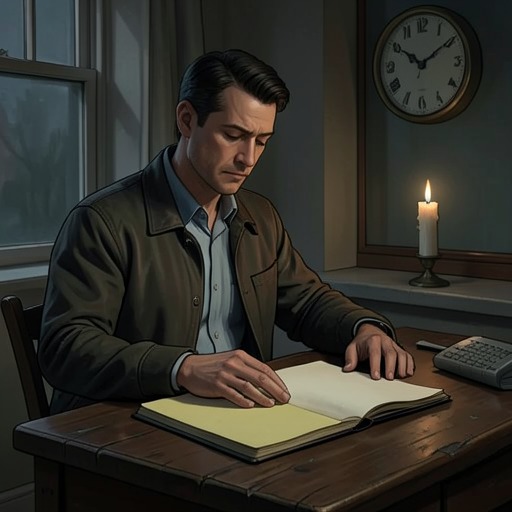
Ma kept the manuscript in a strongbox and gave it to Dominick when she was already very ill, only four or five months before her death. She had preserved a thick sheaf of pages inside a large manila envelope, wrapped around a small dictionary without a cover and secured by an elastic band. When Dominick opened the box, the band broke. The manuscript itself was substantial: its first ten or fifteen pages were typed, including originals and carbon copies, while the rest was written by hand in ornate blue fountain-pen script. The physical mix records not only the author’s words but the difficulty of getting them onto the page.
Ma identified it as her father’s life story, dictated during the summer he died. Though she said Dominick could share it with Thomas Birdsey, she made the gift to Dominick, who understood that she had not read it herself. She knew some Sicilian but not enough to work through the manuscript page by page. Its language therefore separated the story from the daughter whose life stood closest to its author, even as she became the person who saved and passed it on.
From Public Project to Private Confession
Domenico Onofrio Tempesta initially framed his autobiography as a model for young Italians and a means of keeping the Tempesta name alive. The opening, dated July 8, 1949, presents him as a man born sixty-nine years earlier in Giuliana, Sicily, who regards his ancestry and his own character in grand terms. He describes his life as marked by sadness and tragedy, but also treats the absence of sons and his daughter Concettina’s appearance as threats to the family name. The manuscript thus begins with a forceful act of self-presentation: its author claims the authority to tell his family’s history while measuring its worth by his own ideas of inheritance and reputation.
The method of composition proved unstable. Domenico arranged for a stenographer and Dictaphone, with separate private rooms for himself and the person taking dictation. The system lasted about a week. He had misunderstood the rental cost: what he thought was an eight-dollar weekly charge turned out to be eight dollars a day, or forty dollars a week. He sent the equipment back, and the carts sat on the porch for two days before someone arrived from Bridgeport to collect them. Ma, anxious about the machines being left outside, remembered that this arrangement also failed to make the work proceed smoothly. Domenico returned to dictating directly to Angelo Nardi, but that attempt did not go better.
The finished manuscript’s purpose appears to have changed. Ma remembered that on the morning he suffered a stroke, Domenico told her he was nearly done. He had not previously discussed the work directly with her. When she asked what he would do with it, he said he might burn it in the ash barrel. She had expected him to seek publication in Italy, but the threat to destroy the pages and the grief she heard from him suggested a more private burden. In Dominick’s later understanding, the proposed guide for Italian youth was only the public explanation: Domenico had begun a confession and penance that he completed on the day he died.
The Manuscript’s Family Revelations
Domenico’s account gives Dominick material for reconstructing a family history that Ma had been unable to read or had not disclosed. It records the author’s life in Sicily and his establishment in America, details Dominick considers useful even while he recoils from the manuscript’s insistence on its author’s greatness. The narrative does not simply settle the past into fact. It offers a self-interested account, shaped by the very pride and silence that had governed the household, and Dominick has to read its claims against what he knows of Ma and the family around her.
The most devastating disclosure concerns Ma’s childhood. Reading the completed manuscript, Dominick learns that when Ma was eight, her mother, Ignazia Tempesta, tried to take her with her in an act of despair. Ma fought to survive, hid in a shack through the night, and returned home. The evidence of the struggle was written in footprints, but Ma kept silent about what had happened, telling neither the police nor her father. The manuscript turns a childhood memory and a family silence into an account of danger survived. It also changes Dominick’s picture of his mother: the girl who covered her mouth in photographs and the daughter who lived under her father’s authority appears, in this history, as a child who resisted and endured.
The story does not name the biological father Dominick had wanted to identify. He suspects Angelo Nardi may have been that father, but the manuscript leaves the possibility unresolved; Dominick’s speculation about Angelo’s visits and his relationship with Ma remains speculation. Nor does the autobiography explain everything about Ma’s experience or the secrets she kept. Its disclosures deepen the family record while making its silences more conspicuous. The text gives Dominick an ancestor’s voice, but not the certainty he sought.
Inheritance, Reading, and Destruction
Dominick imagined having the manuscript translated and bound as a gift for Ma, so that she could read her father’s history before she died. He hired a translator, but the work took longer than he expected. Ma’s condition worsened quickly, and she died on May 1, 1987, before receiving the translation. The manuscript was subsequently lost, then returned to Dominick after he had mourned its disappearance. Its recovery became part of his own troubled relation to the past: the document he had failed to deliver to his mother became a text he could not easily finish or put aside.
Dr. Patel urges Dominick to keep reading, treating the manuscript as the rare gift of an ancestor’s voice rather than merely a puzzle about descent. She connects its survival to a longer passage of family history, in which the past flows into the present and onward into the future. That interpretation does not erase Dominick’s anger or his disappointment. He resists the manuscript’s grand claims, and at one point, exhausted and unable to sleep, he reaches for it while blaming himself for returning to a story that unsettles him. Yet he recognizes that its existence forces him to face the family history he had been searching for.
After reading the final pages, Dominick tears the manuscript apart in frustration. He has found painful revelations but no answer to the questions he most wanted resolved; instead, the history leaves him with more suspicions and with the discovery of Ma’s childhood struggle. Later, as he gathers the ruined pages for disposal, his understanding of Ma shifts again. The manuscript recalls her father’s anger and the rules that kept her from comforting him as he wrote. It also brings into view her courage: after surviving her mother’s attempt to take her life, she went on and raised her sons as best she could. The act of destroying the pages does not undo what they have revealed, and the text’s damaged remains continue to prompt reflection.
Narrative and Thematic Significance
The manuscript’s importance lies partly in the gap between the purpose its author announced and the meaning it acquires for later readers. Domenico presents himself as a great man preserving his family name and offering an example to young Italians; Dominick comes to understand the work as a confession, written in private and completed at the end of its author’s life. Its changing production—from paid stenography and rented recording equipment to direct dictation and handwritten pages—also makes the record visibly provisional rather than a transparent account of the past.
For Dominick, the manuscript becomes an inheritance that is both intimate and insufficient. It connects him to his grandfather and to Ma, whose act of preserving and giving it to him bridges generations. But it cannot supply the father’s name he longs for, and its disclosures bring grief as well as knowledge. Dr. Patel’s reading of the family as a continuing river offers a way to understand that inheritance without pretending that every mystery has been solved. The manuscript’s final effect is therefore not closure: it makes hidden history legible, reveals the human cost of silence, and leaves Dominick to decide what to carry forward from a story that is at once self-justifying, confessional, and incomplete.