Joy’s confession cassette
I Know This Much Is TrueJoy’s confession cassette is a personal message Joy sends to Dominick during his hospitalization. Delivered by Thomas with a Walkman, it carries an explanation that Joy is not prepared to give face to face; its recorded form gives her a way to speak while keeping her physically absent, and becomes the vehicle for disclosures that reshape Dominick’s understanding of their relationship.
Delivery and purpose
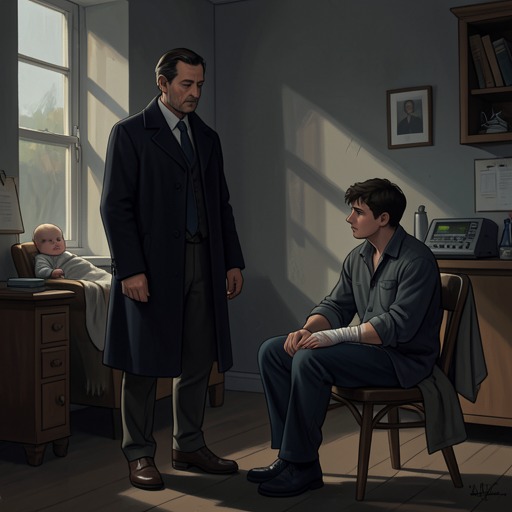
Dominick is dozing in his hospital room when Thomas appears beside him with the Walkman from the house and a cassette. Dominick asks what Thomas wants. Thomas hands over the player and recording, explaining that Joy wants Dominick to listen. When Dominick asks why she has not come up herself, Thomas says she is waiting in the car and has explained everything on the tape, then leaves. The brief handoff places the message between the separated couple: Joy is nearby, but her account reaches Dominick through Thomas and a machine rather than through a conversation.
The recording begins as an alternative to a letter. Joy says she has been trying to write but cannot find the words, and that Thad suggested she make a tape instead. She describes having spent the night thinking about their relationship and admits that Dominick’s disclosure—that the baby could not be his—shocked her. The cassette therefore opens not as a detached account but as a confession addressed directly to him, shaped by her difficulty speaking and by the shame she says kept her from explaining matters in person.
The disclosures about Thad
Joy first addresses the pregnancy and Dominick’s realization that he cannot be the father. She says she wanted the baby to be theirs and still has genuine feelings for him, but identifies Thad as the father. Her confession revises the history she had given Dominick: she and Thad had not met at work, as she claimed. He was her mother’s half-brother, and their sexual relationship began when Joy was twelve and Thad was nineteen. She describes herself as a child who partly understood what was happening and partly did not, placing the relationship’s origins in an unequal and troubling history rather than the adult workplace encounter Dominick had been led to imagine. She also explains that Thad is bisexual, not gay, and that he had told Aaron about the baby, after which Aaron expelled him from their home.
The tape reveals a further violation of the couple’s privacy. Joy says Thad had a crush on Dominick and persuaded her to let him watch them have sex. She resisted for a long time before giving in; the episode happened twice, on Fridays, when she and Dominick ordinarily became intimate. On the second occasion, she says, Thad directed what she should do and where she should turn, while hiding in her closet with its door partly open. Joy emphasizes that she did not want this and that it made her feel awful. The recording makes her account both an admission of betrayal and a description of pressure: she accepts responsibility for deceiving Dominick, while identifying Thad as the one who begged for and orchestrated the watching.
Departure, Repetition, and Disposal
Joy’s account turns from confession to the arrangements she is making for life after Dominick’s hospitalization. She plans to give notice at Hardbodies, where Thad has already quit, and to leave the condominium before Dominick returns. She says Thad will stay at a motel until they go, and that she may drive cross-country with him or travel alone to California, where her mother and Herb have offered her a place to stay until after the baby is born. Her plans remain uncertain: she does not know what will become of her relationship with Thad, and says she may eventually find the courage to make him leave her alone. The practical details make the recording a farewell as well as an explanation; she is removing herself and the baby from Dominick’s home while acknowledging that she wishes he were the father.
The cassette also addresses the consequences of Thad’s sexual history. Joy tells Dominick not to worry about HIV, assuring him that Thad is careful and that Aaron is vigilant about risk. She apologizes for having been jealous of Dominick’s loyalty to his brother, Thomas Birdsey, and urges him to care for himself rather than spending all his energy on other people. Her closing plea for him not to hate her sits beside the earlier admissions without resolving them. Dominick listens to the recording twice, but reports feeling numb; he says he neither hates Joy nor Thad. The tape gives him her account in her own voice, yet repetition does not immediately make the betrayal intelligible or ease its force.
Later, Dominick brings the cassette to Dr. Patel and plays it during therapy. Asked why he has brought the recording rather than simply describing what happened, he explains that he wanted Dr. Patel to hear what had been done to him in Joy’s own words. She observes that he is presenting the tape as another exhibit in what she names the Dominick Birdsey Museum of Injustice and Misery, alongside his accounts of childhood with Thomas Birdsey, his stepfather’s injustices, and his former wife. The recording has become something Dominick can replay and display, but his attention remains fixed on documenting injury rather than exploring his response to Joy or the end of their relationship.
After the session, Dominick descends the stairs without noticing his fear of falling, then waits at a red light and throws Joy’s cassette out of the window. The disposal is a decisive change in the object’s role: what had preserved Joy’s confession and allowed him to return repeatedly to its painful details is no longer something he keeps or presents. He experiences relief at throwing it away, even as his closing self-mockery recognizes how thoroughly he had treated his grievances as a collection to curate.
The cassette as testimony and artifact
The recording’s meaning changes with each act of listening. Sent as a substitute for a conversation Joy cannot manage in person, it preserves her explanation in her own voice; in Dominick’s hands, it also becomes evidence he can replay and present to Dr. Patel. That shift exposes a gap between confession and response: Joy addresses him with affection and remorse, while Dominick initially uses the cassette to make the injury legible to someone else rather than to examine what he feels about it.
Dr. Patel’s description of the tape as an exhibit in Dominick’s museum of grievances reframes the cassette without erasing the betrayal it records. When Dominick later throws it from the car at a red light, he stops carrying and displaying this particular piece of evidence. The act brings the object’s arc to a close, but does not establish forgiveness or reconciliation; its immediate consequence is relief, accompanied by his recognition that he had been curating his suffering.