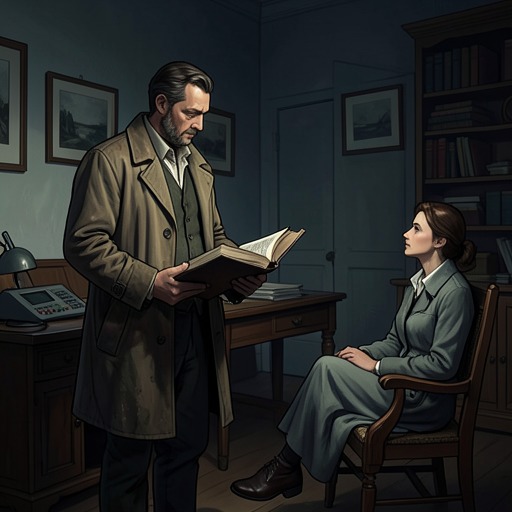
Summer 1949
I Know This Much Is TrueSummer 1949 marks the death of Domenico Onofrio Tempesta, the family patriarch whose private life story survived him in fragments. He died without knowing that his only child, Ma, was pregnant with twins; the manuscript he had labored to produce was unfinished in its preservation, and Ma would die decades later without reading it. The summer therefore joins a family death to two forms of inheritance: the children not yet born and the account of a life that had not yet been made whole.
Family and Setting
Domenico Onofrio Tempesta had emigrated from Sicily to America in 1901. Through hard work and careful spending, he bought a half-acre lot from a farmer’s widow, becoming the first Italian immigrant to own property in Three Rivers, Connecticut. He built the brick Victorian duplex on Hollyhock Avenue that housed the family and remained Ma’s home throughout her life. In the stories Ma later told, he was a stern, forceful father who ruled his household; his achievement and authority shaped the family’s inherited image of him.
His death in the summer of 1949 came while Ma, then thirty-three and unmarried, was carrying twins. She was the keeper of his house and his only child, but he died unaware of her pregnancy. That concealed fact gives the season its particular weight: the family’s next generation was already on its way, even as its central older figure was approaching the end of his life.
The Life History in Progress
Domenico had dictated his life story during the summer he died. The surviving manuscript, dated 8 July 1949 and titled The History of Domenico Onofrio Tempesta, a Great Man from Humble Beginnings, preserves the scale of his ambition as well as the uneven process by which he tried to record it. Its opening pages were typewritten originals and carbon copies; the rest was handwritten in blue fountain-pen ink. When the family later found it in a strongbox, it lay in a large manila envelope curled around a small coverless dictionary and bound with an elastic band.
The method of dictation repeatedly faltered. Domenico arranged a stenographer, a Dictaphone, and separate rooms for himself and the person taking down his words. The arrangement lasted about a week: he had understood the rental charge as eight dollars a week, but it was eight dollars a day, or forty dollars a week. He and Angelo sent the machines back, and Domenico resumed dictating directly to Angelo; Ma remembered that this approach did not go better. She stayed away from the parlor while her father dictated, wary of interrupting a task he treated with grave seriousness.
Death and the Scattered Pages
On the morning of his death, while eating breakfast, Domenico told Ma he was nearly finished. She asked what he intended to do with the manuscript. He had once spoken of trying to publish it in Italy, but now suggested that he might burn the completed work. Ma later remembered hearing him sobbing upstairs that morning. She wanted to go to him but believed that her presence might anger him or make matters worse, so she stayed away.
When Ma later brought him lunch, she found him slumped over the table. The pages had blown across the yard, caught in the hedges and against the chicken coop. She ran inside to call the police and a priest, though Domenico had not been a churchgoer. In her recollection, the scene was bound up with her fear and with the fact that she was carrying the twins. His death ended his own attempt to control how his story would be told; the scattered manuscript became an inheritance that others would have to gather and interpret.
Later Memory and the Unfinished Inheritance
The surviving account reaches the reader through layers of family memory and documentary remains. Ma’s recollections describe the machinery, expense, privacy, and emotional strain of her father’s project; the manuscript itself preserves both typed and handwritten work. Neither form supplies a complete, unmediated life: the pages were scattered, and the circumstances of their creation are known through Ma’s later telling.
Ma died on May 1, 1987, after a night-long vigil with Ray and Dominick. Shortly before her death, Dominick told her he would take care of Ray and gave her permission to go. She never read her father’s history, and she did not reveal the identity of the man who had fathered the twins. Summer 1949 thus remains more than a biographical date: it is the point at which a family story began to be preserved even as its most important personal facts remained withheld.