The Falls
I Know This Much Is TrueThe Falls is a gorge on the Sachem River outside Three Rivers, Connecticut, reached by a path that climbs from the Indian cemetery through pines, pin oaks, cedars, and mountain laurel. It is at once a scenic landmark, the setting for a local legend, a place where young people take risks, and a site marked by deaths. For Dominick Birdsey, its repeated appearances make it more than a backdrop: the Falls gathers childhood memory, family grief, and belated understanding into one landscape.
Setting and Local Legend
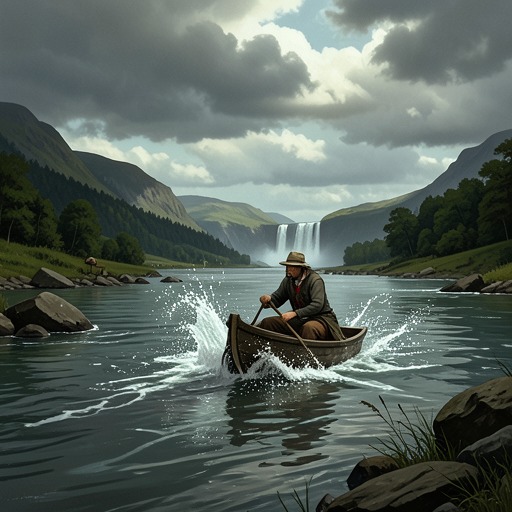
At the southern end of the Indian cemetery, a packed dirt path leads away from the river and uphill through trees and a grove of mountain laurel. The route follows the sound of water before arriving abruptly at the gorge, where the Sachem River runs between sheer cliffs and spills down the steep drop. The approach gives the place a distinct geography: visitors leave the cemetery and its traces of earlier lives, climb through the woods, and encounter the river again from above.
Three Rivers residents call the site simply the Falls. Its history is mixed with legend, and the account Dominick hears concerns Chief Samuel and an enemy sachem. Pursued to the edge, the enemy chief faced surrender or a dangerous leap to the opposite ledge; he made the crossing but was injured. Chief Samuel followed, prevailed in the contest, and marked his victory with an act of violence. The story presents the gorge as a place where a passage between cliffs becomes a test of survival and dominance. Its uncertain status as history, legend, or a mixture of both is part of the Falls’ local identity.
Dominick learns this story from Mr. LoPresto, his tenth-grade American history teacher. The lesson is accompanied by a hierarchy that casts Indigenous people as primitive and Western civilization as superior. The tale thus reaches Dominick through a prejudiced classroom interpretation rather than as a neutral account of the past. The Falls is connected not only to local memory but also to the way that memory is taught and framed.
Recreation and Danger
The gorge is widely regarded as beautiful, but it is also a trouble spot. Teenagers cut school to gather there, and their presence is recorded in smashed beer bottles, graffiti on the cliff faces, and underpants left in trees. The evidence of parties and risk makes the site a visible challenge to the town’s expectations of orderly behavior. Dominick remembers taking foolish risks there as a young person himself, while, as an adult, worrying about the teenagers who continue to do so.
That danger is not merely a matter of adolescent recklessness. Suicides, accidents, and murders have occurred at the Falls. When Dominick and Thomas Birdsey are third-graders, the body of their classmate Penny Ann Drinkwater is found there. She had disappeared during a snowstorm, and for about a week her photograph appears in the newspaper before the coverage fades. At school, her empty chair and desk keep her absence in view; her blue sweater remains stuffed among the desk’s contents. Then the newspaper returns her face to its front page with the news that her body has been found at the gorge. The murder makes the Falls a place of childhood fear as well as an adventurous destination, and the winter setting sharpens the boys’ bewilderment at what has happened to a girl they knew.
A Place of Withdrawal and Grief
Years later, Dessa goes to the Falls for long stretches, often returning from her walks in a daze. She does not explain where she has been or invite Dominick to join her, except that Sadie accompanies her. When he follows them, he finds Dessa sitting for more than an hour and watching water descend through the gorge. Concerned by the site’s isolation, he buys her pepper spray and worries that Sadie may not protect her if trouble arises. Dessa often forgets to take the can, which remains on a shelf at home. Her visits are therefore marked by a tension between Dominick’s wish to guard her and her apparent refusal to make self-protection the purpose of her time there.
After the death of their daughter Angela, the Falls becomes one of the places where Dominick tries, unsuccessfully, to find a larger explanation for grief. On the worst nights he drives fast, leaves the road near the river, and sometimes climbs the ledge as he had when he was young. He hopes that seeing things from above might help him understand religious ideas about God’s will and mercy, but the elevation offers no answer to the loss. His recollection sets the childhood Falls, associated with parties and youthful risk, against the adult’s return after bereavement. The landscape remains the same; what Dominick needs from it has changed.
Reconciliation and Recollection
The Falls also becomes a meeting place during changes in Dominick’s relationships. After a period of conflict, he and Dessa drive there to talk and make up. The setting that had been associated with her solitary withdrawal becomes, for a time, a place where they can meet and restore their connection. The scene does not erase the difficulties between them, but it gives their reconciliation a location already bound to private memory and emotional strain.
Later, while facing the possibility of a hearing that could release Thomas from the psychiatric institution where he is held, Dominick drives in circles and ends up at the gorge. Sitting with his legs over the edge, he speaks toward the falling water as if addressing the Psychiatric Security Review Board. He recalls Dr. Patel’s idea of memory as a river leading toward understanding, but his thoughts do not settle into reassurance. He drinks beer and memories of Penny Ann’s death, Ma’s funeral, and Ray’s violence toward Thomas come to him in succession. The Falls offers him a vantage point, yet the memories arriving there show how many different injuries remain joined in his mind.
After Thomas’s release from Hatch, the brothers make another trip to the Falls. Thomas stops at Penny Ann’s grave and tells Dominick that they are cousins. Dominick dismisses the statement as another expression of Thomas’s illness. Much later, after Ralph Drinkwater explains that Thomas had discussed their kinship with him, Dominick remembers the Falls visit and realizes that Thomas had known. The realization is inseparable from a family secret: their mother had disclosed the truth about their father to Thomas but withheld it from Dominick. The return of this memory changes the meaning of the earlier scene. What Dominick had treated as delusion proves to have contained knowledge, and the Falls becomes a site where a truth he failed to recognize first appeared.
Narrative Significance
Across these episodes, the Falls moves between public landmark and intensely private setting. Its cliffs and river belong to Three Rivers’ shared landscape; its stories include a local account of conflict, the dangerous gatherings of teenagers, and Penny Ann’s murder. At the same time, Dessa’s withdrawal and Dominick’s repeated visits attach the gorge to grief and relationship. The same place can hold solitude, reconciliation, fear, and an insight that arrives only in retrospect.
The river’s continuous movement contrasts with the characters’ difficulty in moving beyond what they have lost or misunderstood. Dominick returns hoping for perspective, comfort, or clarity, but the Falls does not provide a simple cure or moral answer. Instead, it gives recurring memories a common setting. The place’s narrative force comes from that recurrence: each return adds another layer to a landscape already carrying the community’s legend, its dangers, and the Birdsey family’s unresolved history.