Active Participation
I'd Like to Apologize to Every Teacher I Ever HadActive Participation is the book’s most practical and consequential answer to student disengagement: learning becomes more durable when students help produce the lesson instead of receiving it passively. The concept changes Tony Danza’s understanding of teaching, moving him away from the entertainer’s instinct to hold attention through performance and toward a classroom in which students’ questions, judgments, creativity, and work determine what learning looks like.
Definition and Teaching Problem
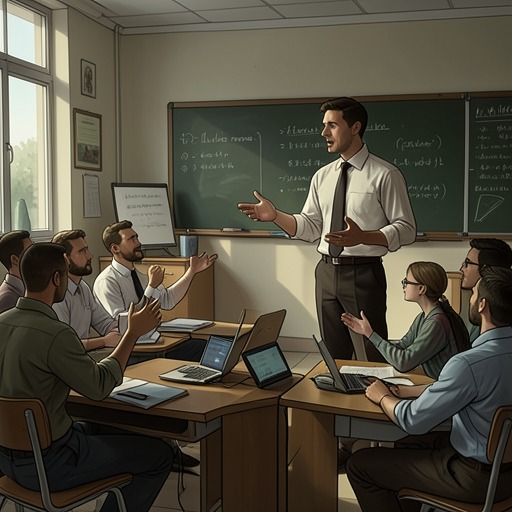
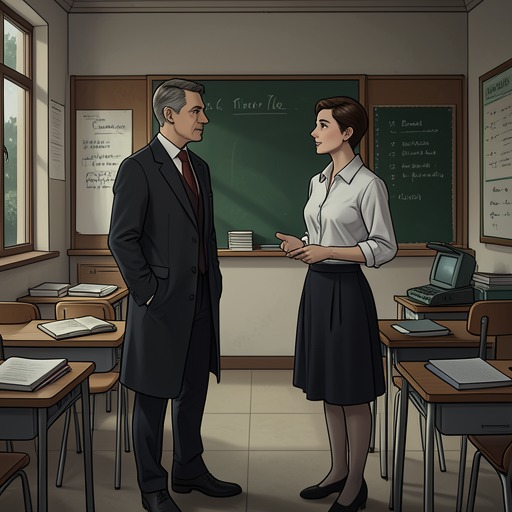
Active Participation emerges in a conversation between Tony Danza and David Cohn about the limits of technology and entertainment in the classroom. Tony worries that students have shrinking attention spans and that the same electronics schools are expected to integrate may also make sustained concentration more difficult. David answers that technology is a fact of life, but warns against treating engagement as passive entertainment. His distinction is decisive: a teacher may capture students’ eyes without involving their minds, and a student may appear attentive while remaining outside the work of learning.
David identifies Active Participation as the alternative. Students learn when they are making something happen; they are much less likely to learn when the teacher is simply talking. This principle also corrects Tony’s earlier anxiety that he must make students like him before he can teach them. David insists that Tony cannot learn for them and that teaching is not a popularity contest. Liking the teacher may make the teacher more interesting, but the essential task is to involve students in their own education. Participation therefore means more than liveliness, compliance, or classroom noise. It requires students to exercise attention and judgment through an activity that belongs partly to them.
Classroom Methods and Student Agency
Tony first applies the principle by converting the study of creation myths into collaborative authorship and performance. He assigns students to write their own creation myths, explaining creation and natural phenomena and including gods, goddesses, or spirit forces. Rather than leaving the assignment as solitary written work, he pairs students and asks them to perform their myths before the class. The task gives students several forms of agency at once: they invent content, negotiate with a partner, construct a presentation, and test their ideas before an audience.
The resulting performance makes the principle visible. Eric Choi and Ben-Kyle present “The Magic Button Myth,” using a large paper button attached to a paper spring and marked “DO NOT PUSH.” Their staged story turns the forbidden button into the cause of the world’s creation. The class cheers, and Eric, previously shy and gawky, does not know how to receive the praise. The paper prop is not merely decoration. It helps transform an abstract literary category into a shared event in which students write, act, design, and respond to one another.
Tony uses the same logic in the uniform-policy debate. When Eric Lopez, Matt, Monte, Eric Choi, Chloe, Katerina, Ileana, and Ben-Kyle begin arguing about the new rule, he abandons the planned exercise on physical fitness and nutrition and writes a prompt asking students how they feel about uniforms and why. The students write with more energy and conviction than in almost anything they have produced earlier in the year, then eagerly read their opinions aloud. Tony organizes them into debate teams, recognizing that disagreement has created an authentic reason to write, speak, listen, and defend a position. The lesson does not manufacture interest from outside; it discovers an issue already carrying emotional and political weight for the class.
Active Participation also governs Tony’s use of art, popular culture, and collaborative interpretation. A lesson on social justice grows out of a discussion of rap lyrics, leading him to use a video by Figureheads that invokes Harriet Tubman, Rosa Parks, Harriet Beecher Stowe, and Uncle Tom’s Cabin. The material connects literary and historical ideas to questions that students can argue about rather than merely memorize. In the study of Julius Caesar, an acting troupe at the Folger Shakespeare Library invites students onto an Elizabethan replica stage. Nakiya, Chloe, and Eric Lopez perform naturally, while Monte and Eric Choi also participate despite their different classroom personas. The students laugh and make fools of themselves, yet their answers about the play show that performance has deepened, rather than replaced, their knowledge.
The Washington, D.C. field trip extends participation from the classroom into historical investigation. At the National Archives, students become archivists, selecting and analyzing diaries, letters, and memoirs for evidence of constitutional issues such as separation of church and state and checks and balances. They then locate support for those concepts in the Constitution. White Nick and Ben-Kyle make a video of the class at work, with Nakiya narrating, creating a record that the students themselves help produce. Even students usually described as unmotivated work because the activity is fun, collaborative, and connected to ordinary people’s lives. At the Lincoln Memorial, the day shifts into reverence, with students absorbed in the physical presence of history before relaxing by chasing geese around the Reflecting Pool. Participation here includes analysis, authorship, performance, movement, documentation, and collective memory.
Participation, Power, and Conflict
The concept changes classroom power without pretending that authority disappears. Tony remains responsible for choosing texts, setting standards, organizing activities, and deciding when an experiment has failed. Yet he increasingly treats students as collaborators in the production of knowledge. The Student Teacher program makes this transfer of authority explicit. Monte believes that Tony’s class is too easy, too disorderly, and too accommodating of students who do not work. In response, Tony gives Monte an entire period to design and teach, allowing him to create his own lesson plan and set assignments and standards as rigorously as he wishes.
Monte prepares a legal-term worksheet based on the trial in To Kill a Mockingbird and teaches the characters’ qualities and interactions during the trial. His lesson is ambitious, but the class cuts him off and disrupts him: Matt walks around, Chloe and Katerina talk about sandals, Eric Choi twists upside down in his seat, and Eric Lopez writes a love note to Ileana. The episode reveals both the promise and the limit of participation. Giving students responsibility does not automatically create a disciplined learning community, and student-centered teaching cannot be reduced to handing over the front of the room. Participation must be structured, supported, and connected to a shared obligation to listen and work.
Tony’s own role also remains under examination. His first impulse is to entertain and to win affection, but David’s warning forces him to distinguish genuine involvement from spectacle. The difference matters because the book repeatedly places attractive forms of activity beside harder evidence of learning. A performance can be noisy; a debate can be unruly; a field trip can feel like play. Their educational value appears when students must interpret, explain, create, defend, or apply ideas. Active Participation is therefore not a soft alternative to rigor. It is a method for making rigor visible in student action.
Assessment and Institutional Pressure
The principle also reshapes Tony’s approach to assessment. When he prepares his first major exam on Of Mice and Men, he learns that a test must do more than check whether students remember names, plot points, and vocabulary. Questions should cover the material emphasized in class while demanding higher-level thinking, such as explaining irony or relating a situation in a story to students’ own lives. Humor may make the test more approachable, but the deeper requirement is that every aspect of the classroom, including testing, engage students.
This approach places classroom evidence in tension with the Pennsylvania System of School Assessment and its institutional consequences. The state uses PSSA results to judge a school’s Adequate Yearly Progress, and Northeast High School’s failure to meet its target in 2009 intensifies pressure for the 2010 test. After the real exams, the school improves in every category except writing but still fails to meet its AYP target. It becomes an Empowerment School, moves closer to Renaissance School status, and receives more professional-development meetings, district walk-throughs, reading and math assessments, and demands to perform. The increased scrutiny treats scores as the decisive evidence of educational success, while Tony’s classroom experience suggests that learning also appears in discussion, collaboration, creative work, historical inquiry, and students’ ability to articulate meaning.
The book does not present participation as easily measurable or institutionally secure. Northeast has no required finals week for lower classes; most teachers base grades on work completed during the quarter, while graduating seniors present a multimedia project to a panel. Tony nevertheless prepares a comprehensive examination because he wants to determine what the class has learned across the entire year. When he finishes grading, no student has failed. Matt’s grade is lower than it should be, while many other students, including all three of Tony’s IEP students, perform better than he expected. Their results provide a form of assessment that matters to him precisely because it records individual growth rather than merely satisfying an external target.
Consequences and Significance
The final essay question asks students to identify the most important lesson they learned in class. Their answers confirm that participation has produced more than temporary attention. They use correct essay form and repeat some of Tony’s classroom language, but the most powerful lessons they name were not scripted in any book. Nakiya writes, “Make the best of a baaaad situation,” turning the year’s difficulties into a principle of endurance and response. The answer gives Active Participation its fullest meaning: students have not simply absorbed information; they have selected, reformulated, and carried forward an idea that can interpret their own circumstances.
Active Participation consequently becomes both a teaching method and a critique of conventional educational assumptions. It challenges the belief that students learn by sitting still while an expert delivers content, but it also challenges the belief that entertainment alone can repair disengagement. Its strongest activities join student voice to intellectual demand: the uniform debate converts conflict into argument, the creation myth turns imagination into literary analysis, the Shakespeare performance makes interpretation embodied, the National Archives exercise makes constitutional history investigative, and the final examination tests understanding rather than mechanical recall. In the book’s larger account of public education, participation is a modest but radical redistribution of responsibility. The teacher creates the conditions, but students must enter the work, make meaning together, and ultimately learn for themselves.