Ben-Kyle
I'd Like to Apologize to Every Teacher I Ever HadBen-Kyle is a student at Northeast High whose brief appearance becomes one of the school year’s most frightening and revealing episodes. During the final challenge of Tony Danza’s Of Mice and Men scavenger hunt, he collapses while running in an ill-fitting costume and appears not to be breathing. His recovery, followed by Danza’s decision to drive him and his father to the hospital, transforms a comic competition into a test of adult responsibility, exposing both the vulnerability of students and the uncertainty of a teacher still learning what real care requires.
Identity and School Context
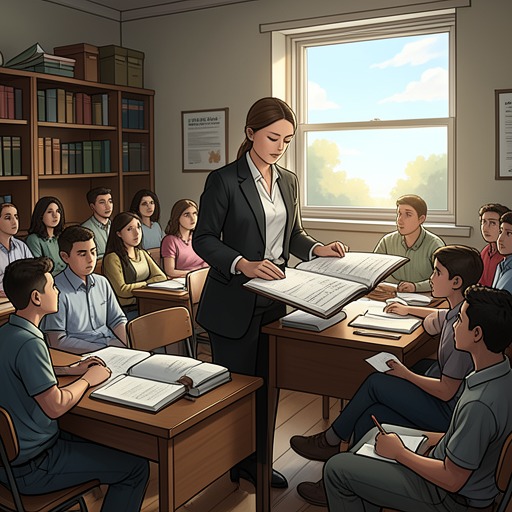
Ben-Kyle is presented as one member of the large and varied student body at Northeast High, the largest high school in Philadelphia. The school occupies a sprawling campus with three stories, trailers, multiple sports fields, its own football stadium, a huge cafeteria, cavernous gyms, and even a Philadelphia police station. Within this enormous institution, students move through an environment organized into Small Learning Communities, including the Arts and Education SLC to which Danza belongs. Ben-Kyle’s episode therefore occurs not in an intimate classroom alone but within a vast, highly structured school culture in which teachers, nurses, families, cameras, and administrators all become part of a student’s safety network.
The available account gives no extended biography of Ben-Kyle, but it does place him among classmates whose participation is shaped by competition, performance, and shared study. Danza’s scavenger hunt is designed as an energetic review activity, with extra credit on the final examination at stake. Students work in teams, help one another when they are stumped, build human pyramids, recite Rudyard Kipling’s “If,” and race between stations. Ben-Kyle is identified in that atmosphere through his role in the closing contest rather than through a long personal history: he is a participant whose physical presence suddenly acquires life-or-death significance.
The Scavenger Hunt Collapse
The hunt takes place on a blisteringly hot Philadelphia day. To reduce the danger, stations are placed indoors or in the shade, water is provided, and Danza warns the students not to run. The warning is immediately overwhelmed by the event’s competitive momentum. When Danza gives the signal, every student runs, and the teams race toward the final challenge. The costumes make the final stretch more cumbersome: students must pull clothing over shirts and shoes while still trying to win.
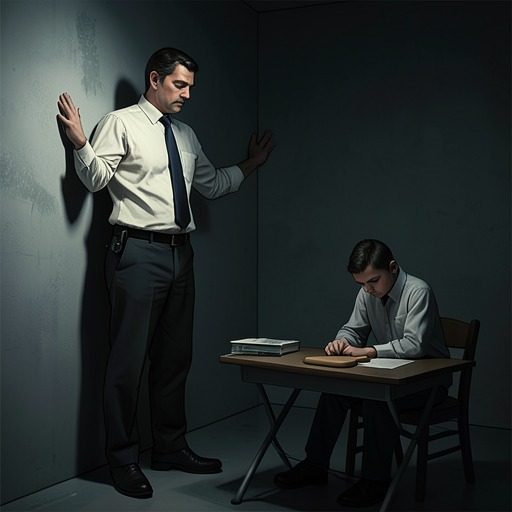
Ben-Kyle is in second place when he puts on Lenny’s overalls and spins a bat five times. He then starts toward the finish line. Halfway there, he falls so abruptly that Danza initially assumes the collapse is a joke or an especially good pratfall. That misreading is crucial. The scene begins in the register of school comedy, where costumes, speed, and adolescent play invite laughter, but the comic interpretation becomes untenable when Ben-Kyle remains motionless. Danza notices that his chest is not moving and sees that the student’s feet are splayed sideways and still.
Danza’s perception fractures between disbelief and emergency. He has seen boxers knocked out and has himself gone down more than once, yet Ben-Kyle’s condition feels categorically different because the fallen person is a sixteen-year-old student under his supervision. Danza kneels beside him, brushes the hair from his face, and searches for a pulse. He thinks he feels one and observes that Ben-Kyle is unconscious but breathing slightly. The students and adults converge around them, and Danza tells everyone, “Stay back, give him some air.” The familiar phrase sounds to him like something learned from television rather than from professional training, making the episode a direct confrontation with the difference between performing competence and possessing it.
Care, Family, and Immediate Consequences
A nurse recommends that Ben-Kyle be examined at a hospital. The practical difficulty is that his father has arrived on foot and the family has no car. Danza receives clearance from the office and drives Ben-Kyle and his father to the hospital himself. The action is modest but decisive: after feeling helpless beside the collapsed student, Danza finds a concrete way to help.
Ben-Kyle is examined and tested, then released with a clean bill of health. The relief belongs to Ben-Kyle, his father, and Danza, but Danza admits that he is probably the most relieved of all. The episode therefore ends without the catastrophe that Danza momentarily fears, yet it does not erase the fear. The near-death experience, or what feels like one to Danza, changes the emotional conditions of the school day. Afterward, the final exam seems easy by comparison, even though it is an eleven-page test containing essays, multiple-choice questions, and fill-in-the-blank sections. Ben-Kyle’s collapse becomes the event against which Danza measures the apparent difficulty of his professional responsibilities.
Narrative Significance
Ben-Kyle’s role is less that of a fully developed individual subplot than that of a sudden pressure point in Danza’s transition from celebrity outsider to accountable teacher. The scavenger hunt reflects Danza’s preferred method of engagement: use movement, competition, costumes, teamwork, and extra credit to make literary review attractive to students. Ben-Kyle’s fall exposes the risk embedded in that method. A lesson intended to generate enthusiasm places students in heat, motion, and awkward clothing, and a warning not to run proves ineffective once competition takes over.
The incident also reverses the balance between spectacle and reality. The scavenger hunt is being observed through the logic of a television production, and Danza initially reads the fall as a performance. But the unmoving body resists that interpretation. The camera-ready energy of the event gives way to a scene in which Danza must act without a script, and the final measure of his teaching is not a clever activity or an entertaining classroom moment but whether he can protect a student and assist the student’s family.
Ben-Kyle’s recovery allows the book to preserve a hard-won sense of proportion rather than manufacture tragedy. The student is not transformed into a symbol of permanent damage; he is examined, cleared, and returned from the emergency. Yet his collapse remains consequential because it teaches Danza that school care is physical, immediate, and shared with families and staff. Ben-Kyle thus becomes a memorable figure in the account’s larger examination of teaching: the student who turns an improvised educational spectacle into a test of responsibility, humility, and the limits of television-trained confidence.