Brittiny
I'd Like to Apologize to Every Teacher I Ever HadBrittiny is introduced as one of Northeast High School’s “older students”: officially a sophomore, she is nineteen and at risk of aging out of public high school without graduating. Her brief encounter with Tony Danza develops into an informal reading partnership, and then into a painful test of what a teacher can responsibly do when a student’s private circumstances enter the school’s protective system. Through Brittiny, the narrative moves from educational encouragement to the difficult consequences of knowing.
Identity and Introduction
Brittiny first appears when she comes to Tony Danza’s room one afternoon, although the two have never spoken before. Her appearance and manner initially make her seem younger and tougher than her age: her uniform shirt is wrinkled and untucked, its sleeves rolled to her skinny elbows, and she remains close to the door while inspecting the room. She is surprised that Tony welcomes her and looks over her shoulder as though he might be addressing someone else. Her attention settles on the student projects covering the walls, and she asks whether his students made them.
The details surrounding her place in Northeast High School are more consequential than her guarded entrance. At nineteen, she is already an “older student,” someone in danger of completing adolescence inside the school system without completing high school. The mismatch between her official status as a sophomore and her actual age makes her presence a visible sign of delayed educational progress. Northeast itself is a vast institution, with three stories, trailers, sports fields, a stadium, gyms, and a police station; within that scale, Brittiny’s difficulty could easily become an administrative category rather than an individual story.
Reading and Trust
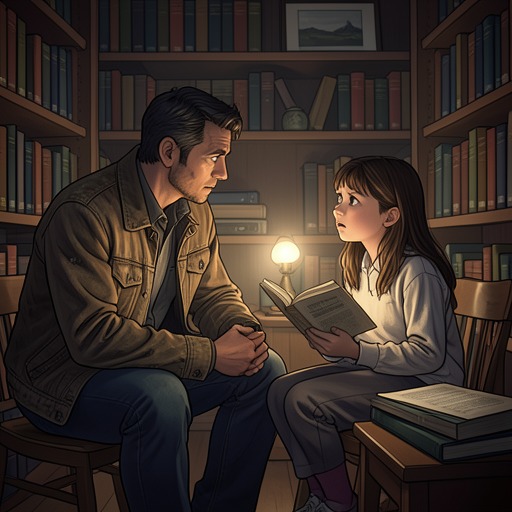
Tony begins by showing Brittiny the displays on To Kill a Mockingbird and asking whether she has read the book. Her response is not a display of academic confidence but a request for companionship: she wants to read it with him. He agrees, and they each take a desk while she opens the book and starts reading. The arrangement is simple, but its effect is cumulative. As they move farther into the novel, reading becomes more enjoyable for her, her confidence rises, and the activity becomes enjoyable for both of them.
Brittiny’s progress is measured less by a formal grade than by a change in her willingness to participate. She tells Tony that she wishes she could be in his class for one day because few people believe in her or have faith in her. His response is to assure her that his faith is sufficient for all of them. The exchange establishes the central emotional structure of their relationship: Tony does not claim to repair her entire life, but he offers a sustained, concrete form of attention through which she can experience herself as capable.
That attention also depends on a deliberate limit. Tony does not ask for the details of what Brittiny has endured at home, partly because he doubts he can bear the truth and partly because he is unsure what he could do after learning it. He tries to keep her mind focused on positive possibilities, and the narrative presents this choice as both compassionate and incomplete. Reading gives Brittiny a protected space, but it does not erase the conditions outside that room.
Disclosure and Institutional Consequences
Brittiny eventually writes something down, folds the paper twice, and hands it to Tony before leaving quickly to meet someone. He reads it alone at his desk, already worried about what it might contain. The disclosure changes his role. Until then, he could imagine their meetings as a private educational refuge; afterward, he must report what he has learned to her counselor.
The report produces a concrete and disruptive result: Brittiny is moved to yet another foster home. The consequence is not presented as a triumphant rescue. Tony wants to believe that Brittiny understood he would have to report the information and perhaps wanted him to do so, but he does not ask her. They continue spending time together without discussing the disclosure. Her silence permits the relationship to continue, while also allowing Tony to avoid a conversation he finds frightening. He admits that he takes the easy way out and “chickens out,” revealing that care can include both necessary action and emotional retreat.
Brittiny’s story therefore distinguishes personal trust from institutional responsibility. Tony’s reading sessions make contact possible, but the written disclosure activates the school’s formal obligations. The resulting move may be necessary within the system, yet it also demonstrates how protection can mean another rupture in an already unstable life. Brittiny is not reduced to the information in the paper, but the paper makes visible how little control she has over the structures governing her safety.
Relationships and Narrative Significance
Brittiny’s relationship with Tony is built through a threshold encounter: she enters his room cautiously, remains near the exit, and gradually claims a desk and a book. The physical movement from doorway to desk parallels the development of trust. She does not arrive as a student seeking a scheduled lesson; she tests whether an adult will receive her, and the answer determines whether the encounter can become educational.
Her connection with Tony also belongs to a wider school culture in which teachers carry responsibilities far beyond classroom instruction. Lynn Dixon, the veteran leader of the Arts and Education Small Learning Community, represents that larger burden through her teaching, administrative work, student advocacy, mediation, and practical maintenance of the school’s copy machine. Against this background, Brittiny’s case clarifies why Tony later tells Lynn that, at his age, he is unsure whether he wants to care so much about anything. Lynn’s answer—that caring is precisely what the work requires—echoes the moral demand created by Brittiny’s disclosure.
Brittiny’s presence also contrasts with Tony’s family anxieties. He struggles to interpret his elder daughter’s reassurance that it is all right if he has not yet bought a ticket home, wondering whether he has missed so much of her life that his presence no longer matters or whether she understands the importance of his work. With Brittiny, he can see the immediate result of attention: a guarded older student reads, gains confidence, and says that someone believes in her. Yet the same relationship leaves him confronting responsibilities he cannot solve through encouragement alone. Her story intensifies the book’s question of what it means to give oneself to students while remaining accountable to a spouse and children.
Change and Ending
Brittiny’s arc does not end with graduation, a permanent home, or a fully disclosed personal history. It ends in continued meetings after her move to another foster home, with the central crisis left unspoken between her and Tony. That incompleteness is important. Her change is real but local: she becomes more confident as a reader and experiences sustained belief in her abilities. The surrounding instability remains unresolved.
For Tony, Brittiny becomes a measure of the seriousness of teaching. The episode begins with an unexpected visitor and a book on a classroom wall, proceeds through shared reading and mutual enjoyment, and culminates in a report that alters the student’s living situation. It teaches him that the teacher’s influence can be intimate without being all-powerful, and that caring deeply may require actions whose consequences cannot be controlled. Brittiny’s story consequently gives human scale to the larger Northeast High School community: behind its policies, quotas, mandates, and enormous physical plant are students whose educational needs are inseparable from the precarious conditions of their lives.