David Cohn
I'd Like to Apologize to Every Teacher I Ever HadDavid Cohn is the veteran English educator whose presence makes Tony Danza’s experiment at Northeast High School accountable to education rather than television. Young enough to be Danza’s son but appointed as his supervisor, David observes the celebrity teacher’s failures, conducts daily postmortems, supplies practical instruction, and gradually becomes both mentor and friend. His decisive contribution is not to rescue Danza from difficulty, but to make him confront what teaching requires: preparation, restraint, assessment, and the transfer of responsibility to students.
Identity and Role
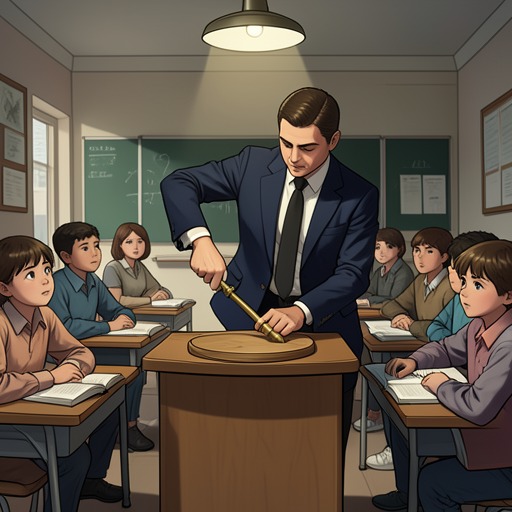
David enters the narrative immediately after Danza’s disastrous first class. Once the last student has left, he approaches Danza, places a consoling hand on his shoulder, and acknowledges that the collapse feels worse than it is because it was a first attempt. David has watched the entire debacle from the back of the room, yet he does not intervene during the lesson. His agreed role is to observe and then review what happened, not to perform the teacher’s work for him. That boundary establishes the central terms of their relationship: David offers professional judgment without taking away Danza’s obligation to learn.
David’s position was part of the bargain that allowed the production to enter Northeast. During negotiations with the Philadelphia school authorities, Danza promised that his students would receive the same quality of education he wanted for his own teenage daughter. To safeguard that promise, the producers agreed to pay for a veteran teacher to observe him and ensure that the class received an effective tenth-grade English course. Danza initially regarded this arrangement as a concession and wanted an unassisted teaching experience, but orientation sessions on classroom management and even the possibility of being spat upon soon made the supposed training wheels seem useful. David therefore embodies the school’s institutional demand that a television project remain answerable to students.
Teaching Method and Interventions
David’s principal instrument is the postmortem. After observing a lesson, he does not merely reassure Danza or list mistakes; he translates the experience into a structure for future action. He explains that a lesson plan must include what the teacher will teach, how the material will be taught, and how students’ retention will be assessed. Each class should have a do-now or warm-up, a main activity, and a wrap-up. Danza had spent three days preparing his plan but forgot to use it, leaving the do-now plainly written on the blackboard while the class unraveled. David’s criticism turns that embarrassment into a concrete lesson about the difference between preparation on paper and preparation enacted in the room.
His most consequential advice is to do “more with less.” David defines the principle as less of the teacher and more of the students: narrow the topic, spend more time on less information, let students read and do their own work, and avoid making the teacher’s performance the center of the class. The advice confronts Danza’s instinct to fill silence, entertain the room, and win approval. David also rejects the idea that popularity is the foundation of instruction. When Danza worries that students may not work unless they like him, David distinguishes between not wanting to work and not wanting to learn, insisting that students must become interested in learning and involved in their own education. The lesson shifts authority away from celebrity charisma and toward active student participation.
David’s teaching is equally visible in the questions he refuses to answer directly. When Danza asks why tenth graders should study Shakespeare before beginning Julius Caesar, David responds by asking why Danza thinks Shakespeare is taught. The exchange forces Danza to search for a reason rather than borrow one. David’s method is Socratic but practical: he does not turn the classroom into a philosophical abstraction, instead making Danza articulate the purpose behind a difficult unit before presenting it to students.
Professional and Personal Relationships
Danza’s dependence on David is sharpened by the presence of cameras. The production repeatedly risks converting genuine teaching into staged conflict, and David becomes the person most alert to that danger. A show runner once urged him, through off-camera stabbing motions, to criticize Danza more harshly while the two men walked down a hallway for a supposedly more interesting shot. David refused to play along and later threatened to quit if the production continued to interfere. His resistance protects both the integrity of his evaluation and the distinction between a teacher’s real judgment and reality television’s appetite for drama.
That distinction becomes especially important whenever Danza faces disciplinary or administrative trouble. After a school trip, Danza worries that an evening at a bar might create a problem, but Kelly Barton’s casual joke resolves the immediate concern. The larger anxiety remains: Danza cannot always tell whether a crisis is genuine or has been nudged into existence by the production team. David’s presence provides a counterweight to that uncertainty. He represents a school-based standard against which the show’s manufactured pressures can be measured.
David also becomes part of the school’s faculty culture. He works alongside Lynn Dixon, the veteran leader of the Arts and Education Small Learning Community, and with the wider group of teachers whose daily labor includes far more than classroom instruction. Danza’s later gratitude names David as his coteacher, mentor, and main cheerleader, placing him within a network of colleagues who accepted and encouraged the outsider. The relationship is therefore not simply a private tutorial between a novice and an expert; it is Danza’s first sustained connection to the professional community whose routines and obligations he initially underestimated.
Development and Ending
The relationship changes as Danza learns to tolerate silence, limitation, and student initiative. In one later encounter, Al G enters Danza’s classroom, sits with his backpack still on, and says nothing for forty-five minutes. Danza has finally learned not to force the interaction and allows the student to initiate if he needs help. When David hears Danza describe this as wearing Al G down, he corrects him: it sounds more like they have worn each other down, “But in a good way.” The observation applies to both student and teacher, and David immediately recognizes that the same mutual exhaustion and adjustment have shaped his own relationship with Danza.
David’s departure provides the clearest measure of Danza’s progress. He is moving to a school in Vermont and will leave before Danza completes the year. Danza teases him for not seeing the experiment through to the finish, but David answers that Danza no longer needs him. Danza replies that he never thought David would say so, and the exchange transforms supervision into recognition: the mentor’s success lies in making himself unnecessary. David then suggests that perhaps one day they might open a charter school together, a compliment so generous that Danza is briefly speechless.
David’s departure does not erase his influence. When Danza later admits to Lynn Dixon that, at his age, he is unsure whether he wants to care so much about anything, her response confirms the demanding ethic David has embodied throughout the year: caring deeply is not an accessory to teaching but its cost and condition. By the end, Danza knows that teaching is hard work and is uncertain about returning, yet David’s judgment has helped him reach a position from which the decision can be his rather than a producer’s or supervisor’s.
Narrative Significance
David Cohn is the book’s corrective to the fantasy that good intentions, personal warmth, or celebrity visibility can substitute for professional knowledge. He protects students indirectly by insisting on planning, focused content, assessment, and their own labor. He protects Danza by refusing both to rescue him from failure and to manufacture failure for television. His counsel repeatedly converts emotion into method: humiliation becomes lesson planning, anxiety becomes reflection, and the desire to be liked becomes a demand to involve students in their own education.
The arc also gives the teaching year a developmental shape. Danza begins as a performer who wants a “real” experience but discovers that real teaching depends on disciplined structures and shared authority. David stands at the threshold between those identities, first as an external safeguard imposed by the school and finally as a trusted colleague who can leave because Danza has absorbed the work. The book’s final acknowledgment of David as mentor and main cheerleader confirms what the classroom scenes have shown: his most important achievement is not making Danza look competent, but helping him become more responsible to the students he came to serve.