Education crisis
I'd Like to Apologize to Every Teacher I Ever HadEducation crisis is the book’s account of a public system that demands measurable improvement from schools while leaving teachers and students to bear the consequences of inadequate time, resources, and support. At Northeast High School, the conflict is visible both in the pressure to meet performance targets and in the daily work of making students want to learn. The book ultimately rejects blame as a solution: meaningful education depends on sustained participation and investment, not on hoping that a school, a teacher, or a television program will get lucky.
Accountability and insecurity
The institutional pressure begins with the prospect of intervention. Under the No Child Left Behind Act, schools that fail to raise scores sufficiently each year can be targeted to become Renaissance Schools. The possibility of a takeover means new management and the likely loss of teachers and staff; the threat makes teaching feel precarious before the school year has properly begun. The book describes this as more than a personnel concern. When time and attention are dominated by the demand to demonstrate annual progress, educators have less room to build the patient relationships and habits that learning requires.
That pressure returns in the account of the Pennsylvania System of School Assessment. The statewide assessment measures reading, writing, mathematics, and science proficiency in one grade, but its results are used to judge each school’s overall Adequate Yearly Progress. Northeast High School missed its 2009 target, intensifying the drive to improve in 2010. A practice test and the later examination become schoolwide priorities, making a specific measurement stand in for the broader work of education. The book sets the urgency of those scores against the question of whether students are actually engaged, developing, and learning.
The gap between educational purpose and institutional incentives also appears in the book’s proposed Three-Fifths Solution: three classes per teacher rather than five. The suggestion is explicitly expensive and speculative, but its rationale is concrete. A reduced teaching load would give teachers more time to prepare and follow through with individual students, and make their schedules less chaotic. The proposal exposes the cost of treating teachers’ attention as if it could stretch without limit.
Classroom engagement and unequal needs
The crisis is not presented as a simple division between motivated students and indifferent teachers. David Cohn cautions that a teacher cannot learn on behalf of students, while distinguishing reluctance to work from lack of interest in learning. His advice shifts the problem from enforcing effort alone to creating conditions in which students take part in their own education. The distinction matters because disengagement can look like defiance while concealing a student’s distance from the material.
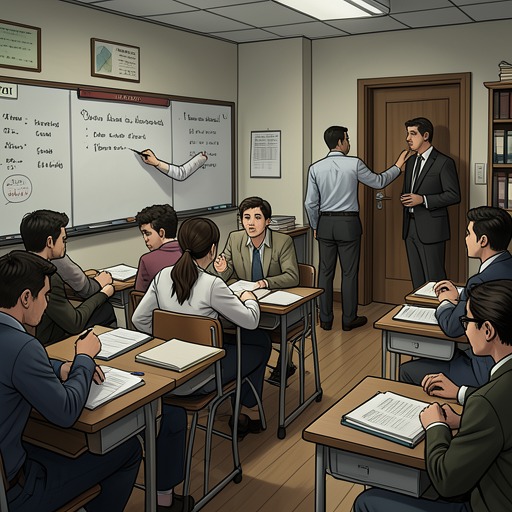
Monte makes that tension especially clear. He tells Tony Danza that he worries he chose the wrong class instead of Advanced Placement English, wants to be the first in his family to attend college, and hopes to win a scholarship to Harvard or Princeton. He doubts whether Danza is qualified to teach him. Later, Monte complains that To Kill a Mockingbird is too easy, while other students object that the book has thirty-one chapters and is too long. Their opposing responses reveal the difficulty of teaching a class whose students need different levels of challenge and support. Danza worries that imposing stricter standards on students who already struggle will drive them out of participation; at the same time, he recognizes that neglecting advanced students may compromise Monte’s ambitions.
The Student Teacher program gives this conflict a practical test. Danza grants Monte a full period to design a lesson and set demanding standards. Monte arrives prepared with legal terminology from the novel’s trial and a lesson on the characters’ qualities and interactions. But the class does not follow his lead: students interrupt, talk, move around, and ignore the discussion. Giving an ambitious student authority and a challenging lesson does not, by itself, change the classroom conditions. The episode makes the work of teaching visible as both intellectual preparation and the difficult management of collective attention.
Participation as a route to learning
Other classroom episodes show how changing the form of a lesson can draw students into the work. After students debate the school uniform policy, Danza replaces a planned prompt on fitness and nutrition with a question about their views on uniforms. Students quickly write opinions with unusual energy and conviction, then read them aloud and debate the issue in teams. The point is not that disagreement automatically produces learning; rather, the issue gives students a reason to express and examine their positions, and discussion makes their participation central to the lesson.
A similar approach shapes the creation-myth assignment. Students first read and discuss the Anansi myth, then work in pairs to create myths explaining creation and natural phenomena. Eric Choi and Ben-Kyle present The Magic Button Myth with a large paper button attached to a paper spring and marked DO NOT PUSH. Their performance turns a warning against pressing the button into the cause of the world’s creation. The class cheers, and the shy Eric is unsure how to respond to the praise. The handmade prop and the students’ performance are small, specific signs of what classroom participation can look like when students make something together.
Danza’s effort to encourage reading similarly responds to the distance between assigned literacy exercises and students’ interests. He identifies many struggling readers not as illiterate but as aliterate: able to read, yet unwilling to do so. Scripted readings and tests consume class time, but students do not enjoy the material. Concerned that students who do not read over summer vacation may lose as much as a grade level, he looks for books that could make reading pleasurable. After hearing students discuss the film version of Twilight, he obtains thirty copies of the first book and places one on every desk. The intervention reflects a broader argument in the book: practice matters, but students are more likely to practice when the material gives them a reason to continue.
From classroom work to public responsibility
The book also connects engagement to questions of social meaning. A discussion of Coolio’s Gangsta’s Paradise prompts students to consider violence, self-respect, and alternatives to pulling a trigger. Their argument leads Danza to seek other rap as teaching material, including a Figureheads video addressing Harriet Tubman, Rosa Parks, Harriet Beecher Stowe, and Uncle Tom’s Cabin. The classroom becomes a place where popular forms can open onto history and social justice, rather than serving only as a distraction from academic work.
In its final assessment, the book rejects the idea that educational failure can be laid at the door of teachers alone. It acknowledges that some teachers and administrators are poor at their jobs, but describes most educators Danza encountered as discouraged and overwhelmed. Low-income and immigrant students, limited parental involvement, and a culture that mocks rather than values knowledge compound the challenge. Teachers are expected to teach, counsel, comfort, coach, and inspire 150 students a day while documenting and evaluating their work and keeping up with changing district mandates and national policies. The book argues that this labor is not matched by adequate public esteem or financial support.
The critique extends to the public’s appetite for effortless solutions. A producer’s description of education as a good cause, a topical subject, and a chance to get lucky becomes, in Danza’s analysis, a metaphor for a country willing to gamble on entertainment or innovation rather than commit the effort, time, and money required for student success. He connects that attitude to the tendency of politicians and commentators to blame educators without understanding what happens in schools, and of parents to blame teachers instead of helping keep their children on track. The conclusion is a call for practical support: teachers and students need help, not accusations and pay cuts, and education must be treated as a national priority. Danza’s own final gesture is personal as well as civic: after learning how difficult teaching is, he apologizes to every teacher he ever had.