Folger Shakespeare Library
I'd Like to Apologize to Every Teacher I Ever HadFolger Shakespeare Library becomes the decisive cultural setting of the Washington, D.C., field trip: a place where Tony Danza’s students move from joking about Shakespeare to performing his work, demonstrating their knowledge, and discovering that serious learning can feel like participation rather than compliance. The library matters not simply as a repository of old books, but as the point at which the class’s uncertain relationship with Julius Caesar becomes public, energetic, and unexpectedly successful.
Setting and Place in the Field Trip
Folger Shakespeare Library is presented as part of the November 16 Washington, D.C., excursion that the production team and network approve after the proposed New York trip is replaced by a visit to the national capital. The choice is partly practical: Washington is less expensive, none of the students has previously visited, and the library offers a direct connection to the Julius Caesar unit. Tony Danza initially wants to take the class to Manhattan, a city he regards as home, but he accepts that the capital and the Folger provide an educational justification he cannot easily reject. The library therefore enters the narrative as both a compromise and an opportunity: the field trip is shaped by television production and expense, yet its central destination gives the students access to history and literature beyond the ordinary classroom.
The library’s proximity to the Capitol intensifies the sense that the students are moving through a city in which nearly every place carries historical meaning. Earlier, the class has viewed the White House and Washington Monument from the bus while Fred acts as an informed tour guide. At the Folger, the movement from national monuments to Shakespearean texts creates a second kind of civic education. The students are not merely sightseeing; they are being asked to locate literature inside a larger public history.
Encounter with Julius Caesar
At the library, the students are unusually polite to the curator who greets them and leads them into the Great Hall. There they see vintage texts and illustrations connected with Shakespeare’s works. The objects give material form to a play that, in school, can seem remote or abstract. Instead of encountering Julius Caesar only as assigned reading, the students see its historical and theatrical afterlife embodied in displayed books, images, and an institutional space devoted to Shakespeare.
Their first response is irreverent but engaged. Katerina calls out that Julius Caesar is dying, and the other students crowd around the exhibit with the enthusiasm they normally reserve for a new Jay-Z single. Their questions move rapidly between confusion and curiosity: they wonder why Romans wore “bedsheets,” correct the term “togas,” ask whether Rome is in Italy, and question why Shakespeare did not write the play in Latin. Nakiya even contrasts Julius Caesar favorably with grammar lessons in Mr. Smith’s class. The humor does not cancel the learning. It reveals that the students are looking closely enough to notice unfamiliar details and confident enough to test their understanding aloud.
The visit also exposes the class’s ongoing conflict with its Latin teacher, a dispute Tony Danza deliberately declines to enter. That small restraint preserves the focus on what the library makes possible. The students arrive carrying resistance, classroom rivalries, and a habit of treating school rules as negotiable, but their attention is captured by a concrete encounter with the play. The exhibit turns a text associated with academic obligation into a shared object of observation and argument.
Performance and Active Participation
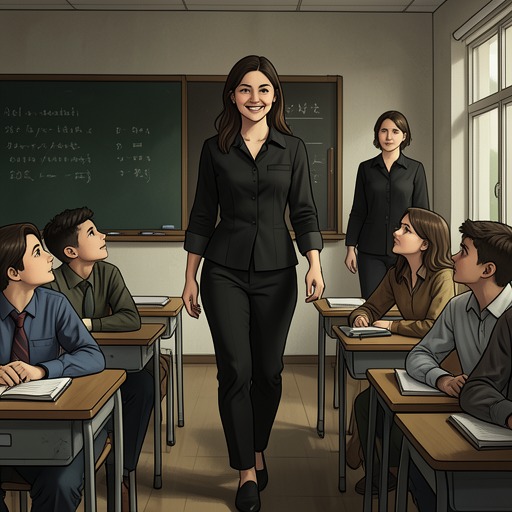
The central experience occurs in an Elizabethan replica theater, where an acting troupe called Bill’s Buddies performs scenes from several Shakespeare plays and then invites the students onto the stage. Nakiya, Chloe, and Eric Lopez prove to be natural performers, while Monte and Eric Choi also join in. Students who might normally protect themselves through indifference instead laugh openly and risk making fools of themselves in front of their classmates. The theater changes the terms of participation: performance gives them permission to be loud, physical, comic, and intellectually present at the same time.
Tony Danza is unsure whether the students realize they are learning because they are laughing so hard. That uncertainty becomes part of the library’s importance. Learning is not shown through silence, solemnity, or obedience; it is visible in movement, shared amusement, and willingness to enter the scene. When the acting troupe quizzes the class about Julius Caesar, the students’ knowledge surprises him. Their answers reveal a level of involvement that ordinary classroom behavior has concealed, and the educators who designed the Folger program demonstrate that they have created conditions in which that knowledge can surface.
The result reverses Tony Danza’s expectations. He does not merely report that the students enjoyed the program; he experiences a new understanding of their engagement. The library’s educators have provided expertise, structure, performance, and invitation, while the students supply energy and prior learning. The encounter makes Tony Danza feel that his students “make me look good,” but the deeper implication is that the program allows the students to make themselves visible as capable readers and performers.
Educational and Narrative Significance
Folger Shakespeare Library functions as a bridge between cultural authority and student experience. Shakespeare is represented through rare or vintage materials, a replica theater, trained performers, and a formal library setting, yet the students gain access not by suppressing their own language or personalities. Their jokes about togas, their questions about Latin, and their enthusiasm for staging scenes become the means through which the text becomes available. The institution does not erase the distance between the students and Shakespeare; it gives them practical ways to cross it.
The library visit also establishes a contrast with the disciplinary uncertainty at Northeast High School. At school, policies concerning hoodies, earbuds, running, shouting, and uniforms are posted but inconsistently enforced, and teachers fear sacrificing classroom momentum to discipline. At the Folger, participation is structured without being coercive. Students work within the expectations of a curator, theater, and educational program because the activity itself gives those expectations meaning. The visit thus offers an implicit model of classroom management: engagement can accomplish what punishment and rules alone often fail to do.
In the broader portrait of Northeast High School, the library becomes evidence against the assumption that apparent student apathy is fixed or total. The same young people who can seem unmotivated in routine lessons become attentive museum visitors, enthusiastic actors, and knowledgeable respondents when the setting invites collaboration. Folger Shakespeare Library is therefore not background scenery. It is the place where a field trip, a play, and a group of skeptical adolescents combine to produce a visible educational reversal: Shakespeare becomes something the students do, not merely something they are told to study.