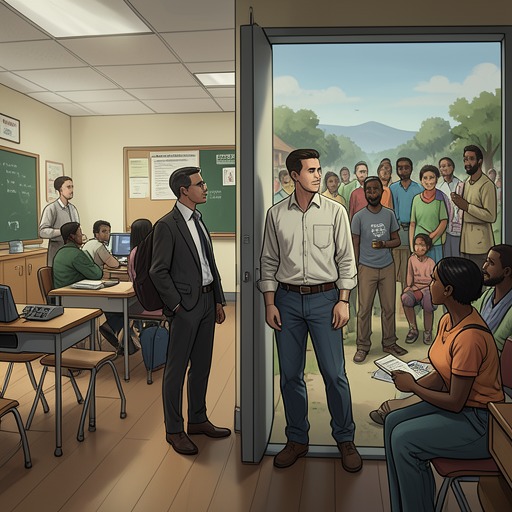
Glen Dyson
I'd Like to Apologize to Every Teacher I Ever HadGlen Dyson is a math teacher at Northeast High School who emerges as a quietly connective figure in Tony Danza’s account of the school. His role is not defined by a single dramatic student storyline but by the practical and institutional work through which he helps make the faculty function: he plays piano, participates in staff fellowship, and later becomes a dean of students. Through him, the school appears not merely as a place of classroom conflict but as a workplace whose adults must build their own forms of cooperation while absorbing pressure from families, administrators, and public criticism.
Identity and Place at Northeast
Glen Dyson belongs to the Arts and Education Small Learning Community, where twenty teachers meet during second period under the leadership of Lynn Dixon. Northeast is an unusually large Philadelphia high school, divided into eight Small Learning Communities so that students can take their core classes in more localized sections. Dyson is introduced within this dense institutional setting as a math teacher, one member of a staff whose daily responsibilities extend far beyond instruction. The teachers’ meetings include deadlines, mandates, planning requirements, and practical problems such as maintaining the school’s copy machine; Dyson’s presence helps establish the ordinary infrastructure behind school life.
He is also marked by his ability to play the piano. When Tony Danza organizes Northeast’s Got Talent, Dyson supplies accompaniment for the auditions on an electronic keyboard borrowed from the band room. His musical skill gives him a useful role in an event designed not only to entertain students but also to draw teachers from different parts of the school into collaboration.
The Faculty Talent Show
The talent show is planned as a rapid, largely independent project. With only two weeks before Christmas and an auditorium already heavily booked, Danza recruits teachers, students, and staff members to create an evening whose ticket proceeds will be divided among the band, choir, and school newspaper. Dyson becomes one of the project’s working partners rather than a passive participant: he plays for the auditions, accompanies performers, and later performs the “Minute Waltz” on piano.
The event brings together an unusually broad range of staff talents. Teachers prepare original songs, a duet from Carousel, poetry, and a Mills Brothers-style group called Tuxedo Junction; five first-year male teachers form Voltron, led by Joe Connelly. Dyson’s contribution is both technical and performative. His keyboard helps the audition process function, while his piano number gives the show one of its deliberately varied attractions. The project’s energy comes from this mixture of competence, embarrassment, play, and shared risk.
Seven hundred students attend. They vote Voltron into first place and award second place to Ms. Solomon, a nervous social science soprano. Danza experiences the response as more powerful than the reception to any performance he had given in Hollywood, because students are seeing their teachers do something radically different from ordinary classroom authority. As the staff packs up, Dyson tells Danza that, in six years at Northeast, the show has created more contact among the teachers than anything he has previously experienced there. His remark identifies the event’s lasting result: its importance lies less in the competition than in the temporary community it creates among adults who usually work in separate rooms and departments.
Administrative Judgment and Student Conflict
Dyson’s significance changes when he is appointed a dean of students. The new position places him near the disciplinary and parental conflicts that Danza has previously encountered mainly as a classroom teacher. During the dispute over Daniel’s failing grade and unexcused absence, Daniel’s mother arrives prepared to demand that her son be removed from the class and that the teacher be punished. She refuses to hear Danza’s account, accepting Daniel’s claim of innocence as sufficient evidence.
Danza turns to Dyson after the mother enters the principal’s office. Dyson explains that the school’s negative public reputation has caused parents to arrive predisposed to blame teachers. In his account, strict teachers are weakened by a recurring pattern: a student acts out, the student receives consequences, the parents accuse the teacher, and the school then reprimands the teacher despite the possibility that the teacher’s only offense was maintaining high standards. Dyson calls this an exhausting and destructive cycle. His observation converts an individual complaint into a structural diagnosis of authority at Northeast, where adult responsibility is repeatedly displaced onto the teacher who enforces expectations.
Collegiality and Institutional Culture
Dyson’s relationship with Danza is grounded in cooperation rather than sentimentality. He helps Danza build the talent show, gives the new teacher a practical role within the faculty, and later offers an institutional explanation when Danza encounters parental hostility. These moments place Dyson between two kinds of school labor: the visible labor of teaching and performance, and the less visible labor of sustaining professional judgment when the school’s authority is under attack.
His place among the male staff is also reflected in the Sons of Happiness, a fraternal society for men at Northeast. The group was formed by veteran teachers and retirees who believed that camaraderie among male employees was lacking. Its members meet for dinner, induct a few new teachers at the end of each school year, and forbid discussion of the society at school. Dyson is not described as a founder or leader, but the society’s existence illuminates the adult culture in which he works: teachers need spaces outside formal school routines to release pressure and form bonds. The talent show offers a public, student-facing version of that fellowship, while the Sons of Happiness provide a private one.
Narrative Function and Significance
Glen Dyson functions as a grounded counterpoint to the spectacle surrounding Danza’s celebrity-teacher experiment. He is a working teacher with a concrete skill, a colleague who recognizes the value of shared activity, and an administrator who understands how institutional blame operates. His piano playing makes collaboration possible in one of the school’s most successful communal events; his later explanation of parental pressure reveals why maintaining standards can become professionally dangerous.
Through Dyson, Northeast High School is shown as a culture held together by improvised relationships as much as by official policy. The school contains conflict among students, racial tension, parental defensiveness, bureaucratic demands, and public stigma, yet it also contains music, humor, ritual, and colleagues willing to make common cause. Dyson’s trajectory from accompanist and fellow performer to dean of students embodies that duality. He belongs to the ordinary labor of the institution, but his actions and observations disclose the larger forces shaping it.