Gwen
I'd Like to Apologize to Every Teacher I Ever HadGwen is a fifteen-year-old student at Northeast High whose sudden academic decline brings the pressures of home, sexuality, heartbreak, and parental unemployment into Tony Danza’s classroom. Initially presented through the dirty looks she directs at her teacher, she becomes one of the clearest examples of how a student’s visible behavior can conceal a private crisis. Her encounter with Tony changes the immediate course of her schoolwork while also forcing him to confront the limits and possibilities of empathy.
Identity and Circumstances
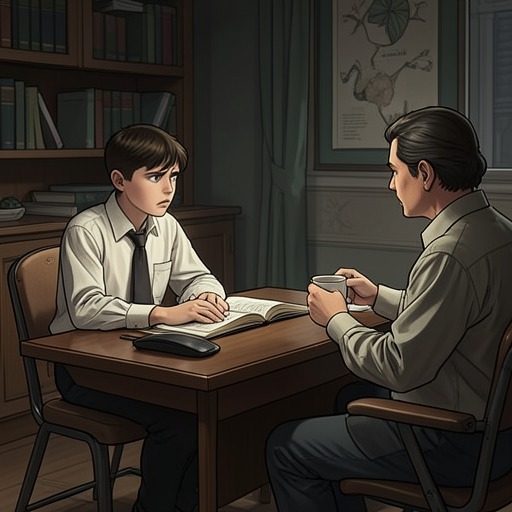
Gwen is described as a good student whose work had been solid until recently. Her deterioration is therefore treated as a change requiring explanation rather than as proof of laziness or inability. She has a notably guarded physical presence during her conference with Tony: she slumps behind her desk, glowers, and repeatedly rubs her chronically sweaty palms against her jeans. The sweaty hands are a source of embarrassment, linking her academic difficulty to the self-consciousness and appearance pressures common in adolescence.
She is also one of the few openly lesbian students at Northeast High and belongs to ALLY, the school’s Gay-Straight Alliance club. Her senior girlfriend has recently ended their relationship, leaving Gwen angry and emotionally unsettled. The breakup is not treated as a decorative detail; it forms part of the emotional weight behind her withdrawal and helps explain why her hostility is directed not only at Tony but at the world around her.
Academic Decline and Family Crisis
Tony calls Gwen for a conference because her work no longer reflects her earlier performance and because he suspects that she has stopped doing the reading. When he asks whether something is bothering her, she first offers only that there is “some stuff at home.” Her reluctance makes the conference a negotiation rather than a straightforward disciplinary conversation: Tony must move past the surface problem without forcing her to disclose more than she is ready to say.
The underlying crisis is her father’s job loss. He has become markedly different since losing work, has largely stopped looking for another job, and has left Gwen’s mother to work double shifts as a nurse. The resulting financial and emotional strain produces repeated fights between her parents. Gwen says that she and her father used to be close, but now regards him as “kind of a creep” and admits that the relationship has deteriorated. Her academic slackening is thus connected to a household destabilized by unemployment, altered parental identity, and conflict.
Gwen’s situation also intersects with Tony’s own life. Around the same period, Tony is struggling with the aftermath of his canceled television show, his separation from his wife after twenty years of marriage, and the fact that only his youngest child remains at home in Los Angeles. He has begun to fear that time is running short as he approaches sixty, especially because his father lived only to sixty-two. When Gwen describes her father’s transformation, Tony recognizes the fear of losing work and the shame of no longer being able to provide. That recognition gives the meeting emotional force, but it also makes the conversation risky: he is not merely advising a student; he is speaking from an unresolved wound.
The Conference with Tony Danza
Tony tells Gwen that his own television career ended abruptly and that he, too, brought the humiliation and anger home. He acknowledges that after being fired he felt finished, lost his temper, and behaved in ways his wife and daughters might also have considered troubling. He explains that many men experience work as a definition of identity, so losing a job can make them unsure who they are. This personal disclosure establishes a connection without pretending that his experience is identical to Gwen’s family circumstances.
The advice that follows has two distinct parts. First, Tony insists that Gwen cannot allow the stress at home to destroy her studies. He tells her that the situation is difficult but that difficulty does not erase responsibility. Second, he asks her to practice empathy toward her father while making clear that empathy is not the same as excusing harmful behavior. He draws on the class discussion of walking in another person’s shoes and applies it to the family conflict, presenting emotional understanding as a discipline rather than as sentimental forgiveness.
Tony also admits his own temper and the different models of emotional expression in his family and his wife’s family. In his upbringing, he says, raised voices could signify caring, whereas his wife’s family did not express concern through shouting. His comparison lets Gwen see that anger can be culturally and personally learned without being harmless. The conversation therefore moves beyond a demand for better grades: it becomes a joint examination of how unemployment, wounded pride, family expectations, and anger circulate between adults and children.
Immediate Change and Narrative Role
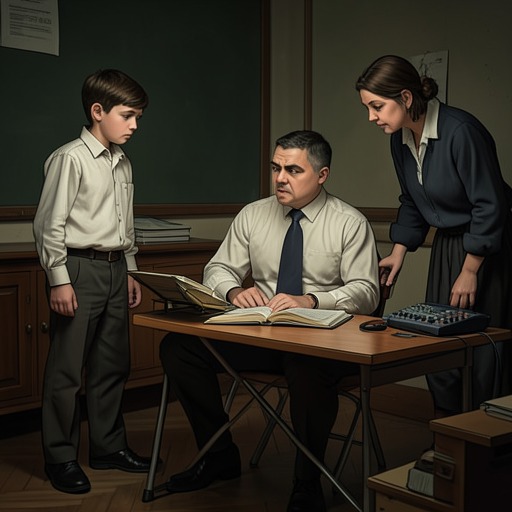
Joe Connelly interrupts the conference by asking whether Tony is having lunch, but Gwen stops Tony from leaving and says, “I think we’re good.” She then hugs her backpack to her chest, thanks him, and leaves with an indication that the conversation has reached a workable stopping point. The gesture does not resolve her family’s problems, yet it marks a shift from defensive silence to limited trust.
The following week, Gwen’s work improves, although she continues to give Tony the hard looks that have become part of her manner. She tells him that things at home are getting better, and he tells her that he is proud of her. The improvement is modest and deliberately incomplete: Gwen does not become cheerful or suddenly lose her anger. Instead, her academic effort returns while her difficult exterior remains, allowing the narrative to preserve her complexity rather than converting recovery into a personality change.
Gwen’s encounter with Tony also changes him. Before speaking with her, he is absorbed in uncertainty about his own family. His elder daughter’s casual assurance that his absence is acceptable leaves him wondering whether he has missed so much of her life that his presence no longer matters, or whether she sees his teaching as meaningful work. He realizes that he is trying to teach students to read while no longer knowing how to read his own daughter. Gwen’s conference turns that abstract anxiety into an act of reciprocal recognition: Tony helps her interpret her father, while her crisis helps him interpret his own behavior at home.
Significance
Gwen embodies the book’s insistence that student performance cannot be separated from the conditions surrounding it. Her reading and schoolwork falter amid a breakup, discomfort with her body, a lesbian identity lived openly within the school, a father’s unemployment, a mother’s doubled workload, and escalating parental conflict. Yet the narrative does not reduce her to any one label. She remains a strong student, an angry teenager, a member of ALLY, a daughter grieving a changed relationship, and a person capable of responding when an adult speaks honestly.
Her role is especially important because she reverses the usual direction of mentorship. Tony intends to correct Gwen’s academic behavior, but her disclosure exposes his own unfinished work as a husband and father. His authority becomes credible not because he possesses a perfect solution, but because he can admit that losing employment made him feel erased and that his temper damaged the people closest to him. Gwen’s subsequent improvement suggests the value of that honesty while refusing to promise permanent resolution. She is not a simple success story; she is evidence that one attentive conversation can reopen a student’s connection to school even when the forces shaping her life remain larger than the classroom.