If—
I'd Like to Apologize to Every Teacher I Ever Had“If—” becomes one of the most important recurring texts in Tony Danza’s year at Northeast High School. Rudyard Kipling’s poem first appears as an improvised test of whether students can memorize difficult poetry, then returns as a shared performance in a large campus scavenger hunt and reaches its fullest public use when Tony Danza recites it at the school’s graduation. Across those appearances, the poem links literary study with bodily effort, emotional self-command, the common touch, and the obligation to make one’s limited time count.
Classroom Discovery and Memorization
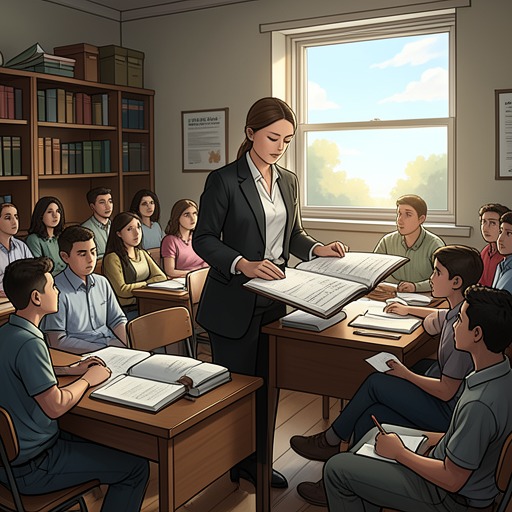
“If—” enters the classroom after Tony Danza offers prizes to stimulate competition in a poetry-memorization assignment. The first-place student is promised a Flip Video camera and ten dollars, while the second-place winner will receive eight dollars. The material incentive excites the students, but the prospect of memorizing poetry does not; the contest therefore begins as a practical attempt to convert competitive energy into literary engagement.
Tony Danza makes the assignment a test of his own credibility by promising to learn a poem in one night. The class searches online for “famous poetry,” and Rudyard Kipling’s “If” appears. The choice presents an immediate challenge: the poem has thirty-two lines, and Tony Danza has publicly committed himself to mastering it before the next morning. He spends the entire night learning it, creating a compact reversal in which the teacher must submit to the same discipline he has demanded from his students.
The following morning, Tony Danza demonstrates that “If” belongs to him through memorization rather than merely reading from a page. He explains that learning a poem by heart changes the nature of the experience: reading it is not the same as carrying it in the body, just as a pianist who has memorized a piece plays differently from one who must continue following sheet music. This argument makes memorization an embodied form of understanding rather than a mechanical school exercise.
He also connects Kipling’s verse to the students’ own cultural knowledge by describing rap as a kind of poetry. When he asks whether anyone can recite rap, Al G offers “Gangsta’s Paradise” by Coolio. Tony Danza has him stand and raise his voice, turning an apparently separate popular form into evidence that the students already possess the capacity for memorization, rhythm, and performance that the lesson requires. “If—” thus becomes a bridge between canonical literature and the students’ existing verbal practices.
A Shared Text in the Scavenger Hunt
Several months later, “If—” is incorporated into Tony Danza’s larger review of the year’s reading. The ultimate scavenger hunt begins and ends on the baseball diamond behind Northeast High School and spreads stations throughout the campus. Students must carry passports and have them stamped as they complete the activities, making literary review visible as movement through the school’s physical spaces.
At one station, teams must recite “If” in tandem. Each student takes a line, and a monitor judges whether the delivery is correct and understandable; an unsuccessful attempt must be repeated. The poem’s earlier function as an individual memorization challenge becomes a collective exercise in timing, accuracy, listening, and mutual dependence. Students cannot complete the task through private knowledge alone. They must make the poem intelligible to one another and to the adult evaluator.
The hunt places the poem among activities that translate literary concepts into physical or social action. Students tap out the rhythm of a sonnet, confront the five-paragraph essay, build a human pyramid whose levels mirror the class system in Maycomb, Alabama, and race in costumes representing figures from “Julius Caesar,” “To Kill a Mockingbird,” “Of Mice and Men,” and “Animal Farm.” Within that design, “If—” is not an isolated recitation but one station in a broader theory of active participation: literature is reviewed through voice, rhythm, bodies, teamwork, and repeated performance.
The Poem at Graduation
At the graduation ceremony for the Class of 2010, Tony Danza uses “If—” to close his address after thanking the teachers who managed students’ moods, phones, grades, and futures. He describes the school year as the greatest of his life, saying that he learned more, worked harder, and became a different and better person through his encounters with the teachers and students of Northeast High School. The poem gives that personal acknowledgment a formal structure suited to a commencement speech.
Tony Danza recites the lines “If you can talk with crowds and keep your virtue” and “Or walk with kings—nor lose the common touch.” In the context of his own passage from celebrity television host to first-year teacher, those lines carry a pointed double meaning. He has indeed spoken before large audiences and moved among prominent public figures, but his teaching year has forced him to value proximity to students and colleagues rather than status alone. The poem’s ideal is therefore joined to the book’s recurring concern with whether public visibility can be converted into genuine service.
The graduation selection continues with the poem’s insistence that neither enemies nor loved ones should entirely control one’s sense of self, and that all people should count without any single person counting for too much. Tony Danza’s choice gives language to the difficult balance between attachment and independence that has marked his year: he cares deeply about students such as Gwen and Brittiny, worries about his own children, and struggles with the emotional cost of teaching without allowing any one relationship to erase every other responsibility.
The concluding passage intensifies the poem’s temporal pressure: “If you can fill the unforgiving minute” with “sixty seconds’ worth of distance run,” then “Yours is the Earth and everything that’s in it,” followed by the promise, “And—which is more—you’ll be a Man, my son!” Tony Danza’s recitation resonates with his earlier awareness of approaching sixty, his father’s death at sixty-two, and his fear that time may be running out. What began as a poem learned overnight becomes a measure of how a person inhabits an irreversible minute.
Meaning and Narrative Function
“If—” serves the book as both an educational object and a structural refrain. In the classroom, it tests whether a teacher will do what he asks of students. In the scavenger hunt, it becomes a shared task whose success depends on coordinated voices. At graduation, it becomes a public benediction. Each recurrence enlarges its audience and changes its stakes without abandoning the basic act of speaking the words aloud.
The poem also sharpens the contrast between celebrity and teaching. Tony Danza can command attention because of his public career, but memorizing and reciting Kipling places him under the same conditions of effort as his students. His authority is not secured by fame; it is rebuilt through preparation, risk, repetition, and performance before the class. The poem’s movement from private overnight labor to communal school ritual mirrors his own movement from an individual career crisis toward participation in the daily life of Northeast High School.
Its final appearance is deliberately both earnest and comic. After reciting the poem, Tony Danza tells the graduating students to make their lives count, then asks whether there are any Vikings in the stadium. The crowd erupts, partly from delight and partly from relief that he has stopped talking, and Tony Danza admits that the poem may have pushed his luck. That self-mockery prevents the passage from becoming pure solemnity. “If—” remains elevated enough for commencement, but the school’s roar, its football identity, and the speaker’s awareness of his own excess return the poem to the ordinary human community it celebrates.