Katerina
I'd Like to Apologize to Every Teacher I Ever HadKaterina is one of Tony Danza’s two Russian students at Northeast High School, a soft-spoken and polite girl whose seriousness in class makes her an easy student to trust. Her importance in the narrative does not come from a single dramatic transformation, but from the way she draws Tony into the daily obligations of care: remembering birthdays, making room for families, encouraging intellectual excitement, and recognizing that a school year is also a chain of temporary attachments. Through Katerina, teaching becomes personal, and the classroom becomes a place where Tony’s professional reinvention is tested by affection, embarrassment, pride, and separation.
Identity and Classroom Presence
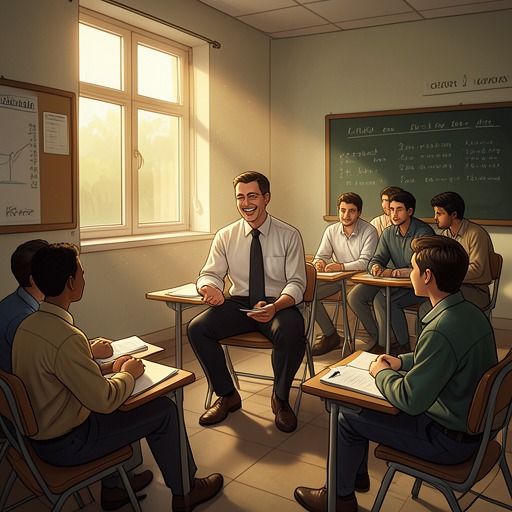
Katerina is introduced as courteous and academically serious. She addresses Tony with formal greetings such as “Good morning, Mr. Danza,” and “Have a good day, Mr. Danza,” habits that distinguish her from the louder, more disruptive students who often dominate his attention. Her quiet manner does not mean passivity. When the class studies myth and heroism, she participates in the collective life of the room, and later she becomes one of the students most visibly excited by Shakespearean material. Her character therefore joins restraint with alertness: she is not a performer in the ordinary classroom sense, yet she responds intensely when the lesson gives her something to see, question, or share.
Tony’s relationship with Katerina also develops within the immense physical and institutional setting of Northeast. The school is the largest high school in Philadelphia, with three stories, trailers, sports fields, a football stadium, a huge cafeteria, cavernous gyms, and its own Philadelphia police station. Against that scale, Katerina’s politeness and recognizable routines give Tony a point of human continuity. She is one student among many, but the narrative repeatedly returns to her because small interactions with her expose what it means to become responsible for individual children inside a system too large to know them all equally.
Birthday Celebration and Parental Encounter
Before the school year begins, Tony hangs a calendar and records every student’s birthday, intending to make some sort of fuss over each child. Katerina asks whether her mother may bring a cake for her birthday, and Tony agrees before promptly forgetting the arrangement. The next day he performs his usual birthday ritual: the class sings “Happy Birthday,” and he adds a little soft-shoe routine in Katerina’s honor. She blushes, thanks the class, and returns to the lesson, appearing pleased but not demanding attention.
The celebration expands unexpectedly during the second of the two periods Tony teaches the class. Katerina’s mother enters with a huge chocolate cake and drinks. She is tall, blond, dressed as if she is headed for a nightclub, and speaks with a thick Russian accent. She lights candles for her daughter’s wish and beams at the rare opportunity to see Katerina in her classroom. Tony recognizes the mother’s love, but he also realizes that the visit has derailed his lesson plan. The scene places two obligations beside each other: the teacher’s schedule and the parent’s desire to participate in her child’s education.
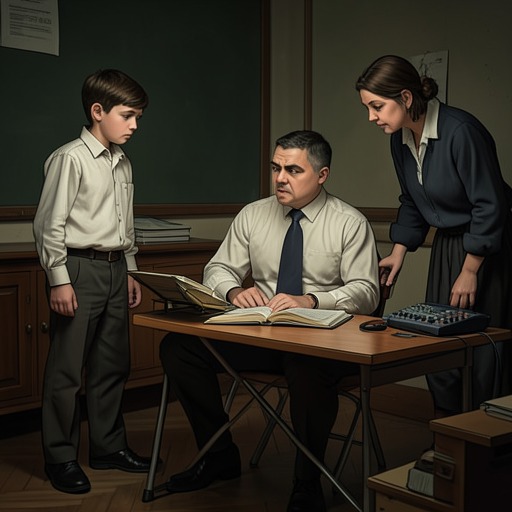
Tony responds by showing the class a DVD of his old professional boxing bouts while everyone eats. The improvised combination of birthday cake and boxing footage turns the classroom into a family-like gathering, but it also brings administrative discipline down upon him. Assistant Principal Sharon McCloskey summons him into the hall and asks what is happening, objecting both to the birthday cake and to the film. She warns him not to let it happen again. Back in the room, Katerina and her mother apologize together, and Tony is left to absorb the lesson that warmth does not exempt a teacher from school rules. Katerina’s birthday thus becomes both a tender family visit and an early demonstration of the boundary between personal care and institutional procedure.
Intellectual Engagement and Shared Cultural Worlds
Katerina’s engagement becomes especially visible during the Washington, D.C., field trip. At the Folger Shakespeare Library, the students encounter vintage texts and illustrations in the Great Hall. Katerina calls out when she sees an exhibit depicting Julius Caesar dying, and the students crowd around it with an enthusiasm normally reserved for a new Jay-Z single. Her response shows that Shakespeare, once treated as remote curriculum, can become immediate when it is encountered as an object, an image, and a scene rather than merely as assigned reading.
The exchange also gives Katerina room to ask direct questions. She wonders why the Romans wore bedsheets, prompting the answer that they were called togas, and she joins Nakiya in asking why Shakespeare did not write Julius Caesar in Latin. Katerina even says she would rather read Julius Caesar in Mr. Smith’s class than endure what she calls stupid grammar lessons. Her remarks are comic, but they also reveal a meaningful distinction between engagement and compliance. She is not simply accepting schoolwork; she is comparing forms of learning and registering a preference for dramatic language over abstract exercises.
Katerina’s excitement helps validate Tony’s attempt to make literature active and accessible. The class has been working with a “Shakespeare to Street” approach, translating canonical works into terms connected to the students’ lives. When Tony later announces that the class has approval for a trip to New York City and a Broadway matinee of West Side Story, the students erupt into dancing, high-fives, and hugs. Katerina is part of that excitement, and at the Palace Theatre she asks whether the usher’s former theater had been like the one in which Tony had performed. When the usher reveals that Tony was the star of the show, Katerina and the other students are visibly awed. Her question allows Tony’s former acting identity to become useful in the classroom: his past is no longer merely celebrity background but a bridge into his students’ encounter with theater.
Family, Migration, and the Approach of Separation
Near the end of the school year, Katerina tells Tony that she will spend the summer with her family in Moscow. She says that she cannot wait to see them, and Tony responds that she is lucky because Russia is a place he has always wanted to visit. Her announcement gives a geographical dimension to her identity as a Russian student, but it is presented primarily through family anticipation: Moscow is not an abstract foreign destination for her but the place where relatives are waiting.
The timing makes the news painful. Katerina plans to leave on the Friday before Memorial Day, turning what might otherwise be a routine summer plan into an early goodbye. Tony is already struggling with the emotional costs of his new profession. His television show has been canceled, he and his wife have separated after twenty years of marriage, and he has begun thinking about age, mortality, and whether he is running out of time. His older daughter has told him it is okay that he has not yet bought a ticket home, a reply he cannot interpret, and he admits that he is trying to teach students to read while being unable to read his own daughter anymore. Katerina’s departure therefore resonates beyond her individual absence: it becomes another reminder that the bonds Tony forms at school exist alongside obligations he has neglected at home.
Narrative Significance
Katerina represents the quieter dimension of Tony’s teaching year. Students such as Al G and Phil force him into confrontation with truancy, suspension, family instability, and the danger of giving up; Katerina instead makes responsibility visible through ordinary occasions. Her birthday requires him to receive a parent into the classroom. Her questions at the Folger Shakespeare Library show that a student’s curiosity can exceed the lesson plan. Her reaction at the Palace Theatre confirms that Tony’s artistic past can give students access to a cultural world that once seemed as distant to him as Broadway seemed to his own teenage self.
She also helps mark the difference between Tony’s former public life and his new vocation. In television and acting, identity is performed before an audience; at Northeast, meaning accumulates through repeated attention to particular children. Katerina’s formal greetings, blush at the birthday song, questions about Julius Caesar, delight at seeing Tony recognized by a theater usher, and anticipation of Moscow all become small but durable encounters. They show why Tony comes to understand teaching as demanding emotional investment. When Lynn Dixon asks whether he will return the following year, Tony says that at his age he is not sure he wants to care this much about anything. Her answer—that caring this much is precisely what the work takes—describes the lesson Katerina has quietly helped him learn. Her presence makes the school year feel less like a television project and more like a temporary community whose ordinary members matter precisely because they cannot be kept forever.