Northeast High School
I'd Like to Apologize to Every Teacher I Ever HadNortheast High School is the central institutional and physical setting of Tony Danza’s teaching year: an inner-city public high school in Philadelphia where a former television actor must exchange performance for responsibility. Its importance lies in the collision of several worlds within one campus—students’ daily struggles, teachers’ professional culture, district accountability, televised observation, and Danza’s attempt to discover whether an old ambition can become a genuine vocation. The school is not merely a backdrop. Its size, rules, history, rituals, conflicts, and personnel continually test what it means to teach and to belong.
Setting and Scale
Northeast High School is described as the largest high school in Philadelphia. Its campus reaches back to the 1840s, while the current brick building dates from 1953 and resembles a postwar factory, complete with a towering smokestack. The complex contains three stories, trailers, multiple sports fields, its own football stadium, a huge cafeteria, and several cavernous gyms. It even has a Philadelphia police station on campus. The physical scale makes the school feel less like a single building than a small city, an impression reinforced by the shrubs outside the teachers’ parking lot, which have been trimmed to spell out NORTHEAST.
That scale also shapes the school’s organization. Because the campus is so large, Northeast is divided into eight Small Learning Communities, or SLCs, each occupying a different section where students take their core classes. Tony Danza belongs to the Arts and Education SLC, a designation that also suits the production’s connection with the A&E television network. Lynn Dixon, a veteran English teacher who has spent more than thirty years in some of Philadelphia’s toughest schools, leads the community and serves as one of its guiding authorities.
Institutional Conditions and Daily Culture
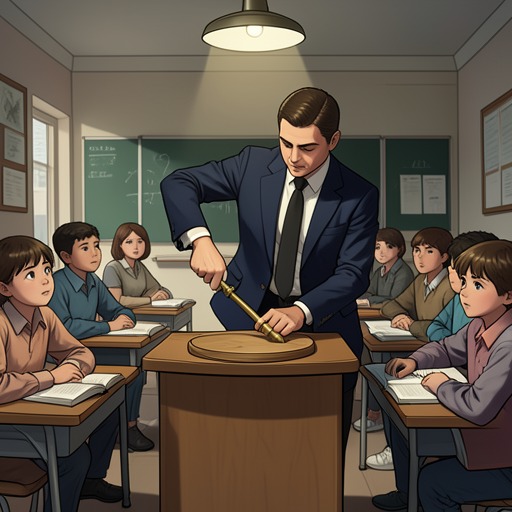
Danza’s access to Northeast is negotiated under exceptional conditions. The Philadelphia School Reform Commission eventually approves the television-linked teaching arrangement, but grants him only one double period each day with a single tenth-grade English class. His class consists of twenty-six fifteen-year-old boys and girls, approximately one-fifth the load carried by regular teachers. The reduced assignment is therefore both an opportunity and a limitation: it permits the experiment while ensuring that it cannot fully represent the ordinary job at Northeast.
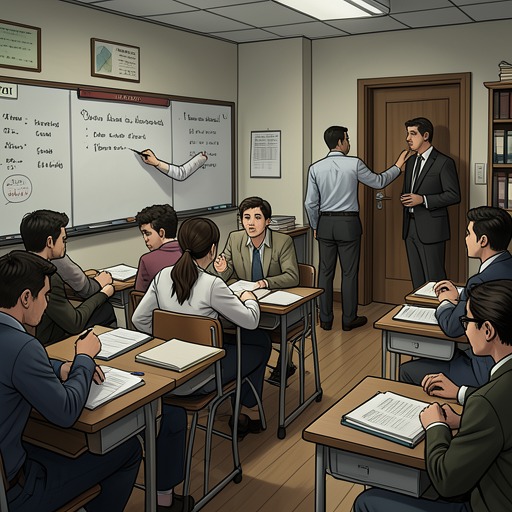
The school board’s concern is summarized by the sign in the district office reading, “WHAT IS BEST FOR THE STUDENTS?” To address that concern, the producers agree to pay for a veteran teacher to observe Danza and ensure that the class receives an effective tenth-grade English course of study. The arrangement places Northeast at the center of an ethical problem. The school is willing to admit cameras and a celebrity teacher, but only with safeguards intended to keep students’ education ahead of production needs.
The ordinary work of the school extends beyond formal instruction. Teachers are assigned advisory, the contemporary version of homeroom, and Danza soon acquires unofficial advisees despite having none officially. At Northeast, advisory becomes a period of counseling, friendship, and surrogate parenting. Teachers explain that in poor schools, they often compensate for less involved parents and students facing more problems. The institution’s daily culture therefore demands emotional and practical labor in addition to lesson planning.
That culture is uneven and sometimes distracted. At an SLC meeting, one teacher eats health food while reading a diet book, another unwraps a large cinnamon bun and nudges nearby colleagues, and others try to listen to Dixon’s announcement about a new academic mandate. A teacher sitting alone at the back initially appears to Danza to resemble one of the school’s problem students, but later explains that he is simply avoiding the noise. The scene reveals a faculty culture marked by fatigue, private habits, professional expertise, and competing levels of attention rather than a single institutional attitude.
Conflict, Accountability, and Collective Life
Northeast’s social world includes serious conflict among students. By the end of October, Matt is tied for the school record for the most fights. After a friend is attacked, Matt fights with African-American students, and four of the same students later assault him, leaving him black-eyed and badly bruised. His father describes him as energetic and anxious while also acknowledging that Matt perceives problems at school involving other students.
The conflict is complicated by the language surrounding it. When Matt’s parents attempt to leave the office, they become trapped behind a group of Black girls talking trash and horsing around, using profanity and racial epithets. Danza warns Matt’s father not to tell Matt that his interpretation is correct, explaining the girls’ behavior as cultural and shaped by home and media. The episode exposes how quickly school violence can become a dispute over racialized meanings, whose conduct is treated as threatening, and whether adults interpret youth behavior through stereotypes or context.
Discipline and fairness are also contested through the school-uniform debate. Paige objects to being punished because other girls dress in ways she considers sexually provocative. Her complaint places individual responsibility, gender judgment, and collective rules in tension. Northeast’s regulations are presented not as neutral background but as forces that organize students’ bodies, choices, and claims to fair treatment.
Academic accountability produces another layer of pressure. The Pennsylvania System of School Assessment measures proficiency in reading, writing, mathematics, and science in the junior year, yet the results are used to judge the school’s overall Adequate Yearly Progress. Northeast failed to meet its AYP target in 2009, so the 2010 testing cycle casts a long shadow over every class, including Danza’s tenth-grade English course. By spring, after one of the snowiest winters in Philadelphia’s history, the approaching assessment appears as a new storm: the institution’s educational priorities are increasingly organized around scores.
Performance, Ritual, and Public Identity
Northeast is also a place where performance becomes a form of community building. Danza uses his theatrical experience to arrange a teacher talent show connected to Viking history, while students already maintain their own annual talent show. A later student variety show, named Extravadanza by the students, is assembled in less than two weeks and involves roughly two hundred cast members from Northeast and two other area high schools. Ticket proceeds are intended to air-condition the library, so theatrical spectacle becomes a practical attempt to improve the school’s resources as well as a shared extracurricular event.
The school’s rituals extend into adult membership. Near the end of the year, Rob Caroselli tells Danza that he has been chosen for the Sons of Happiness, a fraternal society for men at Northeast High. Joe Connelly has been selected as well, and neither man knows much about the group or its induction ritual. Their surprise, uncertainty, and decision to endure the hazing together show that the school contains an informal hierarchy and traditions not visible in official policy documents. Belonging at Northeast is created not only through employment or enrollment but through ceremonies, private knowledge, and shared initiation.
Graduation provides the school’s largest public ritual. Danza is honored to speak at commencement on the football field, while the few underclassmen who attend a technically regular school day are overshadowed by the energy surrounding the graduating class. Afterward, students in his classroom give him an album filled with photographs and notes commemorating their year together. The album transforms the classroom from a site of instruction into a material record of attachment.
Cameras, Departure, and Continuing Significance
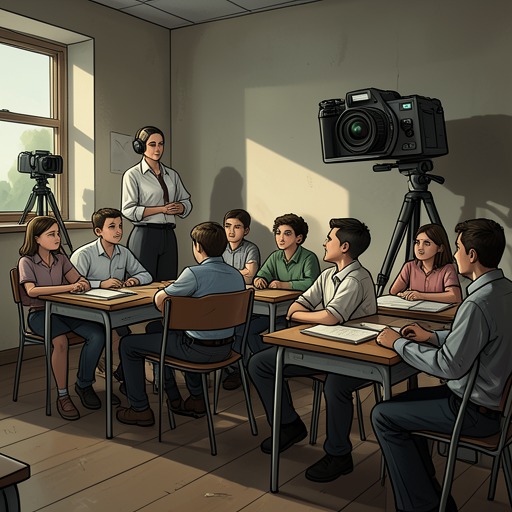
The television production changes the school’s visibility while also challenging its reality. Danza insists that the show be made as a documentary, with no scripting, forced drama, or manufactured story line. Cameras are to be turned on first, with episodes created from what actually happens. Even so, he acknowledges that television can alter events, and the book presents itself as a truer account based on diaries, lesson plans, emails, videotape, online postings, and memory. Northeast is thus seen through multiple recording systems, none of which is entirely innocent or complete.
By the end of January, A&E decides that the roughly six hours of footage already shot are sufficient for six one-hour episodes. The crew will return only for limited pickup footage and interviews, leaving Danza largely on his own at the school. The change reduces the immediate production presence but does not erase the experiment’s consequences. Northeast has become both a workplace and a public subject, while Danza must continue teaching after the television narrative has effectively been shaped.
The end of the school year turns the building into a place of absence. On graduation day, after photographs and embraces, the camera crew follows Danza to the classroom for a final wrap-up. Later, the school’s windows look blank, half the commencement chairs have already been removed, and the campus seems vacant because its defining purpose—the presence of students—has disappeared. The final teacher workday is June 21, a snow-day makeup imposed by the district, with no students present and only one day remaining after graduation.
Danza’s departure makes Northeast’s significance personal and institutional at once. When teachers in his SLC present him with a farewell video, his guilt intensifies because he feels like a deserter and does not want to leave either the staff or the students. As his train leaves 30th Street Station, he questions whether he succeeded and whether he understood his mission. He recognizes that his single class encouraged an unusual degree of attachment, yet concludes that students and teachers have always passed through one another’s lives and that what students retain matters more than the teacher’s permanent presence.
The school continues beyond his departure through emails from former students and colleagues. Budget cuts threaten teachers with fewer than three years of seniority, and many orientation colleagues leave because of layoffs, frustration, or economic necessity. Joe Connelly remains, while more than twenty seasoned teachers, including Chuck Carr and Lynn Dixon, retire the year after Danza leaves. Their departures represent a major loss of institutional knowledge for Northeast. The school’s enduring meaning therefore rests not only in the year Danza spent there but in the teachers, students, and fragile professional community that sustain it—and in the structural pressures that continually threaten to remove them.