Paige
I'd Like to Apologize to Every Teacher I Ever HadPaige is presented as one of the most difficult students for the teacher to understand, but also as one of the clearest examples of the distance between outward behavior and inward feeling. She can complete the academic work yet repeatedly chooses not to, while her volatility, social confidence, and sudden emotional exposure make her resistant to simple judgments. Her decisive moment comes during the poetry unit, when a public recitation of Marvin Bell’s “Unwanted” breaks through the persona of toughness she has maintained in class.
Identity and Background
Paige is a junior and a beauty contest winner who receives considerable attention from boys. That social visibility does not make her emotionally legible. She can be sweet and engaged one moment, then tough, angry, and ready to scream or fight the next. Her speech is delivered in rapid slang and imperfect grammar that the teacher often cannot understand, forcing him to ask her to speak in a way that makes her meaning accessible. Her difficulty is therefore partly linguistic: Paige has a voice, but the adult classroom does not always know how to hear it.
Her family circumstances further complicate the impression she creates. Like many students at Northeast High School, she has a single mother, yet her family spends Christmas in Paris, a form of affluence unusual among the students around her. Paige brings the teacher an Eiffel Tower key chain, which he treasures. The gift becomes a small counterpoint to her reputation for aggression: beneath the swagger is someone capable of thoughtfulness, attachment, and generosity. The coexistence of privilege, instability of mood, popularity, and academic refusal leaves the teacher “completely befuddled” about how to reach her.
The Poetry Contest
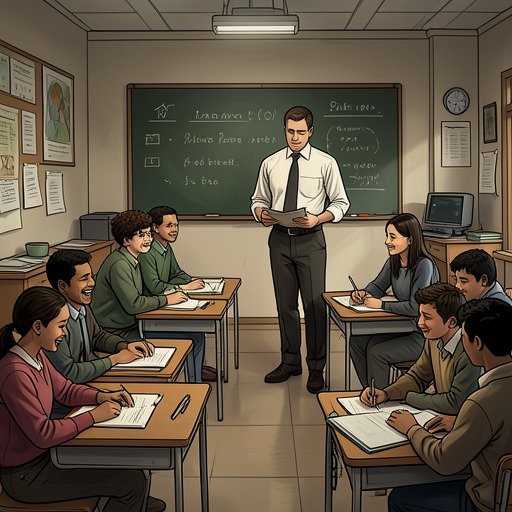
The teacher designs the poetry contest as a competitive exercise modeled on American Idol. Each student must choose and memorize a poem by a notable poet, prepare a poster explaining the poem’s historical context and the poet’s biography, and address such elements as figurative language, mood, structure, and imagery. The assignment turns recitation into research, interpretation, memory, and public performance at once. A Flip Video camera and ten dollars await the first-place winner, while second place receives eight dollars, giving the students a concrete incentive to risk appearing before their classmates and teacher judges.
When Paige takes her turn, Emmanuel helps by holding her poster. The arrangement itself reveals a social contrast: Paige routinely torments Emmanuel, and her swagger seems to dwarf him, while the poster he carries is visually restrained. It is made of black poster board and features a vintage photograph of a Black man with two little girls. Paige introduces the poem as “Unwanted,” by Marvin Bell, and begins with the confidence expected from the student who has learned to command attention.
Emotional Breakthrough
Paige stops abruptly during the recitation. Her hand rises to her mouth, her eyes fill with tears, and she runs into the hall. The class is bewildered because nobody has seen the supposedly toughest girl cry. Her public image collapses not through confrontation but through poetry: the poem has reached an experience or feeling that Paige cannot continue to contain while standing before the class.
The teacher follows her with a box of tissues and interprets the moment as the purpose of reading itself. He tells her that discovering a poem that touches her and allows her to express her feelings is a success, not a failure. His response does not treat her tears as embarrassment or misbehavior. Instead, he witnesses them, gives her time, and asks whether she wants to return and try again. Paige answers yes after taking a shaky breath. She then squares her shoulders and tells herself, “I gotta get gangsta.” The line restores her familiar performance of toughness, but it no longer has quite the same meaning: after the tears, the toughness appears as a conscious posture rather than the whole of her identity.
Change and Significance
Paige’s scene marks a change in the teacher’s understanding of her. Before the poetry unit, her refusal to work and volatile behavior appear as an unexplained contradiction. During the contest, that contradiction becomes productive evidence that her emotional life is larger than the persona through which she moves around school. She is not simply an unmotivated or aggressive student. She is capable of memorization, interpretation, artistic preparation, and an intense response to language when the material gives her access to something personal.
The episode also makes poetry an alternative to the forms of speech that usually fail between Paige and the teacher. Her slang and rapid delivery are treated as obstacles to comprehension, whereas the poem gives her a structured language through which feeling can emerge before she can explain it directly. Her breakdown is therefore both a loss of control and an achievement of expression. Paige returns to the classroom still determined to project toughness, but the return follows an act of vulnerability that her classmates and teacher have now witnessed. Her significance lies in that double movement: she remains socially formidable, yet poetry reveals a self that cannot be reduced to her performance of hardness.