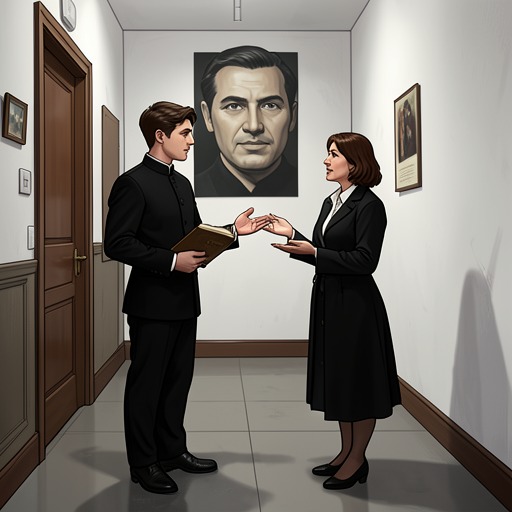
Peggy DeNaples
I'd Like to Apologize to Every Teacher I Ever HadPeggy DeNaples is one of the most recognizable administrative figures at Northeast High School: a woman whose authority is expressed through routine, access, and an unmistakable manner of speaking. At first, Tony Danza cannot read her. By the end of the school year, however, she has become one of his best friends in the building, making her relationship with him a small but telling arc from institutional distance to personal trust.
Identity and School Authority
Peggy DeNaples is associated above all with the school’s intercom, which she treats as her private domain. She, and only she, normally makes the announcements, doing so repeatedly enough that Danza admits he has grown more tolerant of them. This control gives her a quiet form of institutional power: she determines what the school hears, when it hears it, and who is permitted to speak through the public voice of the building.
Her manner reinforces that authority. When she stops Danza as he signs in on the morning of the teachers’ talent show, she formally asks whether he would like everyone in the school to know about the event and whether he would like to make an announcement. Danza has difficulty interpreting her tone, but the offer is significant because she is surrendering a privilege she ordinarily keeps exclusively for herself. Her eventual gesture, stepping aside and sweeping an arm toward the microphone, feels to him like the parting of the Red Sea. The moment turns a bureaucratic procedure into a public act of recognition.
Encounters with Danza and the School Community
Peggy’s relationship with Danza develops against the unusual conditions created by the television production. At the school formal, Danza arrives in a suit and tie while the gym fills with colored lights, corsages, tuxedos, and music whose bass makes the floor bounce. Peggy is among the staff members whose presence helps supervise the event, placing her within the adult structure responsible for maintaining order while students test the limits of the occasion. The teachers’ joking concern about students engaging in simulated sex underscores the practical, sometimes absurd nature of that responsibility.
She also encounters the production indirectly through the community around the school. When Al G’s mother comes to meet Danza, she appears dressed for a different kind of public occasion, with flashy fingernails and a hairstyle taken from the cover of Essence. The presence of cameras has become so ordinary to Danza and the students that they barely notice it, but Peggy’s administrative world remains one in which visitors, announcements, and access must be managed. Her position therefore connects the school’s everyday bureaucracy with the show’s intrusive public visibility.
Gatekeeping, Permission, and Student Opportunity
Peggy’s most revealing decision comes on Earth Day, when Alex asks Danza whether he might recite an environmental poem over the school intercom. Danza privately doubts that Peggy will agree because she guards the microphone so jealously, but he encourages Alex to ask rather than turning his suspicion into a prohibition. Peggy surprises him by being in an unusually good mood for Earth Day. She not only accepts Alex’s proposal but invites him to make the morning announcements, an unprecedented opportunity for a student.
The decision changes the intercom from an instrument of administrative control into a platform for student expression. Alex wants to compete in poetry slams, and Danza has been helping him develop the confidence, enunciation, and stage presence required for performance. Peggy’s permission extends that work beyond the classroom. Her authority does not disappear; instead, it becomes the condition that allows a student to be heard by the larger school community.
Relationship with Danza and Change Over Time
Danza’s first response to Peggy is uncertainty. After nearly four months, he still cannot read her, even when she speaks in her familiar way. That inability matters because Danza is learning to navigate a school whose rules and personalities cannot be mastered through performance alone. Peggy does not offer easy reassurance, and her reserve makes him work out the meaning of her actions rather than relying on obvious approval.
The intercom episode becomes a turning point in that process. By allowing Danza to announce the talent show, Peggy gives him a rare experience of vulnerability: he feels watched by the entire school, flashes back to the fear of making a mistake in high school, and concludes that performing in Las Vegas is easier. His anxiety makes her normal control newly visible. The woman who seems merely restrictive is also the person who can authorize a difficult public moment and make it possible.
At the close of the school year, Danza’s judgment of Peggy has changed decisively. Saying goodbye to her is unexpectedly difficult, and he becomes teary-eyed. Despite their rocky start, she has become one of his best friends at Northeast High School. The friendship is not presented as a sudden sentimental reversal; it is the cumulative result of repeated encounters in which her guarded authority proves compatible with generosity.
Narrative Significance
Peggy represents the human scale of school administration. She is not reduced to an abstract rule-enforcer, even though she controls a highly visible institutional routine. Her decisions show how access to a microphone, a classroom, or a public event can be governed by small acts of discretion. In a school shaped by uniforms, cameras, discipline, and competing claims to authority, she preserves an adult structure while occasionally opening it to students and colleagues.
Her arc also mirrors Danza’s own movement from outsider to participant. At first he experiences her as unreadable and possibly obstructive; later he receives her permission, learns the cost of speaking in her domain, and finally mourns the end of their daily association. Peggy’s significance lies in that gradual revaluation. The school becomes real to Danza not only through dramatic student episodes but through administrative relationships such as this one, where respect is earned through friction, access is granted cautiously, and professional distance can end in friendship.