Pepper
I'd Like to Apologize to Every Teacher I Ever HadPepper is a small, quirky student at Northeast High School whose defining acts are at once comic, provocative, and revealing. He is known for a dog-biscuit prank that turns a uniform violation into a schoolwide legend, yet shortly afterward he is found bruised and close to tears after being punched without warning. The contrast makes Pepper significant: he is neither simply a troublemaker nor merely a victim, but a student whom Tony Danza learns to see beyond the quick labels attached to him.
Identity and Place in School Life
Pepper is called by his last name because it suits his personality, and the narrator presents him as unusual without treating him as intrinsically dangerous. He is not usually a troublemaker. That qualification matters because Pepper’s reputation is built less from a sustained pattern of cruelty than from a capacity for mischief and provocation. His small size also shapes Tony Danza’s response to him; when Pepper is later attacked, the teacher immediately identifies with and sympathizes with the physically vulnerable student.
Pepper belongs to a school culture in which rules are widely known but inconsistently enforced. Northeast High School has policies governing uniforms, hoodies, earbuds, and other conduct, but students understand that many violations produce little consequence unless an adult chooses to escalate them. Pepper’s behavior grows within this gap between formal regulation and daily practice. His actions test what the rules mean in practice, while the adults’ responses reveal how much discipline depends on discretionary judgment.
The Uniform Incident and the Dog Biscuit
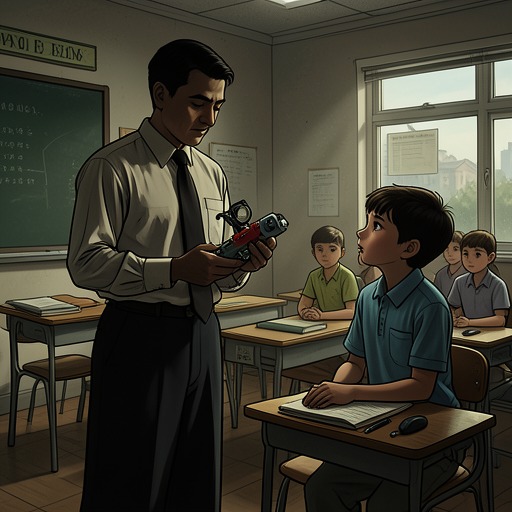
When the Northeast High School uniform policy takes effect, more than a thousand students boo Tony Danza during his monitor duty, making the new rule a collective source of resentment. Pepper is stopped at the security gate because, although he wears the required khaki pants, white shirt, striped tie, and dark sweater, his shoes are the wrong color. He says that the correct shoes are in his backpack, changes them, and then hands Ms. DeNaples a small object, presenting it as a gift for her trouble.
The object is a dog biscuit. Ms. DeNaples reacts with immediate fury and takes Pepper to the office, while another teacher laughs so hard at the report that he has to retreat into the hall. Tony Danza, initially unable to understand the joke, later learns from Ms. DeNaples that the biscuit is an insult: Pepper is calling her a bitch. The prank is therefore more than childish randomness. It converts a minor technical violation into a pointed act of symbolic resistance, using an apparently harmless object to challenge an adult’s authority.
The episode also shows how quickly peer recognition can reward defiance. By the time Pepper returns to class, the whole class has heard about the stunt and is lionizing him. Tony Danza does not punish him publicly or allow the class to turn the incident into a group performance. Instead, he asks Pepper to meet him after class, making clear that the invitation is one Pepper cannot refuse while preserving the student’s dignity in front of his peers. The teacher then abandons a planned exercise on physical fitness and nutrition when the class begins arguing about the uniform policy, turning the immediate controversy into a discussion of discipline, expression, cost, and competing ideas of seriousness.
Pepper’s prank thus makes him a minor celebrity, but it does not settle his identity. The same act that earns admiration from classmates makes him legible to adults as insolent and in need of control. His visibility is double-edged: peer approval gives him status, while administrative attention increases his exposure to punishment.
Assault and Exposure of Vulnerability
The day before the class’s Washington, D.C. trip, Tony Danza receives an alert that Pepper has been assaulted in the hallway. At the school police station, Pepper looks pitiful: his eye is bruised and swollen, and his cheek is discolored. He explains that he had been standing and talking with a friend when another student came by and punched him in the face. The blow nearly knocked him down, and Pepper is close to tears.
Tony Danza’s interpretation of Pepper changes in this scene because the teacher distinguishes mischief from malice. Pepper can be a slacker and sometimes an instigator, but Tony Danza insists that he is not mean. That distinction resists the school’s tendency to collapse different forms of student behavior into the category of the problem child. A student capable of baiting an authority figure with a dog biscuit can also be an unprepared victim of random violence; one fact does not cancel the other.
Security footage confirms Pepper’s account. The camera shows him simply standing and talking during a crowded period change, with no evidence that he invited the confrontation. The punch itself is not visible, but the recording captures Pepper recoiling and the attacker running down the hall and into the stairwell before appearing on another camera. Officer Anderson identifies the assailant as one of the school’s known troublemakers and retrieves his schedule. The surveillance system supplies institutional confirmation of what Pepper cannot fully explain, transforming his uncertain testimony into a documented assault.
The incident also exposes the practical limits of Northeast High School’s disciplinary order. The school has a police station on campus and cameras covering much of the building, yet the assault still occurs in the ordinary movement of students between classes. Pepper’s case sits at the intersection of informal student reputations and formal institutional investigation: he is known as a prankster, but the footage forces the adults to recognize him as someone who has been harmed.
Labels, Recognition, and Narrative Significance
Pepper’s two principal episodes form a deliberate reversal. In the uniform incident, a tiny object gives him power over an adult encounter: the dog biscuit lets him mock the authority enforcing the dress code, and his classmates celebrate the audacity. In the hallway, Pepper has no such control. He is struck, cannot identify the attacker with certainty, and waits bruised in the school police station while adults reconstruct what happened. The same student who appears socially powerful in one setting becomes physically helpless in another.
His story therefore illustrates the danger of reducing students to labels. Pepper is described through phrases such as “dog biscuit kid,” and the nickname is memorable enough to follow him into later conversations. Yet Tony Danza’s attention repeatedly complicates that shorthand. Pepper is small, sometimes provocative, and capable of calculated humor, but he is also not usually troublesome, not mean, and visibly distressed when violence reaches him. His character is built through this tension between the reputation that precedes him and the evidence of the person in front of the teacher.
Pepper also embodies the book’s wider concern with what teachers can do amid imperfect rules and inadequate systems. Tony Danza cannot prevent the prank from becoming a spectacle, and he cannot explain the assault from Pepper’s first account alone. He can, however, refuse to treat the prank as the whole student, invite Pepper into a private conversation rather than humiliate him before the class, and accompany him through the investigation. Pepper’s importance lies in this small but consequential shift in adult attention: the student who first appears as a source of laughter and disciplinary trouble becomes someone whose safety, fear, and credibility demand serious recognition.