Phil
I'd Like to Apologize to Every Teacher I Ever HadPhil is a sixteen-year-old student at Northeast High School whose defining condition is not simple defiance but sustained disappearance from school life. As one of four boys known as the Wanderers, he turns the school’s immense size into a system of evasion, moving through its corridors and hiding places instead of entering class. His story becomes one of the clearest tests of Tony Danza’s belief that a teacher can reach a student one relationship at a time, while also exposing how quickly care can be overwhelmed by absence, family circumstance, academic debt, and the legal system.
Identity and Introduction
Phil belongs to a group of four boys who dress in black and spend their days walking the halls together. Their unusually pale complexions and constant movement make them visually distinctive, but the important fact is procedural: each morning they swipe a student identification card to prove that they are on campus, then roam for the rest of the day. Northeast is so large, with enough corridors, corners, and secluded spaces, that a student who knows the building can avoid class without necessarily leaving the grounds. The Wanderers have mastered that geography.
Phil is initially presented through the school’s judgment of the group. Other teachers describe the boys as having a well-established record of trouble and tell Tony Danza that trying to persuade them to attend class is a waste of breath. Phil, however, becomes distinguishable from the others when Tony catches him alone. Asked what his father thinks about his truancy, Phil says that he has no father, that his mother is alone, and that his older brothers have all been in trouble. His reply, “So what else is new?”, is not merely sullen; it challenges the expectation that his circumstances should surprise anyone. The line places his behavior inside a family and social history rather than treating it as an isolated personal defect.
Truancy and Academic Collapse
The other three Wanderers reject the idea that anything Tony says could matter, but Phil begins coming to Tony’s classroom alone at lunchtime. Tony gives him half a sandwich and gradually learns enough about him to request his class roster. The roster turns the visible habit of wandering into measurable academic collapse: Phil is failing every course because he almost never attends, one teacher says he has cut class every day since school began, and another reports more than sixty unexcused absences. His absence is therefore not an occasional lapse but the organizing fact of his school year.
Tony visits Phil’s teachers and asks them to provide the assignments he has missed so that the two of them can complete the work together. The request imposes additional labor on teachers who already have 149 other students to worry about, yet they agree despite their skepticism. Tony’s immediate objective is larger than making up assignments. He wants Phil to see that his teachers care what happens to him and to understand that changing his behavior might still alter his future. The intervention combines practical remediation with an attempt to reverse Phil’s settled expectation that school has already given up on him.
The school’s structure makes Phil’s situation more complicated than a classroom failure. Later discussion of Pennsylvania’s testing rules explains that Northeast’s accountability results include students living within its boundaries who have been reassigned to disciplinary schools or alternative programs. Chuck Carr locates those students and makes sure they take the PSSA, even though they may never have walked through Northeast’s doors. Phil’s eventual placement in a night-school program illustrates the same institutional problem from the student’s side: his educational trajectory crosses several programs, while responsibility for his outcome remains attached to the school system in ways that do not necessarily provide him with a stable path back into ordinary classes.
Criminal Charge and Last Chance
Just when Tony believes that he may be making progress, Phil is charged with credit card fraud. Phil and his friends have apparently used a stolen Visa card, and the arrest shakes Tony’s confidence in what personal attention can accomplish. Tony tries to tell himself that he entered Phil’s life too late and could not have done more, but that explanation cannot erase the earlier signs: the daily truancy, the failed courses, the family history, and the accumulated absences all preceded the arrest.
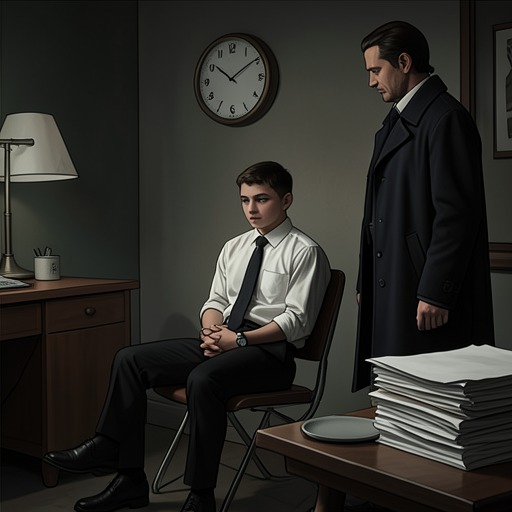
When Tony last sees him, Phil says that he is facing a three-year jail sentence. At the same time, he is beginning the Twilight Program, a night school for students who work or have serious problems and want to earn a General Educational Development certificate. Tony presents the program as Phil’s last chance and tells him that earning the certificate could be taken into consideration by the judge. His appeal is both urgent and limited: Phil cannot undo the past, but he can show the court that he is trying.
Phil nods as if he understands, yet Tony senses that the possibility has not become credible to him. Phil feels buried beneath the ground he has lost and believes he will never catch up. Tony insists that he can succeed if he wants to, but the student will not last in the program. The failed intervention gives Phil’s arc its painful shape: the chance exists institutionally, and Tony can name it, encourage it, and help him approach it, but none of those actions can guarantee that Phil will be able to use it.
Relationships and Narrative Significance
Phil’s connection with Tony is built from small, material acts rather than a dramatic conversion. Tony seeks him out in the suspension setting, offers him food at lunchtime, contacts his teachers, gathers missing work, and repeatedly explains why a change in conduct matters. These gestures establish a nonformal advising relationship in which Tony tries to become a reliable adult presence without possessing the authority or resources to repair Phil’s family situation, attendance history, or criminal exposure.
The relationship also exposes Tony’s uncertainty. He wants to believe that very few students are truly bad and that many are simply mixed up, but Phil’s arrest forces him to confront the difference between recognizing a student’s potential and being able to redirect his life. Phil’s refusal to sustain the Twilight Program is not framed as proof that Tony’s concern was meaningless; instead, it marks the boundary between individual care and structural vulnerability. Tony can throw out a lifeline, but he admits that he has no idea how to help them all.
Phil’s story therefore works as a counterpoint to accounts of easier academic recovery elsewhere in the school. The student is not reduced to the label of “problem kid,” since he responds to Tony privately and accepts the possibility of assistance for a time. Yet the narrative refuses the consoling ending in which attention alone produces redemption. Phil remains caught between school avoidance, inherited trouble, academic isolation, and the courts, making his unfinished trajectory one of the book’s strongest reminders that commitment matters without always being enough.