Philadelphia Inquirer
I'd Like to Apologize to Every Teacher I Ever HadPhiladelphia Inquirer is the large Philadelphia newspaper recruited to observe Tony Danza’s classroom when the publicity strategy for Teach turns from silence to exposure. Its intervention matters because it places an independent journalistic account beside the television production: the newspaper is expected to generate attention, but its eventual report also records the ordinary difficulty of teaching rather than manufacturing a convenient dramatic spectacle.
Role in the Publicity Conflict
The newspaper becomes involved after the network refuses to let anyone discuss Teach with the press because the show has not yet been given an airdate. The policy is meant to preserve media interest until the network is ready to launch the program, but the silence produces the opposite effect. The Northeast Times begins portraying the blackout as a sinister conspiracy, even running a headline asking, "WHY WON’T TONY DANZA TALK?" In response, the network and production company invite the Philadelphia Inquirer’s education reporter to interview Tony Danza and observe his class, using the city’s larger newspaper to counter the smaller paper’s suspicion.
The arrangement reveals a tension between publicity control and journalistic scrutiny. The Philadelphia Inquirer is not invited simply because the classroom needs coverage; it is brought in as a strategic answer to the claim that Tony Danza has something to hide. Leslie Grief warns that refusing the visit would itself look suspicious, so Tony Danza accepts the sudden reversal from a total press blackout to a full classroom invasion. The newspaper thus enters the story through a media maneuver, but its presence produces evidence the producers cannot completely control.
Classroom Visit
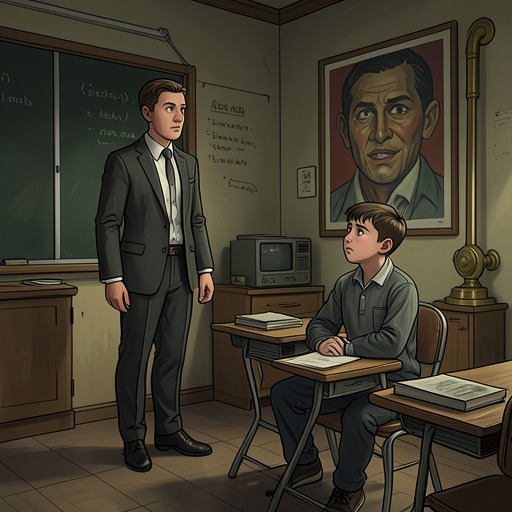
The reporter arrives with a photographer on a morning devoted to group PowerPoint presentations about To Kill a Mockingbird. Tony Danza has assigned seven research topics: the Jim Crow Laws, Harper Lee, a trial in the U.S. legal system, the Great Depression in Alabama, its effect on the Black community, capital punishment, and the Scottsboro Boys. Because students in a public school cannot simply be assumed to have computers at home, the class uses a COW, or computers on wheels, a cart carrying thirty Apple laptops. The cart must move around the school, making the projects cumbersome and slowing their completion, but the assignment also gives students a way to connect literary study with legal, historical, and racial questions.
Tony Danza expects some presentations to be late, yet he hopes the creative work will display both his students’ talent and his classroom management. The reporter and photographer leave after what seems to have been an entertaining period. David Cohn responds with an earthy compliment that suggests Tony Danza has survived a difficult performance in front of outsiders, and Tony Danza credits Emmie with helping him through it. The scene briefly resembles the kind of success television wants: a teacher under pressure, a visible classroom challenge, and a visitor whose judgment matters.
The Newspaper’s Account
The next morning, Tony Danza opens the Philadelphia Inquirer and finds a sharply different version of the visit. The report begins by stating that he was having a bad day. A laptop malfunctioned, few students were ready to present, and the class became restless, giggly, and distracted. Students responded to the new reading assignment with snickers and moans. Rather than hiding these failures, the newspaper identifies them as ordinary features of school life.
The report’s central comparison is that the class was "a typical day in a typical high school class—with a typical teacher." Its significance lies in the refusal to treat an imperfect lesson as a scandal or a television climax. The account acknowledges the disorder, then notes that all the groups eventually submitted their PowerPoint presentations. The students’ work therefore becomes the measure of the period’s outcome, not the smoothness of the performance before the reporter or the immediate dramatic value of the footage.
Media, Evidence, and Education
The Philadelphia Inquirer’s account stands within a larger struggle over how classroom life is represented. The producers of Teach want drama, and Leslie Grief complains after a peaceful Washington, D.C. field trip that there was "nothing" for the show because the students were engaged and learning. Tony Danza, by contrast, regards that apparently uneventful day as a success. The newspaper report offers a third position: it neither turns the classroom into an idealized educational showcase nor invents a crisis, but documents the friction, distraction, technical failure, and eventual completion that make up an ordinary lesson.
This contrast also clarifies the book’s recurring concern with media as a force that redistributes attention. Tony Danza uses production resources such as ultrafast Wi-Fi, YouTube, and classroom cameras to support instruction, while cameras elsewhere record conduct that would otherwise remain disputed, including Howard’s phone-assisted cheating and the hallway assault on Pepper. The Philadelphia Inquirer operates differently. Its reporter and photographer observe briefly, then publish an account whose authority comes from acknowledging what television usually treats as unusable material: the laptop acting up, incomplete preparation, and students losing focus. The newspaper’s most consequential contribution is consequently not glamour or scandal but a concrete record of teaching as uneven work.
The organization also indirectly tests Tony Danza’s original ethical demand for responsible reality. He had insisted that students must come first, that the show should be filmed like a documentary, and that there should be no scripting, forced drama, or fake conflict. The Philadelphia Inquirer does not resolve the conflict between education and entertainment, but its report makes the difference visible. By presenting an ordinary bad day alongside the eventual completion of the assignments, it gives public recognition to learning that is partial, delayed, and unspectacular—the very kind of outcome that a ratings-driven production might be tempted to overlook.