School District of Philadelphia
I'd Like to Apologize to Every Teacher I Ever HadThe School District of Philadelphia functions in the book as both gatekeeper and pressure system: it must authorize Tony Danza’s unusual entry into Northeast High School, protect students from an inexperienced celebrity teacher, and judge the school through measures that often sit uneasily beside the daily work of teaching. Its decisions make the television project possible, but they also expose how institutional caution and performance accountability can narrow the time, freedom, and trust available to educators.
Institutional Gatekeeping and the Television Project
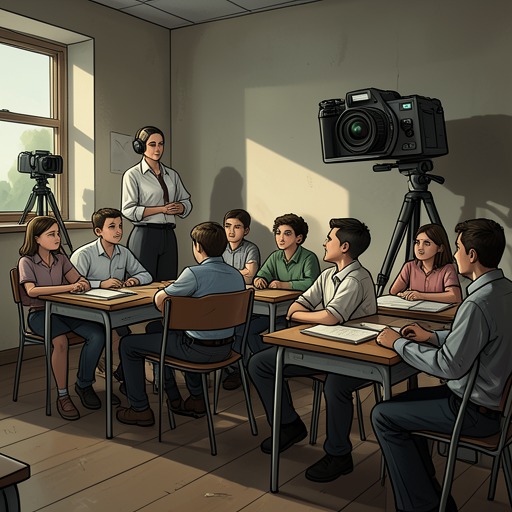
The district’s permission is not automatic. The production team approaches school systems across the country, including districts in New York, Baltimore, Chicago, Dallas, Atlanta, Washington, D.C., Los Angeles, Pittsburgh, and Newark, but none is willing to admit a celebrity teacher accompanied by cameras. Philadelphia becomes the exception only after Sharon Pinkenson, who leads the city’s film and television production office, persuades Mayor Michael Nutter that the project might help the city’s schools. Danza and Leslie Grief then present the proposal to the mayor, Superintendent Dr. Arlene Ackerman, and the Philadelphia School Reform Commission. The process lasts for months, and unfavorable press intensifies the district’s public risk; one report accuses Danza of exploiting Philadelphia’s children to revive his acting career. The eventual approval is cautious rather than celebratory. The School Reform Commission grants Danza one double period each day with a single tenth-grade English class of twenty-six fifteen-year-old students. That teaching load is only one-fifth of what regular teachers carry, a limitation that the commission makes clear is a condition of its willingness to proceed rather than a faithful representation of the profession. The district therefore permits the experiment while carefully containing it: the project can occur, but only within a reduced timetable and under explicit institutional supervision.
Student Protection and Supervision
The district’s most visible safeguard is David Cohn. During negotiations, the school board points to a sign in its meeting room asking, “WHAT IS BEST FOR THE STUDENTS?” Danza answers that, as the father of a teenage daughter, he intends to give his Northeast students the same quality of education he wants for her. To make that promise enforceable, the producers agree to pay for a veteran teacher to observe him and ensure that the class receives an effective tenth-grade English course of study. David initially feels like an unwanted set of training wheels to Danza, but the orientation makes clear why the district regards supervision as necessary: the novice teacher is prepared for problems ranging from classroom management to the possibility of a student spitting in his face. The supervisory relationship also establishes a boundary between television’s needs and the district’s educational responsibility. David watches Danza’s first class collapse from the back of the room and then approaches him with consolation, but his role is not merely emotional support. He repeatedly redirects Danza away from the desire to be liked and toward the obligation to make students participate in their own education. When Danza worries that some students do not want to work, David distinguishes unwillingness to work from unwillingness to learn and insists that teaching is not a popularity contest. The district’s intervention thus gives institutional form to a pedagogical principle: students cannot simply be performed for, and a teacher cannot learn or participate on their behalf. The district also enforces ordinary professional duties that Danza’s television identity initially obscures. After his class misses other lessons for a field trip to Washington, D.C., Ms. DeNaples summons him to the office because he failed to notify the students’ other teachers. She explains that attendance affects classroom momentum and that notifying faculty was his responsibility, not something to be left to the students. Danza must apologize personally and ensure that the failure is not repeated. This correction is small beside the district’s larger policies, but it is revealing: institutional accountability operates through routine coordination as much as through public testing or formal sanctions.
Accountability, AYP, and the Threat of Takeover
The district’s most consequential presence is its accountability regime. At the start of the school year, Linda Carroll explains that schools must meet Adequate Yearly Progress under the No Child Left Behind framework. Failure to raise test scores sufficiently can lead to a district takeover and the dismissal of teachers and staff. The resulting Renaissance School model is presented as reform, but its practical meaning is replacement: outside management consultants, district advisers, or charter-school operators can displace the existing school community. One teacher summarizes the logic as replacing old insiders with new outsiders. The Pennsylvania System of School Assessment makes this pressure concrete. The statewide test measures reading, writing, mathematics, and science in the students’ junior year, yet the results are used to assess the school’s overall Adequate Yearly Progress. Northeast High School missed its 2009 target, so every class is drawn into preparation for the 2010 practice and official tests. A teacher’s dark suggestion that students might perform badly enough to get the administration fired prompts a special auditorium meeting. Carroll warns that failure threatens not only administrators but every employee: Northeast could be classified as a failed school, taken over by the superintendent, staffed anew, and possibly converted into a charter school. When the real tests are administered, Northeast improves in every category except writing but still fails to reach its AYP target. The school is renamed an Empowerment School, an institutional euphemism that masks its movement closer to Renaissance School status. The district responds with more professional-development meetings, more auditor walk-throughs, more reading and mathematics assessments, and intensified demands to perform. Parents are notified that Northeast has not made AYP and are given the opportunity to transfer their children elsewhere. The consequences extend beyond evaluation: teachers feel watched, humiliated, and exhausted, conditions that the narrative presents as counterproductive to the lively, trusting classrooms in which students learn best. The fairness of the district’s measurement is also questioned from within the school. Carroll suggests that Northeast’s scores may include children in its designated region who do not actually attend the school. In that account, the district and state attribute responsibility for a broader population to Northeast while judging the staff by a single institutional score. The result is a mismatch between the school’s lived work and the statistical object constructed for accountability: teachers are held responsible for outcomes over which the school may not possess complete control.
Policy, Teaching, and Institutional Contradictions
The district’s formal priorities repeatedly collide with the conditions required for thoughtful teaching. Danza imagines a “Three-Fifths Solution” in which each teacher would handle three classes rather than five, leaving more time for preparation and individual follow-through. He recognizes that the proposal would be expensive, but regards it as possible if education were treated as a genuine national priority. The district’s actual system instead places extraordinary weight on test scores, even though Danza’s classroom practice depends on slower forms of work: designing accurate quizzes, teaching interpretation and figurative language, encouraging debate, and helping students connect literature to their lives. That conflict appears in the difference between classroom assessment and district assessment. Danza learns that even a short quiz requires careful construction: students must know plot structure and mythology while also practicing concise writing, accuracy, higher-level thinking, and interpretation. His comprehensive examination on Of Mice and Men must address story, characters, vocabulary, tone, mood, imagery, and figurative language rather than merely rehearse likely test answers. By contrast, the district’s AYP process compresses the school’s educational condition into annual standardized results. The book does not reject evaluation altogether; it shows instead how a narrow, high-stakes measure can crowd out the very engagement that meaningful education requires. The same institutional tension surfaces in curriculum and participation. David urges Danza to involve students in their own education. Danza responds by turning a creation-myth assignment into collaborative performance, replacing a health do-now with a debate over the school uniform policy when students show strong opinions, and using rap about Harriet Tubman, Rosa Parks, Harriet Beecher Stowe, and social justice to provoke discussion. He also gives Monte, a demanding student who believes the class is sacrificing scholarship for disengaged classmates, an entire period to design and teach his own lesson through the Student Teacher program. These activities make students producers of knowledge rather than passive recipients, but they depend on teacher discretion and time—resources made more precarious by the district’s surveillance and testing demands.
Meaning and Limits of Institutional Authority
The School District of Philadelphia is neither presented as a simple villain nor as a reliable guarantor of educational justice. Its officials create necessary safeguards, insist on professional responsibility, and keep student welfare visible in the negotiations. At the same time, its risk-averse approval limits Danza’s teaching load, while its accountability structure threatens jobs, invites outside takeover, multiplies audits, and encourages the school to treat performance data as the decisive sign of worth. The district’s authority therefore shapes the book’s larger argument about public education. It protects students from an experiment that might otherwise place publicity before learning, yet it also belongs to a system in which institutional survival can become synonymous with annual scores. The television project itself mirrors this contradiction: Danza insists on documentary observation, no scripting, and putting the students first, while producers press for manufactured conflict because ordinary learning is considered insufficiently dramatic. In both cases, an institution claims to serve reality but is tempted to reorganize reality around what can be measured, sold, or defended. The district’s significance lies in that unresolved pressure: education requires accountability, but students cannot be reduced to the indicators by which institutions protect themselves.