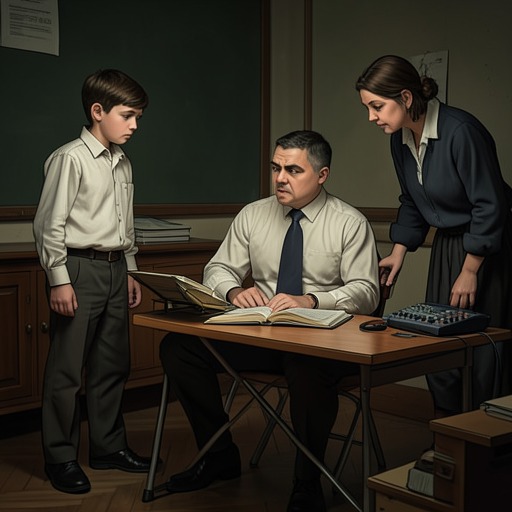
Stephanie
I'd Like to Apologize to Every Teacher I Ever HadStephanie’s conflict with Ileana is one of the clearest instances in which private adolescent hurt spills into the classroom and begins to obstruct learning. Once best friends, the two girls become locked in a feud that forces the teacher to confront not only their anger but also the social history beneath it. Stephanie’s role is significant because she embodies the wounded friend’s movement from rejection and threatened retaliation toward a structured attempt at being heard.
Identity and Introduction
Stephanie is presented as soft, pale, and understated in contrast to Ileana’s dramatic black clothing, heavy eye makeup, extreme hairstyles, and lip piercing. The contrast is more than visual description: Stephanie remembers Ileana as someone who was once “all colors and always happy and always got along with everybody,” while now seeing her as “all dark and mean.” Her language reduces the change to a sharp opposition between a former good friend and a present hostile one, revealing how thoroughly the feud has divided her understanding of Ileana.
The friendship had lasted three years, which gives Stephanie’s anger a history deeper than the immediate classroom incident. She insists that she had not provoked Ileana and explains that when Ileana asked for help, receiving it should not have led to cursing and name-calling. Her account presents herself as the wronged party, but it also shows how little access she initially has to the other girl’s sense of exclusion and betrayal.
The Classroom Rupture
The conflict erupts when Ileana refuses to read from the same handout as Stephanie. The teacher, unaware of the depth of the dispute, gives a brief lecture about the class being like a family and needing to share. Eric tries to solve the immediate problem by offering his own copy to Ileana so the girls will not have to work together, but the intervention fails: the teacher tells him to mind his own business, and Stephanie ends up in tears.
After class, the teacher speaks with Stephanie privately. She is angry enough to border on irrationality, yet the teacher recognizes that such conflicts can feel like matters of life and death to sixteen-year-olds. The response is deliberately practical rather than punitive: Stephanie is urged to focus on taking care of herself, completing her work, and making things happen for herself instead of allowing the feud to consume her. She calms enough to attend her next class, but the underlying dispute remains unresolved.
Escalation and Absolute Blame
The next day, Stephanie returns after lunch sobbing and reports that Ileana spat on her. She calls the act the highest level of disrespect and says that, if she sees Ileana, she will kill her. Given water and tissues, she remains too distressed to be helped by reassurance alone. When the teacher asks what she thinks the best solution would be, Stephanie answers, “She’s dead.” The bluntness of the response converts injured pride into an expressed fantasy of annihilation, showing how completely the friend has become an enemy in Stephanie’s immediate emotional world.
Her account is later complicated by Eric, who comes to the teacher alone because he is worried about Ileana. He explains that Ileana also feels betrayed and suggests that the roots of the conflict reach back to the beginning of the year, when Stephanie became friends with Crystal and Ileana felt excluded. This information does not erase Stephanie’s pain or establish that her accusation is false, but it reveals that the quarrel is reciprocal rather than one-sided. The teacher’s concern shifts from deciding which girl is right to preventing the drama from interfering with either student’s education, while also warning Eric, an honor student, not to be pulled into it.
Mediation and Narrative Significance
The teacher concludes that the two girls must meet and talk, but arranges professional support rather than attempting to manage the confrontation alone. In the school counselor’s office, Ms. Morton establishes rules requiring one girl to speak at a time while the other listens, ensuring that both will have an opportunity to tell her side. The meeting gives Stephanie’s grievance a formal setting, but it also places her certainty under pressure by making room for Ileana’s account.
Ileana begins by denying that she spat on Stephanie, explaining that she did not even have any water. Stephanie immediately interrupts, insisting that water flew into her face while Ileana happened to be standing beside her. Their exchange preserves the central ambiguity of the incident: the emotional consequences are certain, but the precise action remains contested. Stephanie’s importance lies in this tension. She is neither reduced to a victim nor detached from the harm caused by her rage; instead, she is shown inside the painful, unstable process of trying to turn betrayal into language and language into a possible resolution.