Student Teacher program
I'd Like to Apologize to Every Teacher I Ever HadThe Student Teacher program is a classroom experiment in shared authority that allows a student to design and lead an entire lesson. Tony Danza creates it for Monte, whose demand for stricter standards exposes a central problem in Danza’s teaching: his determination to keep disengaged students participating may be compromising the education of students who are already ambitious and academically focused. The program therefore tests whether authority can be learned by being exercised rather than merely discussed.
Origins and Purpose
Monte’s criticism emerges during the class’s study of To Kill a Mockingbird. He considers the novel too easy, objects to the time Danza takes to complete it, and complains that Danza repeatedly loses control of the room. Other students resent having to submit work on time when classmates face no comparable consequences, while Danza hesitates to impose severe discipline because he fears driving the least engaged students out of participation altogether. Monte’s grim concentration makes the cost of that compromise unmistakable: Danza’s attention to students who “can’t be bothered” may be weakening the scholarship of a student aiming for Princeton.
Monte appears to believe that the class could be brought into line if he were placed in charge. Danza responds by granting the request rather than simply defending his own methods. He promises Monte one full period in which Monte will create the lesson plan and set assignments and standards as demanding as he wishes. The arrangement gives Monte autonomy, but it also places him inside the same institutional contradiction that Danza faces every day: a teacher is expected to maintain high standards while persuading students who may resist the work, the rules, or the authority behind them.
Structure and Classroom Operation
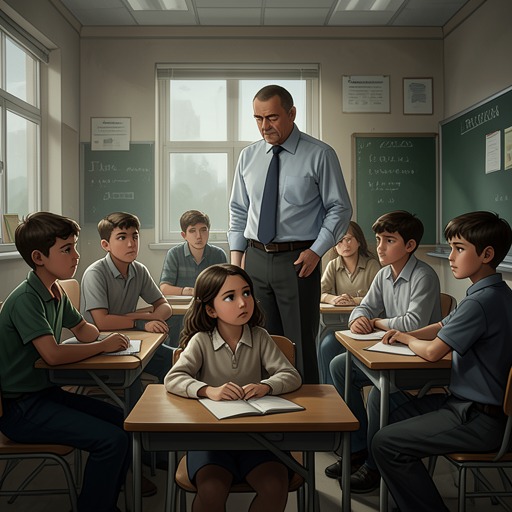
The program is not an informal invitation to help with one exercise. Monte receives an entire class period and responsibility for its intellectual design. A week later, he arrives prepared, begins with a legal-terms worksheet drawn from the trial in To Kill a Mockingbird, and builds the main lesson around the qualities and interactions of the characters during that trial. His choices show that he understands academic rigor as more than reprimanding students. He selects specific textual material, establishes a task, and asks the class to analyze character and conduct.
Danza’s wider teaching philosophy gives the experiment its context. In conversation with David Cohn, he learns that liking a teacher may make students more receptive, but that teaching is not a popularity contest; students must ultimately become involved in their own education. The Student Teacher program extends that principle from student participation in assignments to participation in classroom governance. It also resembles Danza’s other attempts to make learning active: he pairs students to compose and perform creation myths, turns disagreement over the Northeast High School uniform policy into a debate, and transforms review for an Of Mice and Men examination into a six-station scavenger hunt. In each case, students are asked to do more than receive information. Monte’s period asks one student to assume responsibility for producing the learning environment itself.
The Test of Authority
Monte’s lesson quickly reveals how different authority feels from the student side of the room. The class does not reward his preparation with automatic respect. Matt takes his customary walk around the room and laughs when Monte tells him to sit down. Chloe and Katerina discuss spring sandals while Monte analyzes Atticus Finch and Heck Tate. Eric Choi sits corkscrewed upside down in his chair, and Eric Lopez writes a love note to Ileana instead of attending to the lesson. The interruptions are not abstract resistance; they are small, visible acts that consume the teacher’s attention and make orderly instruction difficult.
Danza is present but deliberately constrained. When he tries to tell the students to quiet down and give Monte a chance, the rules of the program prevent him from rescuing the lesson. Charmaine immediately points out that Monte is the teacher and therefore must make the class comply. Her objection is both mischievous and exact. Danza has transferred authority to Monte, so intervening whenever the experiment becomes uncomfortable would turn the exercise into a performance of student leadership without its actual burdens.
Monte soldiers through the period, but the effort leaves him depleted. Danza compares his condition to a tire with a slow leak: by the bell, he is running unevenly and nearly worn out. The image registers the hidden labor of teaching—maintaining attention, managing interruptions, explaining material, and absorbing disrespect—more effectively than Monte’s earlier criticism could. The student who thought control was mainly a matter of stricter standards discovers that standards require continuous labor to make them actionable.
Debrief and Reconciliation
After the class empties for lunch, Monte remains seated while Danza conducts a debrief modeled on the guidance David usually gives Danza. They review what worked, identify what Monte would change, and then reverse the usual direction of advice by considering what Monte has learned that might help Danza. The program thus becomes a reciprocal exercise rather than a punishment or a demonstration designed to prove Monte wrong. Danza does not erase Monte’s concerns; he makes Monte experience their practical consequences.
Monte’s most important insight comes through Atticus Finch’s explanation to Scout that a person cannot truly be understood without considering that person’s point of view and imagining life in another’s skin. The lesson gives the Student Teacher program its ethical center. Monte has judged Danza’s classroom from the standpoint of the diligent student who wants uninterrupted instruction and strong academic expectations. Leading the class forces him to encounter the standpoint of the teacher, whose decisions are shaped by competing obligations: discipline, access, participation, and the fear that a harsh response may cause vulnerable students to withdraw altogether. Danza then asks whether Monte would consider a truce, turning literary perspective-taking into a direct change in their relationship.
Significance in Danza’s Teaching
The Student Teacher program demonstrates that classroom authority is relational and experiential. Monte’s intelligence and preparation are real, but they do not automatically translate into influence over peers. Conversely, Danza’s concern for participation is not simply softness; it is an attempt to keep students connected to school even when their performance is uneven. The program makes both positions more complicated by forcing each participant to confront the work and limits behind the other’s conduct.
The experiment also distinguishes genuine student agency from passive compliance. Danza’s students are repeatedly asked to debate, perform, interpret, and connect literature to their own lives, while tests are designed to require higher-level thinking rather than mere rehearsal of answers. Yet the Student Teacher program adds a sharper question: can students participate in their own education while also seeing how educational authority is constructed and maintained? Monte’s period suggests that they can, but only when responsibility includes the possibility of failure, frustration, and revision.
Its final effect is therefore not that Monte successfully controls the class. He does not. Nor does Danza abandon his concern for students who struggle or disengage. Instead, the program converts conflict into knowledge. Monte learns that demanding instruction must be accompanied by the difficult work of securing attention, and Danza gains a student’s informed criticism rather than a student’s detached disapproval. Their proposed truce marks the program’s lasting achievement: authority becomes less a contest between teacher and student than a shared problem that can be examined from more than one point of view.