Student poverty and housing insecurity
I'd Like to Apologize to Every Teacher I Ever HadStudent poverty and housing insecurity are not presented as a single circumstance shared by every student at Northeast High School. They appear instead in particular pressures that enter school with students: hunger, a cold night after electricity is cut off, parents’ unemployment, unsafe homes, and the possibility of homelessness or Foster care. These conditions affect what students can manage in class, and they expand teaching into work as counselor, advocate, and source of immediate practical support. The book’s examples also mark the limit of that support: teachers can listen, offer food, and try to keep a student connected, but cannot by themselves remove the conditions weighing on a family.
Conditions Brought into School
In the teachers’ lounge, veteran staff describe students who arrive hungry, come in late after gunfire outside their bedrooms has kept them awake, or remain silent in class because of abuse at home. Some teachers, they say, have come close to adopting students in an effort to keep them from falling into Foster care or homelessness. One teacher calls this impulse an Adoption fantasy, a name that captures both the depth of educators’ concern and the scale of the need they face. These are staff members’ accounts of students’ lives, not a claim that every student experiences the same hardship.
The teachers compare these circumstances with their own memories of high school. They recall walking home without fear of being mugged, and parents who pressed them to do well and go to college, even when those parents had not attended college themselves. The contrast makes clear what may be missing for some students now: safety, stability, and consistent adult support. One teacher argues that schools, especially poorer schools, must compensate for much of what is absent from students’ lives, even as politicians discuss reducing education costs. The observation frames poverty not only as a private family problem, but as a condition that increases the demands placed on schools and their staff.
Material Hardship and Attendance
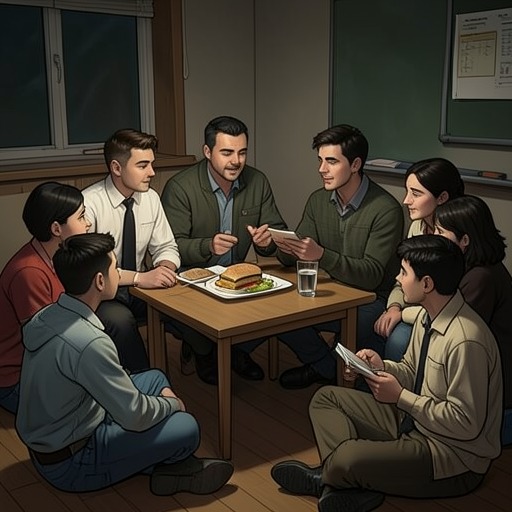
The narrator’s informal advisory role gives these broad concerns a concrete form. Students begin seeking him out in hallways, the cafeteria, and his classroom. Some come because he has air-conditioning; he also gives half sandwiches to students who need lunch. A late arrival may be a student who is usually dependable but has spent the night in a home without electricity, where the cold made sleep difficult. In that situation, the response described is sympathy and a note to excuse the student’s late return to class. The small intervention recognizes that lateness can arise from circumstances beyond a student’s control, though it cannot restore electricity or undo the night’s disruption.
Phil’s circumstances show a different path from hardship into academic disengagement. One of four boys who routinely roam the large school rather than attend class, he tells the narrator that he has no father, that his mother is on her own, and that his older brothers have all been in trouble. He challenges the assumption that the adults around him expect anything different. At lunchtime he starts visiting the narrator, who gives him half a sandwich and then asks for his class roster. The narrator learns that Phil is failing all his courses because he rarely attends; one teacher says he has cut class every day since the school year began, and another reports more than sixty unexcused absences.
The narrator asks Phil’s teachers for missing assignments and offers to help him complete them, knowing that each teacher has many other students to serve. Their willingness to cooperate gives Phil a chance to reconnect with coursework, but the effort does not erase his accumulated absences or the pressures around him. After he is charged with credit card fraud involving a stolen Visa card, he tells the narrator he may face a three-year jail sentence. He is beginning a night-school program for students who work or have other difficulties and want a General Educational Development certificate, but he feels too far behind to catch up. The narrator urges him to show the judge that he is trying; Phil says he understands, while the narrator fears he is already slipping away. The episode presents educational support as consequential but uncertain: access to assignments and an adult advocate cannot guarantee that a student will be able to recover lost ground.
Family Instability and Academic Strain
Gwen’s difficulty begins with a change at home rather than an absence from school. When her work stops reflecting her usual performance, the narrator asks whether something is troubling her. She eventually explains that her father has lost his job, cannot find work, and has largely stopped looking. Her mother, a nurse, takes double shifts, and the parents fight. Gwen says that she and her father used to be close but that he now seems like a different person. The account links employment insecurity to strain within a family and to a student’s changing relationship with a parent; it does not reduce Gwen’s problem to a simple academic failure.
The narrator responds by telling Gwen that he himself was fired the previous year. His disclosure offers a point of connection, but the conversation’s force comes from the specific change Gwen describes: unemployment has altered her father’s behavior, her mother’s workload, and the atmosphere at home. The book shows that such pressures can become visible at school through a student’s work and emotional state, even when the underlying problem is outside the classroom.
Courtney’s story offers a contrast. She is a popular, bright senior who sings in the choir and acts in school plays, yet arrives in tears because she believes she will not graduate after failing physics. The evidence does not identify her difficulty as poverty or housing insecurity. Her case nevertheless helps define the narrator’s informal advisory work: students may bring serious, immediate problems that are not apparent from their usual reputation or performance. He connects Courtney with Kelly Gould, a physics major, and supports a project that breaks a daunting task into manageable steps. Courtney builds a Rube Goldberg device that switches on a hair straightener and earns an A. Unlike Phil’s increasingly severe setbacks, her academic crisis is met with time, support, and a successful route back into the work.
Care, Schooling, and Structural Limits
The book describes advisory as a period when teachers act as counselors, friends, and surrogate parents as well as instructors. A teacher in the narrator’s small learning community observes that counseling can take up more of the job than teaching, particularly in poor schools where staff are expected to pick up slack left by less involved parents and respond to students with problems. The unofficial advisees who gather in the narrator’s room make that claim tangible: they come at the start of the day, during lunch, or whenever they can obtain a hall pass. The narrator sometimes has to write notes explaining their late return to class, while recognizing that the circumstances behind a visit may be more serious than a missed period.
This care is practical and relational rather than a substitute for material security. A sandwich meets an immediate need; an excused-lateness note acknowledges a difficult night; a teacher’s request for missing assignments can reopen a path into class. Yet the story repeatedly sets those acts beside problems beyond any one teacher’s reach: hunger, housing conditions, family conflict, prolonged nonattendance, and the prospect of homelessness or Foster care. Its central tension is therefore not between caring and indifference, but between the effort to help one student at a time and the larger conditions that make such intervention necessary. The teachers’ accounts and the narrator’s encounters show both the value of school-based support and how often students are asked to learn while carrying instability from home.