Take Part in Your Own Education
I'd Like to Apologize to Every Teacher I Ever HadTake Part in Your Own Education is both a posted classroom command and the governing idea of Tony Danza’s teaching year at Northeast High School. It asks students to move beyond receiving information from a teacher and become active participants in producing understanding. The phrase begins as part of Danza’s carefully prepared classroom environment, but its decisive significance emerges when his students repeat it in their own writing and actions, proving that a slogan has become remembered knowledge.
A Slogan Made Into a Classroom Rule
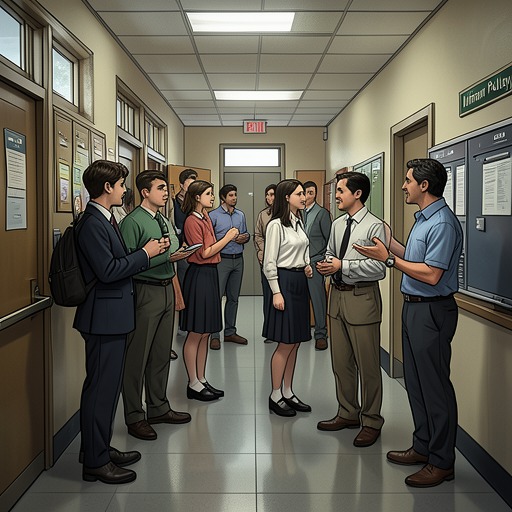
Take Part in Your Own Education appears in large letters above Danza’s blackboard, alongside banners such as “THE ONLY PLACE SUCCESS COMES BEFORE WORK IS IN THE DICTIONARY” and “NO MOANING, NO GROANING.” He has scrubbed the institutional beige room, dusted the bookshelves, cleaned the windows, installed hand-sanitizer dispensers during the swine flu epidemic, and covered the walls with encouraging blue paper. The phrase therefore enters the year as part of an intentional declaration of care and expectation: students are being invited, and also instructed, to regard school as something in which they must participate rather than merely endure.
The slogan also exposes an early tension in Danza’s method. He wants the students to like him and sometimes talks so much that he seems to perform the class instead of teaching it. David Cohn tells him that he cannot learn for the students and that teaching is not a popularity contest; the essential task is getting students involved in their own education. Danza recognizes the irony that he has displayed this principle on the wall while violating it in practice. The physical sign becomes a standard against which his own teaching is measured.
From Lecture to Active Participation
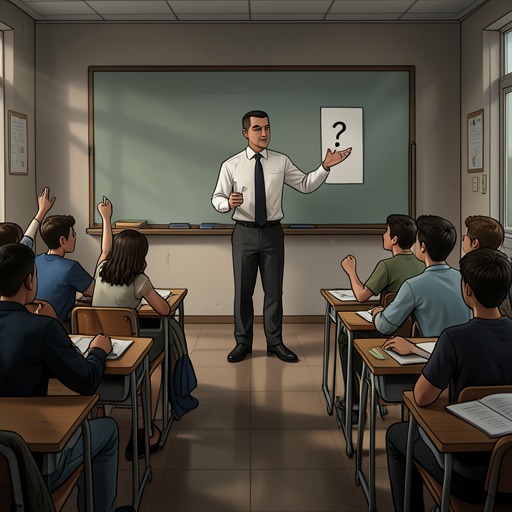
David Cohn’s criticism gives the phrase its operational meaning. He tells Danza to “Get out of the way” and let the students do the work, describing the necessary method as “More with less.” Later he identifies the decisive principle as “Active participation”: when students make an activity happen, they learn, whereas when the teacher does all the talking, students are more likely to tune out and look for their BlackBerries. The contrast is not simply between entertaining and boring lessons. It is between a classroom organized around the teacher’s voice and one in which students’ voices, choices, and actions carry the intellectual work.
Danza repeatedly redesigns lessons around that distinction. For a creation-myth assignment, he pairs students to invent and perform their own myths after the class reads the story of Anansi, the trickster spider credited in Ashanti legend with creating the sun, stars, and moon. Eric Choi and Ben-Kyle present “The Magic Button Myth” with a paper button marked “DO NOT PUSH,” turning literary concepts into a shared performance and giving the shy Eric an unexpected experience of public praise.
The same principle governs Danza’s Of Mice and Men review. Instead of delivering another lecture, he announces a scavenger hunt, divides the class into six teams, and prepares maps, passports, challenge sheets, Post-its, Sharpies, sand-filled burlap bags, and live hamsters to stand in for the book’s dead mice. Teachers, guards, and other staff members become station monitors. At six locations around the school, students must complete literary challenges, receive passport stamps, follow clues, remain together, obey safety rules, and demonstrate integrity. The test review thus makes knowledge mobile, collaborative, and accountable: students learn by navigating the activity rather than listening to an explanation of what they are supposed to know.
The approach extends beyond conventional English exercises. When the students erupt over the Northeast High School uniform policy, Danza abandons his planned physical-fitness prompt and asks them to explain their opinions. Their writing has unusual energy and conviction, so he organizes a debate and lets the disagreement generate the lesson. A poetry contest modeled after American Idol requires each student to choose and memorize a poem of at least ten lines, research its author and historical context, create an explanatory poster, and perform before classmates and teacher judges. Even the promised prizes, including a Flip Video camera and cash, become instruments for drawing students into an activity whose deeper demands are interpretation, preparation, memory, and performance.
Agency, Incentive, and the Limits of Participation
The phrase does not imply that every form of engagement is equally deep. Danza uses competition, humor, novelty, physical activity, and rewards to overcome student disengagement. A boxing lesson with Matt begins when Danza installs a cobra punching bag in a visitors’ locker room. Matt is excited by the prospect of punching the bag, but the lesson quickly attracts about a dozen boys and girls, including both football players and nerds. Danza demonstrates a seven-punch combination, and the students’ applause establishes a temporary community around skill, movement, and attention. Participation here begins with an object and an appetite for action, then becomes an opportunity to learn through doing.
Reading produces a different route into the same principle. Danza uses Twilight to show that books are stories rather than merely boring print. The forbidden love between Bella and Edward resonates with students who recognize its mixture of attraction and fear, and even students who resist Steinbeck begin to respond to reading through a narrative that feels accessible to them. The goal is not to replace demanding literature with popular entertainment. It is to create enough interest for students to cross the threshold into sustained reading, after which quizzes and discussion can become possible.
Brittiny’s reading sessions reveal the relational dimension of agency. She can do the work but chooses not to, and Danza does not know what she has experienced at home. He begins reading with her, and as they move deeper into the book, her confidence rises along with her enjoyment. Brittiny tells him that few people believe in her and that she wishes she could be in his class for a day. Danza answers with faith in her, while keeping the focus on the positive work in front of her. The exchange shows that participation depends not only on assignments or incentives but also on a student’s sense that effort will be noticed and that success is imaginable.
Responsibility and Moral Choice
Take Part in Your Own Education also carries an ethical meaning. Danza’s confrontation with Al G makes participation a matter of choice rather than classroom enthusiasm. After Al G returns from a three-day suspension, Danza catches him openly cheating on a makeup test, with his book open on the floor beside his desk. Instead of immediately seeking another suspension, Danza offers a conditional agreement: Al G must apologize, say that he wants to do the work, and promise to do his best for the rest of the year. After repeated resistance, Al G complies, acknowledging that another suspension will not benefit either of them.
The following lesson on moral development gives Al G’s statement a larger framework. The class considers six stages, ranging from behavior motivated by avoiding pain or gaining rewards to action guided by personal principle and concern for others. Students place themselves at stages shaped by friends’ opinions or obedience to rules, while identifying Atticus Finch with the highest development in To Kill a Mockingbird. Al G concludes that he is stuck at Stages One and Two because he acts only for reward or to avoid punishment. His admission is limited, but it is also an act of self-recognition: he names the motive behind his behavior instead of hiding behind defiance. Participation here means accepting responsibility for the choices that determine whether education can occur.
Monte’s Student Teacher program supplies a contrasting experiment. Frustrated that the class moves too slowly and that Danza’s attention to disengaged students compromises the scholarship of students such as himself, Monte wants authority. Danza gives him one entire period to design a lesson, with demanding assignments and standards. Monte prepares a legal-term worksheet and a lesson on character qualities and interactions during the trial in To Kill a Mockingbird, but the class treats him as harshly as it treats Danza. Matt walks around, students talk about sandals, Eric Choi twists upside down in his seat, and Eric Lopez writes a love note to Ileana. Monte’s failure teaches him that control alone cannot produce participation. His later handshake with Danza marks a new understanding: teaching is not simply the power to demand attention but the difficult work of reaching one student at a time.
When Students Return the Lesson
The principle reaches its clearest confirmation at the end of the year. After grading the final examination, Danza discovers that no one has failed his class, that all three of his IEP students have performed better than he expected, and that Matt’s grade is weaker than it should be but not a total defeat. The results leave him caught between exhilaration and exhaustion, because the exam has become evidence about both student learning and his own ability to teach.
The final essay asks students to identify the most important lesson they learned during the year. Their answers show that the classroom’s central messages have moved from Danza’s voice into the students’ own written language. Nakiya writes, “Make the best of a baaaad situation.” Ben-Kyle writes that “books are more than books. They are stories, too.” Most decisively, “Take part in your own education” appears in Al G’s loopy cursive. The phrase that once decorated the wall is now reproduced by a student who had cheated, accepted punishment, and admitted that his actions were governed by reward and fear.
That recurrence changes the expression from a slogan into a measure of transmission. Danza sees that students have heard and remembered not only the formal curriculum but also the principles repeatedly tested in their conduct: participate, work, read, speak, and assume responsibility. The final essays do not prove that every student has become fully self-directed, but they demonstrate that the command has acquired a life beyond the teacher’s display. Take Part in Your Own Education names the book’s central educational wager: meaningful teaching succeeds when students cease to be the objects of instruction and become the people who carry the lesson forward.