The Northeast High truancy patrol
I'd Like to Apologize to Every Teacher I Ever HadThe Northeast High truancy patrol is Tony Danza’s first sustained encounter with Northeast High School as an institution rather than merely a classroom. Assigned by Ms. DeNaples to police lateness and escort stragglers into school, he discovers that attendance enforcement requires repeated confrontation, emotional self-control, and judgments about responsibility. The patrol strips away the protective glamour of his television persona: before he can teach effectively, he must learn to perform one of the school’s most difficult and least celebrated forms of daily labor.
Assignment and Institutional Setting
Ms. DeNaples, the assistant principal and school disciplinarian for both students and teachers, places Tony Danza on truancy duty after his failure to sign in properly. The assignment covers the first hour of every school day. He is expected to confront parents who bring their children late, tell them that getting to school on time is their responsibility, and personally escort tardy students across campus. Ms. DeNaples’s instruction is uncompromising: he must do whatever it takes, and he will work with her every morning for the rest of the week and periodically throughout the school year.
The patrol takes place in a school whose scale makes lateness difficult to contain. Northeast High School is Philadelphia’s largest high school, with a three-story brick building, trailers, multiple sports fields, its own football stadium, large gyms, a cafeteria, and even a Philadelphia police station. Its campus dates back to the 1840s, while the current building was erected in 1953. The vastness of the site turns attendance into a spatial problem as well as a disciplinary one: students can remain outside, gather in side alleys, move between buildings, or simply drift away before the school day has properly begun.
Encounters on the Patrol
Tony Danza initially dislikes the assignment because the students he must challenge are unlikely to welcome an unknown adult telling them where to be. He is also conscious that some of the tougher students intimidate him, with tattoos rising up their necks and deliberately aggressive postures. To borrow Ms. DeNaples’s authority, he plans to tell students and parents that she is watching him closely. The strategy exposes his dependence on institutional power: his celebrity can attract attention, but it cannot by itself establish legitimate school authority.
The first patrol reveals how widespread the problem is. Even after the bell rings, many students remain outdoors. Some race toward class, while others take their time. A group of smokers gathers in a side alley off Algon Street and refuses to move when Tony tells them to extinguish their cigarettes and go inside. He finally plants himself in front of them and orders them to give up the habit. Nearby, another group walks in the wrong direction, away from school. When he calls them back, they shuffle around and pretend not to hear him. Their arrival that day offers no assurance that they will attend the next day, making truancy appear not as an isolated lapse but as a recurring condition.
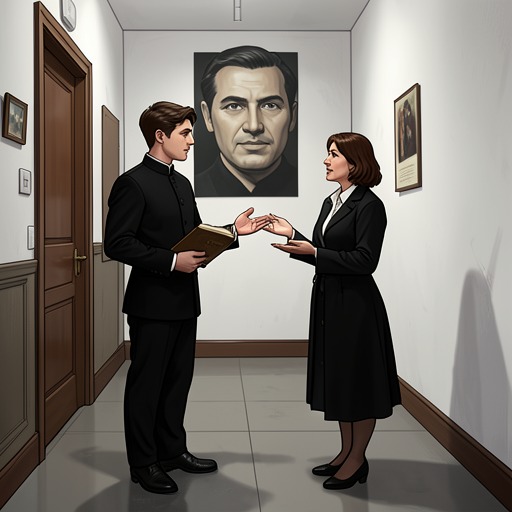
One encounter brings the problem into direct contact with family life. A battered Volkswagen Bug stops at the curb, and Tony opens the door for a red-haired boy wearing an Eagles sweatshirt. He urges the boy to hurry because Ms. DeNaples is on the warpath, then tells the boy’s mother that arriving twenty minutes late is unacceptable. Instead of defending the delay or apologizing, the mother asks Tony for his autograph. Tony agrees only on the condition that she bring her son to school on time from then on. She laughs, but he means the condition seriously. The exchange is comic on its surface and revealing underneath: the parent continues to see him as a television personality, while he is trying to make the encounter count as an act of school responsibility.
Rules, Authority, and Contradictions
The truancy patrol is shaped by a wider culture in which rules are visible but inconsistently enforced. Northeast posts codes governing uniforms, hoodies, iPods, running, shouting, and other conduct, yet students know that many violations produce no consistent consequence. Physical fights receive serious attention, while lesser forms of noncompliance are often allowed to continue. In Tony’s classroom, a teacher may tell students to remove hoodies or earbuds, but if they refuse, enforcing the rule requires involving the dean’s office and sacrificing valuable instructional momentum. The patrol therefore exposes the gap between formal policy and practical authority: the school has rules, but individual teachers often lack the time, backing, or procedural clarity to make them effective.
Ms. DeNaples’s own authority is presented as personal and institutional at once. Her position as assistant principal gives her disciplinary power, but her manner makes that power felt before any formal punishment occurs. Tony’s earlier failure to sign in brings him face to face with her, and the resulting unease helps explain why he accepts the patrol rather than attempting to evade it. He understands that refusing would undermine his credibility with colleagues and students. The assignment becomes part of his initiation into the school’s adult culture, where even a celebrity teacher must submit to routines that ordinary teachers have followed since early morning.
The patrol also clarifies the limits of punitive thinking. Tony can stop a student at a curb, interrupt smoking, or redirect a group walking away, but he cannot guarantee future attendance. His work addresses the visible moment of lateness without resolving the conditions that make school attendance unstable. The repeated nature of the assignment suggests that truancy is not defeated once a student crosses the threshold; it must be managed again and again through relationships, surveillance, reminders, and the willingness of adults to remain present.
Consequences for Danza’s Teaching Identity
The patrol changes Tony Danza’s understanding of what teaching entails. He enters Northeast High School hoping to contribute through classroom instruction, but the school requires him to perform attendance enforcement before the first lesson begins. The experience lets him see, in concrete form, what teachers and administrators confront every day: students who resist direction, parents who minimize lateness, rules that lack consistent force, and institutional problems that cannot be solved by one successful interaction.
This work contributes to the broader strain of his teaching year. After his television show is canceled, he is separated from his wife of twenty years, and only his youngest child remains at home in Los Angeles. He has begun to fear that he is running out of time and has returned to teaching partly to reclaim a path he once imagined for himself. The demands of school complicate that hope. While considering whether to travel home for Thanksgiving, he worries that his responsibilities at Northeast will leave little attention for his family. His elder daughter’s seemingly reassuring response makes him question how much of her life he has already missed and whether he can still understand her feelings.
By the end of the year, the emotional cost of caring has become explicit. When Lynn Dixon asks whether he will return to teach the following year, Tony admits that, at his age, he is not sure he wants to care so much about anything. Her reply—that caring is precisely what the work requires—recasts the truancy patrol as an early version of the year’s central challenge. Attendance enforcement is not simply a task to complete; it is a demand to keep investing in students whose immediate choices may offer no guarantee of lasting change.
Significance
The Northeast High truancy patrol establishes the school as a place where educational work begins before instruction and extends beyond the classroom. It reveals attendance as a daily contest among policy, family expectations, student autonomy, and adult persistence. Tony’s celebrity produces moments of irony, such as the mother who requests an autograph while being reprimanded, but it cannot replace the ordinary authority earned by showing up, accepting unwelcome duties, and returning to the same problem the next morning.
The patrol also foreshadows Tony’s eventual recognition that teaching is demanding precisely because its results are uncertain. Later, when Joe Connelly asks whether he will come back next year, Tony says he does not know, even though he already knows that he must return home and work on being a husband and father. He also admits that teaching is extremely hard work. The patrol is one of the first experiences to make that difficulty visible: it turns the school’s attendance crisis into a personal obligation, then shows why no single intervention can settle it.