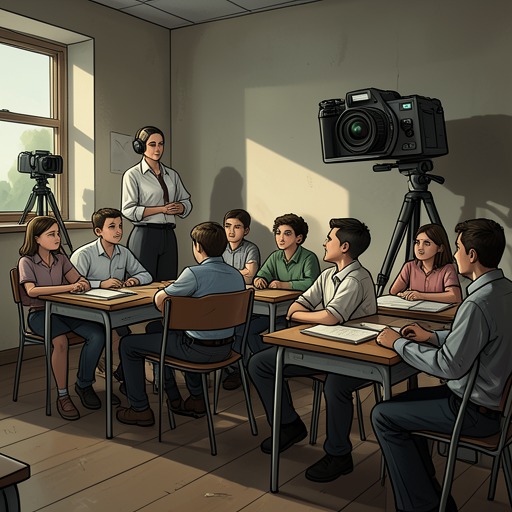
Tony Danza
I'd Like to Apologize to Every Teacher I Ever HadTony Danza is the central participant-observer of the book’s experiment in public education, entering Philadelphia’s Northeast High after the cancellation of his television talk show and attempting to become, in his students’ terms, Mr. Danza. His decisive discovery is that teaching cannot be reduced to performance or classroom technique: to engage students, he must accept responsibility for their work, conflicts, fears, families, and futures. The intimacy that makes the year meaningful also makes it exhausting, forcing him to reconsider what kind of teacher, parent, husband, and education advocate he can be.
Identity and Reinvention
Tony Danza begins the school year as a man crossing between incompatible public identities. In Room 230, he unlocks the door on the first day and confronts the fact that acting is no longer the governing metaphor: real students, real lives, and real educations will be at stake. Only fellow teachers may call him Tony at Northeast High; to students, he is Mr. Danza, a title that feels less like a costume than a new authority he must earn.
The teaching experiment follows a personal rupture. In 2007, Danza had hosted a live, one-hour talk show in New York City, broadcast on the ABC network between Live! with Regis and Kelly and The View. One of his proudest features, “School Room Makeovers,” supplied impoverished schools with equipment, including keyboards and brass instruments for a music department serving four hundred children with only six instruments. When the show was canceled, Danza’s wife separated from him after twenty years of marriage, his youngest child remained at home in Los Angeles, and the approach of sixty made him conscious of mortality; his father had lived only to sixty-two. Those losses redirected him toward an earlier ambition. He had earned a history degree and originally planned to teach before boxing and acting rerouted his career, while his television character on Who’s the Boss? had ultimately become a teacher. Real teaching offered a way to pursue that vocation rather than merely portray it.
A Teach For America documentary supplied the immediate emotional catalyst. Danza was moved by a Baltimore school production of Bye Bye Birdie, but especially by the camera’s sweep across an audience containing only about seven applauding people. In contrast with the packed performances he had known from his children’s private schools, that near-empty room made unequal educational support visible as a human absence, not merely a funding problem. His decision to teach therefore joins professional reinvention to a desire to do something that would make his children proud.
Entering Northeast High
Northeast High is not a small or symbolic classroom setting but Philadelphia’s largest high school: a campus dating to the 1840s whose current brick building was erected in 1953, with three stories, trailers, sports fields, a football stadium, cavernous gyms, a huge cafeteria, and even its own Philadelphia police station. Danza arrives as an outsider carrying cameras, celebrity, and uncertainty. His production team had approached districts in New York, Baltimore, Chicago, Dallas, Atlanta, Washington, D.C., Los Angeles, Pittsburgh, and Newark, but schools repeatedly refused to admit a “celebrity teacher” with a film crew. Philadelphia became possible through Sharon Pinkenson, Mayor Michael Nutter, Superintendent Dr. Arlene Ackerman, and the School Reform Commission, after months of negotiation and hostile publicity that accused Danza of exploiting Philadelphia’s children to revive a stalled career.
The school’s internal structure quickly teaches him that education is also an institution of routines, paperwork, and relationships beyond the lesson. Northeast is divided into eight Small Learning Communities, and Danza belongs to the Arts and Education SLC, led by veteran English teacher Lynn Dixon. Dixon has taught for more than thirty years in difficult Philadelphia schools and combines advocacy, mediation, administration, and practical maintenance. At daily second-period meetings she distributes deadlines, mandates, seminar schedules, planning requirements, and technology instructions; she also repairs the copy machine, manages the SLC’s unlimited-copy privilege, and keeps an office stocked with books, costumes, colored pencils, movies, magazines, Viking helmets, award certificates, and a life-size cutout of President Obama. Danza’s admiration for her clarifies how much labor politicians and media overlook when they imagine teaching as the hours spent in front of students.
His own entrance is marked by contradiction. Orientation gives him the mantra “Engage the students,” while one instructor questions why teachers alone are expected to create engagement when students and parents are asked so little. A veteran teacher advises him, “Never smile before Christmas,” warning that students will exploit visible softness. Danza instead brings an overabundance of decorations bought on his own credit card, despite Philadelphia teachers receiving only one hundred dollars each for classroom supplies for the entire year. His generosity and inexperience are inseparable: he wants to build a room that welcomes students, but he has not yet learned the institutional economy in which such gestures are made.
Methods, Failure, and Improvisation
Danza’s principal classroom resource is his own restless personality. He describes himself as having ADHD, though he was never diagnosed, and finds that attempts to capture students’ attention expose his difficulty sustaining his own. He wanders into tangents, tells stories apparently unrelated to the assigned work, and believes that even his digressions have a purpose. When Al G arrives without a pencil or homework and responds to leniency with a threatening look, Danza becomes flustered and talks more. His advice about students who aim too low rather than too high meets a room of doodling, split-end picking, hooded bodies, and eyes that seem to look through him. The scene does not turn his storytelling into a simple virtue; it establishes the gap between a performer’s instinct to fill silence and a teacher’s need to make students do the intellectual work.
He gradually learns to use participation, competition, performance, and extracurricular life as extensions of instruction. After Christmas, a five-paragraph essay unit intimidates students who cannot yet see the point of thesis statements and topic sentences. The class also contains sharply different reading levels, including students who began the year reading at roughly a third-grade level and three girls with Individualized Education Programs. Danza is required to send students to the Resource Center when they request help, but prefers to work with them personally so that support does not become a public declaration of incapacity. His challenge is to move quickly enough for advanced students without abandoning those who need more time.
His theatrical background becomes useful when he organizes “Northeast’s Got Talent,” a teacher talent show. Students already have an annual show, but teachers have never staged one, so Danza recruits colleagues, plans a two-week production, charges one dollar per ticket, and distributes the proceeds among the band, choir, and school newspaper. He deliberately does not pitch the event to the production company beforehand because he wants it to be real and organized on his own terms. The show lets him connect with teachers beyond the Arts and Education SLC while turning his entertainment experience toward school community and fundraising rather than self-promotion.
His instincts are most tested when student problems refuse to remain inside academic boundaries. Matt, a strong athlete and starting middle linebacker, is repeatedly in fights, carries anger and a damaged self-image, and remains constantly in motion in class. By the end of October he is tied for the school record for fights after being badly beaten by four African-American students connected to an earlier conflict involving a friend. Matt’s father reports that his son is both highly energetic and convinced that racial problems exist at school. Danza urges the father to help correct Matt’s attitude and persuades Matt to see a counselor; a meeting with the parents, department head, counselor, and teacher establishes regular counseling. When Matt’s father later argues that a corridor confrontation with Black girls proves his son’s complaints about Northeast, Danza warns him not to reinforce that conclusion, explaining that the girls’ language reflects a cultural mode of communication rather than an indictment of every student. The father agrees to let Matt finish the year but plans to send him to a Catholic school, while Danza reluctantly admits that stricter discipline may help.
Danza also enters debates over the Northeast High School uniform policy, where Paige rejects the idea that girls should be punished because some dress in ways others call sexually provocative. The exchange exposes the moral and racialized assumptions that lie beneath apparently practical regulation, while Charmaine’s joke about wearing mismatched socks breaks the tension without resolving the dispute. Danza’s role is not to provide a final policy answer but to keep students arguing in a space where their competing experiences can be heard.
Relationships and Emotional Cost
The half-sandwich club becomes one of Danza’s most consequential informal institutions. Students begin joining from his English class, often when they are in trouble, and the gathering allows him to know them outside the narrow sequence of assignments and discipline. His relationships with students are therefore built through repetition and access rather than a single inspirational intervention. The same openness that helps him reach them also creates boundary problems: he admits that he inserted himself into students’ lives and later wonders whether becoming attached to a single class made his departure feel like a betrayal.
The cost is visible in his relationship with his own family. During a November phone call, his elder daughter responds to his uncertainty about buying a plane ticket with “Oh, that’s okay, Dad.” Danza cannot tell whether she means that she has grown accustomed to his absence or that she understands the importance of his work. He recognizes the irony that he is trying to teach students to read while being unable to read his own daughter. Teaching has begun to absorb the emotional attention he once owed to his wife and children, making his vocational commitment inseparable from guilt.
Brittiny’s situation pushes that involvement toward its ethical limit. After reading a paper she gives him, Danza reports its contents to her counselor, and she is moved to yet another foster home. He suspects she may have wanted an adult to understand what she faced, but he never asks her directly, continuing to spend time with her while accepting the silence between them. He calls this response the easy way out and admits that he chickens out. Soon afterward, when Lynn Dixon asks whether he will return the following year, he says, “At my age, I’m not sure I want to care this much about anything.” Dixon’s answer, “That’s what it takes, baby. That’s what it takes,” identifies caring not as an optional supplement to teaching but as the labor’s unavoidable condition.
The faculty’s changing attitude gives Danza another measure of belonging. Near the end of the year, Rob Caroselli tells him that he has been chosen for the Sons of Happiness, a secretive fraternal society created by veteran teachers and retirees because camaraderie among the school’s men, especially male teachers, was lacking. Danza and Joe Connelly undergo the induction together, and Harry later tells Danza that he voted for him because he had earned the honor by sticking out the year. Joe then reveals that the faculty had not expected Danza to last when he arrived. Their acceptance transforms the celebrity outsider into a colleague who has endured the same institutional strain.
Change and Ending
The final examinations provide Danza with a concrete, if imperfect, measure of success. After two hours of grading, no student has failed his class. Matt’s grade remains below what it should be, but many students exceed Danza’s expectations, including all three of the students with Individualized Education Programs. The result leaves him suspended between exhilaration and exhaustion because he had not realized how much of his own identity was invested in the test. The final essay asks students to name the most important lesson learned in class; their correct essay form and echoes of Danza’s language matter to him, but Nakiya’s answer, “Make the best of a baaaad situation,” matters more because it turns the year’s improvised philosophy into a student’s own formulation.
The last week of school converts professional uncertainty into separation. Danza wakes furious when the television crew asks him to stage a classroom goodbye before most students leave, fearing that the production will manufacture the very reality it claims to document. His anger exceeds the immediate inconvenience, and he recognizes that the shoot is only a scapegoat for the deeper pain of departure. At Northeast’s commencement, nearly seven hundred graduates assemble in Viking red and black. Although he has not officially taught the graduating class, Danza knows many seniors through the half-sandwich club, talent shows, dances, and coaching. He tells them that finishing high school beats the odds, insists that work must continue after graduation, asks families to maintain high expectations, and thanks teachers for enduring students’ moods, phones, earbuds, and difficult grading decisions.
His central commencement statement is an acknowledgment of transformation rather than a claim of mastery. He tells the graduates, “This has been the greatest year of my life. I learned more and worked harder than I ever have. I met people I will always look up to and students I will never forget. I am a different and better person because of all of you, and I thank you for that.” He ends in English-teacher mode with Rudyard Kipling’s “If,” linking the school year to a traditional language of endurance and character.
As Danza leaves Philadelphia by train from 30th Street Station, he questions whether he accomplished his mission or ever fully understood it. He worries that he became too attached, yet reminds himself that teachers and students have always passed through one another’s lives and that what students retain is more important than permanent possession of them. Lynn Dixon’s gift, discovered only after the train departs, is a polished wooden plaque carrying the starfish story: a man throws stranded starfish back into the water one by one and answers the objection that he cannot save them all by saying, “Made a difference to that one!” The story gives Danza a final image for teaching. He did not rescue everyone, but he believes he moved most students closer to safety and possibility.
Narrative Role and Significance
Danza’s character arc is a movement from performance toward accountable participation. He begins with a public identity, a camera crew, and a talent for talking, but the classroom repeatedly deprives those assets of automatic authority. Students ignore his stories, colleagues judge his endurance, and institutional demands expose the work behind the visible lesson. His progress is measured less by becoming flawlessly teacherly than by learning to remain present when a student’s problem is racial conflict, learning disability, foster care, academic failure, or emotional withdrawal.
The book’s deepest tension is that engagement requires involvement, while involvement threatens the limits that make teaching sustainable. Danza eventually states the paradox plainly: he had to become engaged in students’ lives, problems, and futures in order to engage them academically, but that intensity made teaching far tougher than expected. He may not be suited to a permanent classroom career, yet the year changes his understanding of educators, whom he now regards as heroes deserving wholehearted public respect and support.
His ending is therefore not a retreat from education but a revision of its form. Danza decides that contribution need not be all or nothing: a person need not be a full-time teacher to read with children, volunteer in a neighborhood school, mentor students, or support organizations such as Teach For America, DonorsChoose, the Freedom Writers Foundation, the EnCorps Teachers Program, and the Fulfillment Fund. Tony Danza leaves Northeast High without claiming to have solved public education, but with a durable principle learned through one classroom: meaningful change is measured one student at a time.