Tony Danza–Katerina relationship
I'd Like to Apologize to Every Teacher I Ever HadTony Danza’s relationship with Katerina is a close teacher-student bond shaped by shared classroom experiences, a first Broadway outing, and the abrupt approach of her departure for Moscow. Their exchanges show Danza working to make literature and performance vivid to his students; his distress when Katerina leaves reveals that the connection has become more than a sequence of lessons. Her absence makes the end of the school year personal, exposing how much he has come to care about the young people he teaches.
Identity and Classroom Connection
Katerina is one of Danza’s students at Northeast High School, where his effort to connect the curriculum to students’ interests also brings him into contact with them beyond ordinary lessons. In preparing a school talent show, he recruits Katerina and Nakiya, both talented artists, to help create and distribute flyers inviting teachers to perform. The task gives Katerina a role in a communal school project, rather than leaving her only as a recipient of instruction. The event is planned on short notice, with just two weeks to organize it, and Danza builds it through the participation of teachers and students.
Katerina’s presence in Danza’s classroom is also apparent when he prepares his students for a trip to New York City. The outing is intended as a reward and an introduction to a kind of cultural experience none of his students has had before: seeing a Broadway show. Danza explains that they will attend a matinee of West Side Story, connecting its story of rival gangs and young love to Romeo and Juliet, which the class studied the previous year. The comparison makes a canonical work legible through a familiar classroom activity, and Katerina takes part in that conversation with an immediate question about whether the lovers die as they do in Shakespeare’s tragedy.
Broadway and Shared Experience
Danza refuses to give away the ending, preserving the students’ anticipation for the performance. Katerina’s question registers her engagement with the comparison and with the story’s stakes; the exchange is playful, but it also shows the teacher trying to protect the students’ experience of encountering the work for themselves. The trip is not simply a change of scenery. Danza remembers how his own English teacher, Charles “Chick” Messinger, used theater to open an imaginative world beyond the classroom, and he hopes to offer his students something similar.
At the Palace Theatre, Katerina asks the usher whether the theater is like the one where Danza performed. The usher confirms that Danza had been the star of a show there, referring to his earlier stage career. The students are impressed, and the moment gives Danza an unexpected measure of credibility with them. For Katerina, the question links the teacher in front of her to a professional life she may not have known; for Danza, the answer helps his students see him through a new lens. The episode briefly reverses their usual classroom positions: Katerina prompts the discovery, and an adult outside the class supplies the answer that changes how the group sees its teacher.
The scene also brings his two identities—performer and teacher—into the same space. Danza has wanted the students to encounter a Broadway performance with the excitement that his former teacher once conveyed to him. Yet it is his own past as a performer that unexpectedly becomes part of the students’ experience. Katerina’s curiosity helps make that connection visible, while the group’s response turns a personal credential into a shared moment of recognition.
Summer Plans and Separation
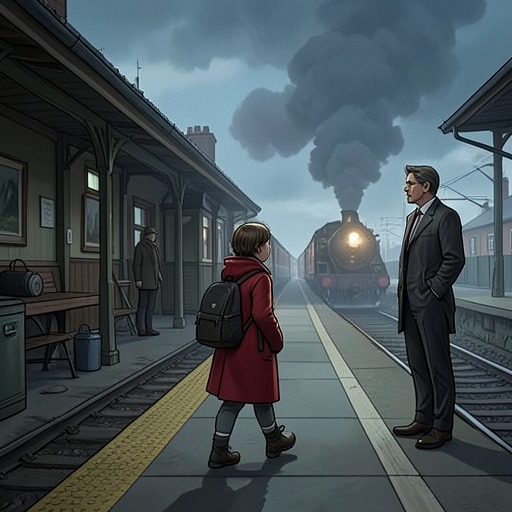
Near the end of the school year, Katerina tells Danza that she will spend the summer with her family in Moscow. He responds with envy and interest, then asks when she will leave. Her answer—that she is going the Friday before Memorial Day—changes the tone of their conversation. Danza realizes she will miss the final month of school, and he is upset that she will be gone so soon. He restrains his question about what her mother is thinking; Katerina, by contrast, seems untroubled, mentioning cheaper airfares and family commitments.
The difference in their reactions reflects their unequal positions. Katerina’s travel is determined by family plans, while Danza, as her teacher, cannot decide those plans or prevent her absence. He can only adjust his teaching. He hopes to complete a comprehensive review and give the final exam before she leaves, turning his concern into a practical effort to finish the course while she is still there. The calendar and the review materials become the means through which he tries to accommodate a departure he cannot change.
Katerina’s last day arrives sooner than Danza expects. He tells her that he will miss her and means it, but after she is gone he worries that he did not show her how much he appreciated her, how strongly he hopes she succeeds, or how much he wants her to remain safe and happy. His regret is not about an unresolved classroom task; it is about whether she understood the depth of his concern. He recognizes that he is not ready to say goodbye to his students, and Katerina’s departure gives that realization a concrete form.
Meaning of the Relationship
The bond with Katerina illuminates a central tension in Danza’s year: teaching requires him to invest emotionally in students whose lives and decisions remain beyond his control. At school, teachers are expected to offer advice and support as well as academic instruction, and Danza’s connection with Katerina belongs to that broader pastoral dimension of the job. He can encourage her, plan around her departure, and wish her well, but he cannot keep her in his class or know everything about the future she faces.
Her leaving also comes as Danza is confronting competing demands in his own life. He has been separated from his wife, worries about the time he may be missing with his own children, and struggles to interpret an elder daughter’s reassurance about his delayed visit home. Against that uncertainty, his attachment to students such as Katerina is both meaningful and difficult: care gives the work significance, but it also makes parting painful. When he later admits that he is unsure whether he wants to care so much about anything, the admission echoes the cost of the investment he has made throughout the year.
Katerina’s role in the relationship is not defined by a dramatic conflict or a single life-changing intervention. Its shape emerges through ordinary encounters: helping with a school project, asking about a play, discussing summer travel, and saying goodbye. Those moments accumulate until Danza’s regret after her departure makes the relationship’s importance unmistakable. She becomes one of the students through whom he understands that teaching has made him responsible not only for what happens in class, but also for how deeply he is willing to feel when the school year, or a student’s time with him, comes to an end.