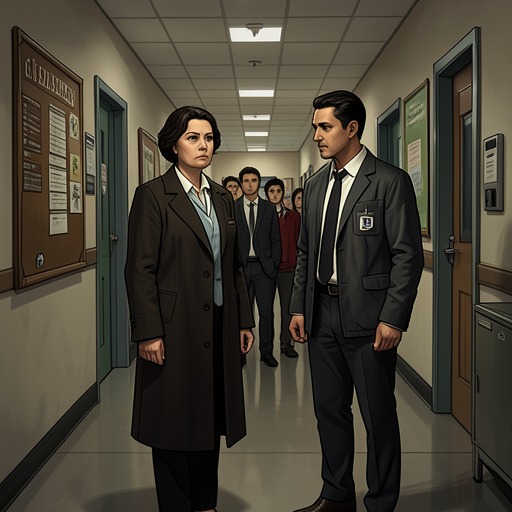
Tony Danza–Linda Carroll relationship
I'd Like to Apologize to Every Teacher I Ever HadTony Danza–Linda Carroll relationship is the working relationship between a first-year teacher and the principal of Northeast High School during Danza’s teaching year. It is defined by the tension between his informal, student-centered approach and Carroll’s responsibility for keeping students, staff, and the school within institutional rules. Their encounters move between collaboration, correction, public crisis, and parting affection; neither authority nor warmth alone accounts for the bond they form.
Identity and institutional setting
Danza arrives at Northeast High School as a celebrity embarking on a serious career change, while Carroll leads a large school whose physical scale and administrative demands make oversight an everyday necessity. The campus contains several buildings and trailers, multiple sports fields, a stadium, a large cafeteria, cavernous gyms, and even its own Philadelphia police station. Within that complex institution, the principal’s decisions carry consequences well beyond one classroom. Danza’s account repeatedly brings the two roles into contact: he wants to make school meaningful and engaging for students, while Carroll must also answer for safety, conduct, and measurable academic performance.
Their relationship is therefore not simply personal. It is shaped by the position Carroll occupies and by Danza’s unusual visibility as a teacher working before television cameras. She can invite him into schoolwide work and recognize the value of his teaching, but she can also remind him that a teacher’s lapse may expose the principal and the school to serious consequences. The hierarchy remains clear even as the year produces moments of genuine regard.
Shared responsibility and student engagement
A revealing early test comes when Carroll decides to join Danza’s planned New York City field trip. The students object because they fear the principal’s presence will prevent them from enjoying the outing. Danza uses the conflict as a lesson in making the best of a situation with limited options. Rather than let the class treat Carroll’s attendance only as an intrusion, he suggests that the students could welcome her and perhaps build a useful connection with the principal’s office. They write her an invitation, and she accepts it warmly, saying later that she looks forward to spending time with them.
The invitation does not erase the difference in status. On the trip, Carroll is both a participant and the principal responsible for what happens. The group tours Manhattan, attends a play, and eats at Patsy’s Italian Restaurant. On the return journey, Danza confronts Matt after the student locks a girl in the bathroom and suspects him of having a matchbook. Danza keeps Matt’s tacit confession to himself, while Carroll is angry about the match that has been lit. The episode shows Danza exercising informal judgment inside an excursion for which Carroll shares responsibility: he handles the student directly, but his choice not to disclose what he suspects leaves the principal managing the larger risk.
That risk becomes explicit after the group returns to school around ten at night. While they wait for students to be collected, Carroll tells Danza that if a student reports what happened, both of them could lose their jobs. Danza has slipped away to a bar during the outing, although he says he was legally old enough to drink, had only one drink, and was not in the same room as the students. He apologizes, and Carroll answers with a brief good-night rather than a prolonged reprimand. The exchange makes their relationship more than a routine exercise of supervision: her warning identifies the stakes he has overlooked, while his apology acknowledges that his conduct could have endangered her as well as himself. The next morning, Kelly Barton’s joke about a virgin martini suggests that the incident has not become the dismissal Danza feared, but it does not cancel the seriousness of Carroll’s warning.
Academic pressure and mutual recognition
Carroll’s administrative role becomes especially visible when Northeast High School faces pressure to meet its Adequate Yearly Progress target. The school had missed its 2009 target, and the 2010 Pennsylvania System of School Assessment results could affect every teacher’s job. Carroll calls teachers to a special auditorium meeting and warns that failure could result in the school becoming a Renaissance School, with the superintendent taking over, staff dismissed, and the school restarted under a private contractor. Her concern is not presented as abstract bureaucracy: the test results place the school and its employees under a direct threat, and she must communicate that threat to the people whose work will determine the outcome.
At a different register, Carroll’s response to a class poetry contest shows her capacity to be moved by student work. After Daniel’s poem about a grandmother he seldom sees wins unanimous top marks, Carroll is still drying her eyes as she congratulates him. Danza then surprises the finalists with Flip Video cameras. Carroll tells the class that the week had made her question why she was there, and that they had reminded her why she does the work. The scene gives their relationship a shared point of reference: Danza’s classroom activity is not merely a private project under her supervision but an experience that can renew the principal’s sense of purpose too.
The school’s demands also make their responsibilities inseparable in moments of danger. During the ceremony for passing school leadership from seniors to juniors, a water-balloon fight between the classes turns into a stampede. Danza tries to slow the crowd but is overwhelmed and pulls another teacher out of the aisle. Carroll takes command from the stage, threatening to cancel everything planned for the rest of the year, including graduation. Her authority stops the students; no one is hurt, and she later decides not to cancel graduation. Danza’s account emphasizes that this is not theatrical bluster: he has seen her manage many situations, but here her anger is unmistakable. The crisis displays complementary forms of responsibility—Danza intervenes amid the crowd, and Carroll uses the authority of her office to halt the escalation.
Change and ending
By the end of the year, the relationship has acquired the warmth of a shared institutional life without ceasing to be professional. Danza says goodbye to Carroll on the final teacher workday, June 21, and describes the parting as difficult. His acknowledgment matters because the year has included both correction and strain: Carroll has warned him about the consequences of his conduct, but she has also welcomed his students’ efforts, shared their successes, and held the school together in a dangerous moment.
The final thanks in Danza’s book place Carroll among the people whose support helped make the year possible, naming her as principal Linda Carroll. This retrospective recognition completes the arc of their relationship. Danza entered a school where he had to learn not only how to teach but also how his choices affected colleagues and administrators. Carroll remained the principal, with all the authority and accountability that role entailed; she did not become merely a friend or an ally who exempted him from rules. Their bond instead rests on repeated encounters in which student opportunity, institutional pressure, and personal responsibility meet. Its strongest evidence is practical: a principal joins a class trip, warns a teacher when both are exposed to risk, responds emotionally to students’ work, intervenes in a crowd, and ultimately receives a difficult goodbye.