Tony Danza–Monte relationship
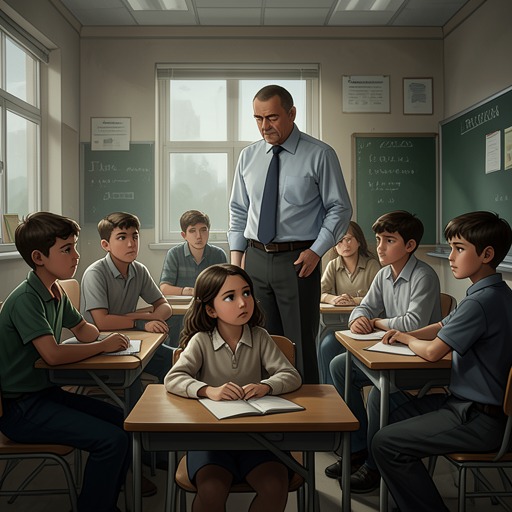
I'd Like to Apologize to Every Teacher I Ever HadTony Danza’s relationship with Monte is a sustained negotiation over what teaching owes both an ambitious student and a difficult-to-manage class. Monte challenges Danza’s pace and classroom control, while Danza worries that concentrating on students who resist the work will compromise Monte’s prospects. Their conflict becomes productive when Danza lets Monte teach for a period: Monte experiences the obstacles he has criticized, and the two eventually make peace through a lesson in considering another person’s point of view.
Identity and Early Classroom Dynamic
Monte stands out in Danza’s tenth-grade English class as a student who is ready to move faster than the room around him. During a vocabulary writing exercise, his story is already finished while he sits directly in front of Danza’s desk, his face twitching with impatience. The small physical detail captures a persistent difference between them: Monte wants the work and the class to move on, while Danza is trying to hold the attention of students who need more time or resist participating.
That difference is not simply a matter of one student being difficult and one teacher being patient. Danza’s class includes markedly different reading levels, including students who began the year reading well below grade level, and he is trying to advance the material without losing those who need additional support. Monte’s impatience makes visible the other cost of that balancing act. Danza recognizes that his attention to students who cannot be bothered may be compromising Monte’s academic development and even his Princeton scholarship. The teacher’s effort to keep reluctant students from quitting therefore risks shortchanging a student who wants to learn.
Disagreement and Shared Insight
Monte’s contributions in class show that his critical stance is accompanied by an ability to reason through ideas. In a discussion of a gang member’s search for respect, he proposes that owning a company could give someone another way to command respect: an employer could dismiss disrespectful workers rather than resorting to killing. Danza uses the answer to extend the discussion toward nonviolent ways of earning self-respect and social standing. Monte is not merely demanding that class become more rigorous; his intervention demonstrates the kind of analysis Danza wants students to practice.
The sharper dispute comes when the class reads To Kill a Mockingbird. Monte considers the novel too easy and faults Danza for taking too long to teach it and for repeatedly losing control of the class. Other students complain that the book is too long, while some object that deadlines are not enforced equally. Danza understands the fairness complaint but fears that imposing strict discipline on the students who are already struggling will drive them out of participation. Monte’s grim disapproval forces him to confront the consequence of that choice: his effort to retain disengaged students can diminish the challenge available to a student with much stronger academic ambitions.
The Student Teacher Experiment
Rather than answer Monte’s criticism with an argument, Danza gives him a chance to take responsibility for the classroom. Drawing on a strategy previously used with Al G, he establishes the Student Teacher program and promises Monte an entire period in which to devise a lesson, assignments, and standards as demanding as he wishes. The arrangement gives Monte the authority he appears to want, but it also puts him inside the conditions he has judged from a student’s desk.
A week later, Monte arrives prepared. He begins with a worksheet of legal terms from the trial in To Kill a Mockingbird, then leads an analysis of the characters’ qualities and interactions. His high expectations meet the same class Danza faces every day. Matt wanders around the room and laughs when told to sit; Chloe and Katerina talk about sandals; Erik Choi turns upside down in his seat; and Eric Lopez attends to a love note. Danza is restricted from taking over by the program’s rules, and students invoke those rules when he tries to quiet the room. Monte discovers that preparation and demanding material do not, on their own, make a class cooperate.
He soldiers through to the bell, but Danza describes him as a tire with a slow leak, increasingly worn down by the effort. While the others hurry off to lunch, Monte sinks into a seat. Danza debriefs him as David Cohn usually debriefs Danza: they consider what worked, what he would change, and what advice the experience might offer the regular teacher. The exercise turns their disagreement into shared professional experience. Monte has not simply been told that teaching is hard; for one period, he has had to confront that difficulty himself.
Truce and Its Meaning
For his advice, Monte opens his copy of To Kill a Mockingbird to the scene in which Atticus explains to Scout the need to understand another person by considering life from that person’s point of view. The passage answers the hostility between teacher and student without deciding that either one’s original concern was meaningless. Monte had accurately identified the ways Danza’s classroom management and pacing could fail students who were ready for more. Danza, in turn, had been balancing that concern against the risk of losing students who were already disengaged. Their classroom experiment has given each a more immediate view of the other’s position.
Danza asks whether Monte would consider a truce. Monte responds with a sheepish grin, stands, and formally extends his hand; they shake. The gesture settles their particular conflict, but the account does not suggest that the broader classroom problem has vanished. Danza reflects that teaching often means working with one student at a time, even as the number of students makes that ideal difficult to sustain. Monte’s case sharpens the point: a student who wants to learn still needs the teacher to notice what the class’s competing needs may be taking from him.
Their reconciliation is therefore more than a moment of restored goodwill. Monte’s criticism helps Danza see the cost of protecting participation when that protection slows or weakens the education of a motivated student. The Student Teacher period makes Monte encounter the unruly conditions behind Danza’s decisions, and the novel supplies a language for turning that encounter into perspective-taking. Their handshake closes the immediate contest over who understands the classroom, replacing it with a more reciprocal understanding of what each has been facing.