Tony Danza–Pepper relationship
I'd Like to Apologize to Every Teacher I Ever HadTony Danza’s relationship with Pepper is a portrait of care that does not mean letting a student off the hook. At Northeast High School, Danza treats Pepper’s dog-biscuit prank as an opportunity to teach responsibility; when Pepper is later punched in the hallway, that same attention becomes protectiveness. The relationship moves from comic troublemaking to vulnerability and danger, while Danza tries to answer both with personal concern and a teacher’s restraint.
First Encounters in a Discipline Dispute
Pepper enters this account amid the school-uniform policy’s contentious first day. Danza has been assigned to monitor the auditorium, where more than a thousand students boo him loudly enough that he leaves the doorway. Outside, he finds Pepper stopped for a violation. Pepper is wearing the required khaki pants, white shirt, striped tie, and dark sweater; his offense is the color of his shoes. Ms. DeNaples directs him to the auditorium, but Pepper says he has the correct shoes in his backpack. After changing, he gives her a small object and tells her, “This is for your trouble.”
The object is a dog biscuit. Ms. DeNaples understands the gift as an insult, explaining that it means she is a “bitch”; David Cohn recognizes the joke’s creativity, but she rebukes him too. Danza, initially bewildered, does not treat the stunt as harmless simply because the class has begun to lionize Pepper. Instead, he calls Pepper to meet him after class, making the response private rather than turning the incident into a public exercise. The move preserves the teacher-student relationship as more than a contest over who can command the room: Danza addresses Pepper directly, but does not humiliate him before his classmates.
A Lesson in Accountability
The timing gives Danza another way to connect discipline with learning. The class’s argument about uniforms has displaced his planned opening task. Students disagree over the policy’s effects on expense, clothing choice, and self-expression; the discussion lasts the whole period, and the students are engaged enough that Danza decides to make debate a weekly feature. Pepper, too, seems more thoughtful by the bell. Danza reminds him that they still have business to attend to, separating his willingness to welcome debate from his refusal to ignore Pepper’s insult.
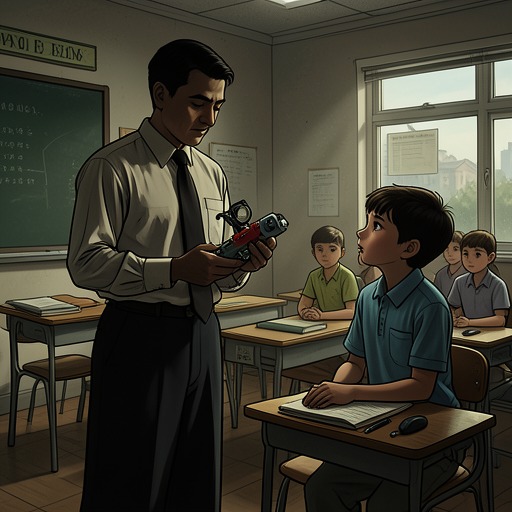
At their meeting, Danza asks whether Pepper has ever written an apology note. Pepper shrugs and looks down at his shoes. Danza gives him stationery and an envelope, then dictates the wording rather than leaving Pepper to choose it himself. Pepper writes what he is told without protest and delivers the note to Ms. DeNaples in person. She is not fully reconciled, but dismisses him with a warning: “Disrespect is no laughing matter.” The exchange makes the correction concrete: Pepper must address the person he insulted, not merely endure a consequence imposed by Danza.
Afterward, Pepper and Danza stand looking at one another for several seconds. Danza asks whether Pepper is going to lunch; Pepper says yes and heads toward the cafeteria. As he enters the stairwell, he gives Danza a small backward wave. The gesture does not erase the offense or suggest that Ms. DeNaples has forgiven it. Instead, it marks a modest easing between teacher and student after Pepper has complied and Danza has stayed with him through the process. Danza considers the outcome an even balance: Pepper has been held responsible, and at least some of Ms. DeNaples’s dignity has been restored.
From Misbehavior to Vulnerability
The next major turn comes on the day before the class’s trip to Washington, D.C. Danza has been worrying about the inconsistency of school discipline when an assistant principal alerts him that Pepper has been assaulted in a hallway. Pepper is sitting in the school police station with a bruised, swollen eye and a discolored cheek. He says he was standing and talking with a friend when another student came by and punched him; he is close to tears and does not know why he was hit. He saw the attacker running away but cannot identify him.
Danza responds to Pepper as a teacher who has himself absorbed punches, and as someone who sees that Pepper is small and has been badly struck. He describes Pepper as not mean, though sometimes a slacker or instigator, and immediately sympathizes with him. The earlier dog-biscuit incident has not fixed Pepper in Danza’s mind as merely a troublemaker. Faced with Pepper’s injured face, Danza asks whether he knows who hit him or why, taking seriously both the harm and Pepper’s uncertainty.
School security footage identifies a student seen running from the scene, and Officer Anderson recognizes him. When Pepper returns to the bench with Danza, he still looks miserable despite their now knowing who hit him. Danza sees the attacker’s photograph and feels like a protective father, with an immediate desire to give the bully a beating. The phrase signals how personal the encounter has become, but it also exposes the danger in his response: sympathy for Pepper pulls him toward the very kind of violence he knows he must not use.
Protection and Restraint
Officer Morton asks Danza to accompany him to retrieve the accused student. Danza knows his emotions are running high. He remembers being small and picked on, and the ways he once believed a person could make bullies back down. At the same time, he recognizes that fighting violence with violence is not an acceptable answer. His care for Pepper is therefore expressed not as revenge, but as remaining present while the school’s officers act.
In the hallway outside the student’s classroom, Danza asks why he hit Pepper. The student denies having hit anyone and says he does not have to talk to Danza because Danza is not his teacher. The encounter leaves the relationship’s central tension unresolved: Danza feels responsible for protecting Pepper, yet his authority has limits and his impulse to retaliate must be checked. Across both incidents, his approach combines intervention with boundaries. He makes Pepper repair the harm he caused, and when Pepper becomes the victim, he takes the assault seriously without pretending that personal anger can substitute for a just response.