teacher-student boundaries
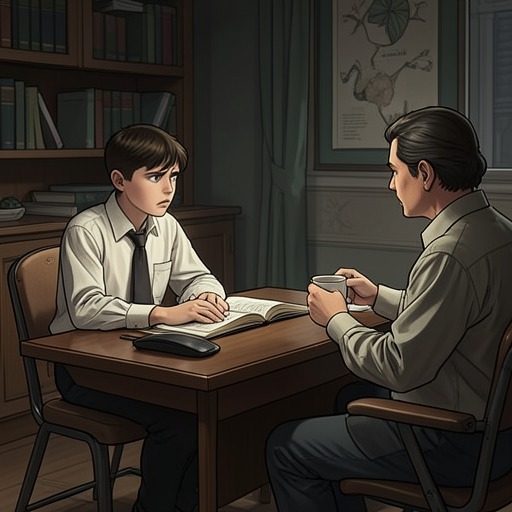
I'd Like to Apologize to Every Teacher I Ever Hadteacher-student boundaries are one of the central unresolved questions of Tony Danza’s year at Northeast High School. The book rejects both extremes: teaching is not a popularity contest, but neither is it confined to delivering lessons and grading work. Students must participate in their own education, while teachers often have to supply forms of attention, counseling, protection, and practical support that formal job descriptions do not capture. The resulting boundary is not a fixed line but a pressure point between professional restraint and human commitment.
From Instruction to Involvement
David Cohn helps Tony Danza distinguish affection from education. Tony worries that students who do not like him may not learn from him, but David answers that a teacher cannot learn on behalf of a student. His point is not that relationships are irrelevant; liking a teacher may make a student more receptive, but the decisive goal is to involve students in their own education rather than win their approval. Tony’s classroom practice gradually tests that principle by turning disagreement into participation. When students argue about the Northeast High School uniform policy, he abandons a planned fitness exercise and replaces it with a written opinion prompt, then organizes a debate. The students’ writing becomes unusually energetic because the lesson gives their experience and judgments legitimate classroom space.
The same approach shapes the creation-myth assignment and the social-justice rap discussion. Tony pairs students to write and perform myths, allowing Eric Choi’s paper “magic button” to turn a shy student’s craft into a public success. Later, a discussion of Coolio’s lyrics leads students from poetry to equal opportunity, violence, self-respect, and the unequal chances that structure their lives. Tony’s role is therefore neither detached lecturer nor substitute peer. He creates conditions in which students speak, interpret, and act, while retaining responsibility for the intellectual frame.
The Teacher as Adviser and Surrogate Parent
At Northeast High School, the formal distinction between teaching and counseling is already porous. Although Tony has no official advisory students, students begin appearing in his classroom from the hallways, cafeteria, teams, and clubs. They use the air-conditioning, accept half sandwiches at lunchtime, and increasingly return because they want to remain with him. Some arrive during fifth-period lunch or obtain hall passes by claiming that their teacher knows where they are. Tony must write notes explaining their lateness, but the apparently comic situation exposes serious problems: one student is late because the electricity was shut off and the family spent the night in freezing conditions.
The teachers describe this expanded role as unavoidable in poorer schools. They tell Tony that educators may have to be mothers, fathers, siblings, social workers, counselors, friends, or anything else students need. Their stories include hunger, gunfire outside a child’s bedroom, abuse at home, and teachers who nearly adopt students to prevent foster care or homelessness. The phrase “Adoption fantasy” names the danger as well as the impulse: care can become so intimate that the teacher imagines replacing the family rather than supporting the student within an institutional network.
Tony’s half-sandwich club illustrates both the value and the cost of this intimacy. Students do not come only for food or climate control; they also like being with him, and he admits that he is susceptible to that attachment. His unofficial advisory becomes a daily refuge, but every refuge creates a question about limits. Sympathy and a note may be all he can offer when a student describes housing hardship, yet refusing to try would mean accepting the school’s official boundaries as an excuse for indifference.
Discipline, Difference, and the Limits of Intervention
The boundary problem becomes especially sharp in Tony’s work with Matt. Matt is an athlete and starting middle linebacker for the Northeast Vikings football team, but he is also constantly in motion, argumentative, and prone to fights. By the end of October he is tied for the school record for the most fights after being attacked in a racially charged conflict. Tony contacts Matt’s father, asks whether Matt will see a counselor, and helps arrange a meeting with the parents, department head, counselor, and himself. Matt agrees to regular counseling, showing how a teacher can initiate support without pretending to be the sole solution.
The arrangement is threatened when Matt’s parents encounter a group of Black girls in the crowded corridor. Their confrontation escalates from complaints about crude language and racial epithets into a screaming match. Matt’s father concludes that his son’s negative judgment of Northeast High School and its students is justified. Tony warns him not to reinforce that interpretation, explaining the girls’ language as a cultural mode of communication rather than proof that Matt’s broad condemnation is correct. The scene exposes how quickly care can become partisanship: a parent’s defense of his child may deepen racial separation, while Tony’s attempt to mediate must navigate culture, violence, discipline, and the risk of validating prejudice. Matt’s father agrees to let him finish the year but plans to send him to a Catholic school afterward, leaving Tony to acknowledge that stricter discipline may help even though the change also marks the limits of what the public school relationship has accomplished.
Tony encounters another version of the boundary when Monte criticizes the class for moving too slowly through To Kill a Mockingbird and for tolerating disorder. Monte believes that, if placed in charge, he could bring everyone into line. Tony gives him one full period to design and teach his own lesson through the Student Teacher program. Monte prepares a legal worksheet based on the trial and a demanding analysis of character and interaction, but the class interrupts him, while Matt wanders, Chloe and Katerina discuss sandals, Eric Choi sits upside down, and Eric Lopez writes a love note to Ileana. The exercise changes authority without abolishing the teacher’s responsibility: Tony can share control, but he cannot simply transfer the classroom’s social complexity to a student.
Attachment, Separation, and Continuing Responsibility
By the end of the year, Tony’s relationships make detachment nearly impossible. Al G comes to the classroom, sits with his backpack, and says nothing. Tony has finally learned not to force conversation and instead lets Al initiate contact. Forty-five minutes pass in the cool room while the air conditioner drones; Al leaves with only a nod. Tony interprets the silence as a small sign of mutual change, but David Cohn observes that Tony may have “worn each other down.” The remark applies to both teacher and student: trust has developed through persistence, yet it cannot be measured as a completed intervention or converted into a simple success story.
David’s departure makes Tony recognize another boundary. David is moving to a school in Vermont before the year is finished, and he tells Tony that he no longer needs help. The teacher-student relationship has produced enough independence for the mentor to withdraw, but the withdrawal is painful because Tony has depended on David as much as David has supported him. The relationship therefore models a healthy ending while also revealing how deeply teaching has altered Tony’s emotional life.
Alex makes the boundary question more difficult. After Alex is moved to another foster home and separated from his sister, Kelly Gould arranges a free four-week summer stay at a family camp in the Poconos. Tony helps reach out to people who might assist, encourages Alex to send him a poem, and tells him that academic effort must matter for Alex’s own sake rather than merely for a trip or for Tony’s approval. Even this encouragement contains a warning against making the teacher the center of the student’s future.
When Alex’s foster placement later deteriorates because his friendship with another boy has soured and the family is experiencing unrelated conflict, Tony tries to help from a distance. Alex eventually moves to live with his twenty-three-year-old married brother in an apartment near Northeast High School. Returning to Philadelphia makes Alex happy, but his statement that he wishes he lived with Tony activates Tony’s “adoption fantasy.” Tony does not adopt him; he settles for becoming an unofficial mentor, checks in every Sunday, and helps arrange another summer at the Poconos camp. Alex appears to be doing well but finishes his junior year with a C average, and his new girlfriend delights him while worrying Tony. The continuing contact demonstrates care without control, but it also leaves Tony asking where teaching stops and starts and how much any teacher can do.
Meaning and Unresolved Edge
Tony ultimately concludes that engaging students required becoming engaged in their lives, problems, and futures. That connection made teaching rewarding, but its intensity also made the work much harder than expected. The book therefore treats boundaries as an ethical tension rather than a rule that can be perfectly enforced. A teacher who refuses all personal involvement may fail students whose educational difficulties are inseparable from hunger, violence, housing insecurity, family disruption, or racial conflict. A teacher who becomes too involved risks dependency, emotional exhaustion, and the fantasy of replacing social institutions or families.
The ending gives this tension a concrete image. As Tony leaves Philadelphia from 30th Street Station, he reflects that he inserted himself into his students’ lives and then disappeared, a sequence that feels wrong even though teachers and students have always moved in and out of one another’s lives. He decides that what students retain matters more than their permanent access to him; he can remain in touch by sending advice and aphorisms, but he cannot continue directing their days. Lynn Dixon’s gift, discovered on the train, is a plaque recounting the story of a man throwing stranded starfish back into the water one by one. When another man says that saving so few cannot make much difference, the first replies, “Made a difference to that one!” The story gives Tony a modest measure of educational responsibility: he may not reach every student or solve every problem, but individual help remains meaningful.
Alex prevents that image from becoming a falsely complete happy ending. His return to Philadelphia, C average, foster-care history, and ongoing need show that a teacher’s intervention cannot guarantee a stable future. Tony admits that he still does not know where the boundary lies, yet he rejects the idea that responsibility is all or nothing. He may not become a full-time classroom teacher, but he can support education through reading to children, volunteering, mentoring, and organizations such as Teach For America, DonorsChoose, the Freedom Writers Foundation, the EnCorps Teachers Program, and the Fulfillment Fund. teacher-student boundaries thus end not in emotional withdrawal but in a more sustainable conception of commitment: care must remain active, while the student’s life must ultimately remain the student’s own.