
The Homework Evidence and the Plane Theory
I'll Be Gone in the DarkThis thread follows Paul Holes’s investigation of papers found near a Danville crime scene and the increasingly speculative possibility that the offender’s work involved development and private aviation.
increasing Bearing strength in each event
 decreasing
Bearing strength in each eventdecreasingThe Forgotten Bag
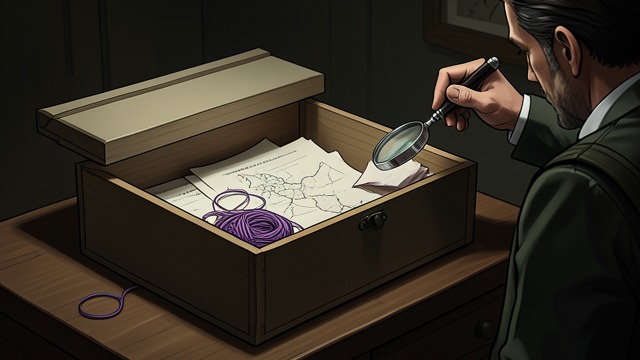
An Old Property Room Box
A Search for a Mask
Paul Holes went to the property room looking for a ski mask associated with Jim Walther, an earlier suspect. While examining the stored evidence, he noticed a separate bag labeled as having been collected from a railroad right-of-way.
Inside were sheets of notebook paper, a hand-drawn map, purple yarn, and a fragment of typed paper. The items had remained in storage for decades, with little documentation about exactly where they had been found together or how they related to the attack.
A New Lead Takes Shape
Holes copied the papers and studied them, uncertain at first whether they belonged to the offender or were unrelated material. Their presence near the path used by tracking dogs made them potentially significant, but the missing scene documentation left room for doubt.
The discovery shifted his attention from the suspect mask to an overlooked cluster of objects. In a case built from incomplete traces, the bag offered an unusual chance to recover a discarded clue from the margins of the original investigation.
The Word Punishment
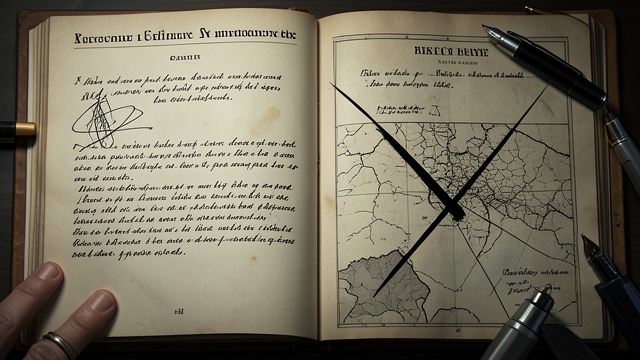
A Disturbing Inscription
Reading the Pages
One page appeared to begin a poorly written school essay about General Custer. Another, titled “Mad is the word,” described a sixth-grade teacher who had humiliated the writer through repeated sentence-writing as punishment.
The tone was disproportionate to the stated grievance. The writer described lasting hatred and framed school discipline as profound injustice, details that made the page feel psychologically charged without proving who had written it.
The Map’s Reverse
Holes initially paid limited attention to doodles on the back of the map. A clerk prompted him to look more closely, and he noticed the word “PUNISHMENT,” written large and forcefully across the page, with a backward initial letter.
The contrast between ordinary marks and the emphatic word drew him into the evidence. The papers now seemed to hold both a personal grievance and a carefully drawn plan, though their meaning remained open to interpretation.
A Professional Map

Interpreting the Drawing
Design in the Details
The map showed a residential layout with paths, cul-de-sacs, a lake, and a business area. Holes consulted people familiar with development and landscape design, one of whom judged that the drawing displayed professional skill rather than casual doodling.
That opinion offered a possible explanation for why the map combined a neighborhood plan with writing about school. Perhaps its author had access to development work or was preparing an idea for a project; neither possibility could be established from the paper alone.
A Career Hypothesis
Holes began reconsidering the offender’s assumed circumstances. If the map reflected practical design knowledge, the person who made it might have been connected to land development, a field that could also explain travel between distant communities.
The hypothesis was intriguing but fragile. The evidence did not identify an employer or author, and the paper’s relationship to the crime scene remained circumstantial. Holes treated it as a lead that could guide questions, not as proof of a career.
The Davis Airport Route

Following the Footprints
A Route Beyond the Neighborhood
In Davis, Holes and Michelle reviewed an attack near Village Homes and the shoe impressions that had been followed away from the victim’s house. The track continued past the residential area and toward the UC-Davis airport, an unusual route that had not been fully understood at the time.
Holes learned that small aircraft could arrive after hours without generating the kind of formal records he had assumed would exist. That possibility made the airport’s proximity relevant, although the footprints alone could not establish that the offender had flown.
Connecting Separate Incidents
The visit also revisited an attack in Modesto roughly twenty-two hours before the Davis assault. A cab driver had described an unusual passenger picked up at an airport and dropped near new construction, a detail that Holes found suggestive when paired with the Davis route.
He proposed that work travel might explain the quick movement between the two cities. The proposal depended on linking two uncertain clues, so it remained an investigative theory rather than a demonstrated travel history.
A Plane in the Hypothesis

Resources and Uncertainty
A Suggestive Possibility
After discussing whether the offender had a vehicle, Holes told Michelle he thought the man might have had access to a plane. He imagined a small aircraft as a possible resource for someone traveling between development sites, rather than evidence of exceptional wealth.
The idea drew together the airport observations, the Modesto cab ride, and the development hypothesis. Each detail had other possible explanations, and their combination could easily create a compelling pattern without proving that the offender flew.
An Unresolved Lead
The plane theory illustrates how a cold case can generate productive questions and dangerous speculation at the same time. Holes’s fieldwork encouraged him to reconsider neglected locations, but the available material did not identify a pilot, a plane, or a company that employed the offender.
The thread ends as a possibility left for future investigation. The map and travel clues broadened the suspect profile, while their uncertain status kept the case from being reduced to a single attractive explanation.
March 31, 2011
After the papers were copied in 2011
During Holes’s subsequent analysis
During the 2013 Davis field trip
Near the end of the 2013 Contra Costa tour
