
Control of Time
I'll Be Gone in the DarkThis thread follows the offender’s manipulation of timing—from preparation and prolonged fear to false departures—and the investigators’ effort to turn delayed evidence into a path forward.
increasing Bearing strength in each event
 decreasing
Bearing strength in each eventdecreasingThe Watched Routine

The Watched Routine
Preparation Before the Attack
In the early Sacramento attacks, the East Area Rapist often appeared to know when a household would be vulnerable. Reports of hang-up calls, prowling, and earlier entries suggested that he watched people’s routines before entering their homes, selecting moments when a spouse had left or a victim was alone.
Victims Awakened on His Schedule
The attack began abruptly, often with a flashlight and a threat delivered before the victim could fully understand the danger. By preparing first, the offender controlled the first moments of the encounter and forced victims to react within a script he had already formed.
The timing made ordinary habits feel dangerous in retrospect. A departure for work or a quiet interval after bedtime could become part of the offender’s opportunity, making the crime seem less like a sudden intrusion than a violation of routines victims had not known were being observed.
The Dishes Alarm

The Dishes Alarm
Noise as a Threat
When the offender began attacking couples, he sometimes placed dishes on the bound man’s back and threatened to kill everyone if he heard them fall. The arrangement transformed a small sound into a constant warning, making the male victim’s body serve as an alarm and extending the attacker’s control beyond the woman he assaulted.
Time Stretched by Fear
The threat forced victims to monitor each breath and movement. The offender could leave the room or rummage through the house while the couple remained suspended in anticipation, unable to know whether quiet meant safety or merely another pause in the attack.
The device was crude but psychologically effective. It made time feel measurable through the possibility of a crash, while denying victims any reliable way to know when the danger would end. Control depended not only on physical restraint but on keeping the next moment uncertain.
The False Departure
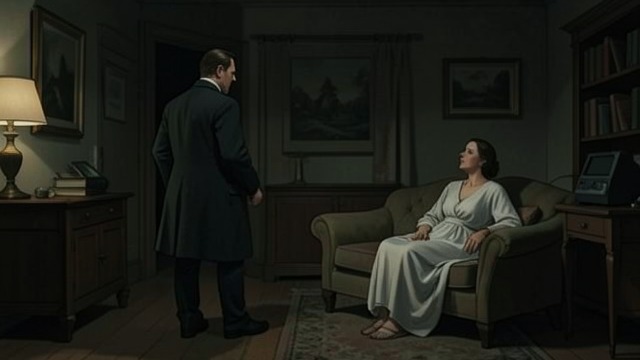
The False Departure
Silence as a Trap
Many victims believed the intruder had finally left after hearing him move away or after a long stretch of silence. They loosened their bodies by degrees, listening for proof that the house was empty. The offender sometimes returned at precisely that moment, turning relief into renewed terror.
Delay as Escape
The uncertainty forced victims to wait before seeking help. Some remained bound for hours, unsure whether a footstep or a closing door meant the offender was still nearby. That delay gave him additional time to move away from the neighborhood and complicated efforts to reconstruct his route.
The maneuver reveals how the offender manipulated not just a victim’s body but her sense of time. A pause became an instrument of control, and the possibility of safety was made unreliable. Investigators, arriving afterward, had to work backward from fragments left by an absence carefully staged.
The Unquiet Interval

The Unquiet Interval
A Community Begins to Relax
After a run of attacks in Contra Costa County, several weeks passed without another known strike. Residents who had spent nights bracing for the offender cautiously began to feel that the danger might have moved elsewhere. The absence of new crimes looked like a reprieve, though no one could know what it meant.
A Return to Danville
The offender had not disappeared from the region. In December, he attacked Esther McDonald in Danville, breaking the apparent southward pattern that had led some observers to expect him farther away. The return exposed how little communities could infer from a quiet interval.
The lull was not neutral. It allowed vigilance to weaken while preserving the offender’s advantage: he could choose when to return, while residents could only wait and guess. The episode echoes his false departures inside individual homes, expanding his manipulation of time from a single victim to an entire community.
The Clock Reversed

The Clock Reversed
Old Evidence Reopened
Decades after the attacks, stored evidence became useful in ways that investigators at the original scenes could not have anticipated. New DNA techniques and searchable records allowed investigators to compare old samples, connect cases, and revisit leads that had once seemed exhausted.
The Pursuit Changes Direction
In the epilogue, Michelle McNamara imagines technology reversing the offender’s former advantage. Police reports are scanned, records become searchable, and genetic methods offer new routes through a case once buried in paper files. The image is not that the past disappears, but that its neglected details can be brought forward again.
The shift turns time from the offender’s ally into a possible investigative resource. His years of apparent escape do not erase evidence; they allow techniques and databases to develop around it. Still, the book stops short of claiming that technology has already supplied the final answer.
June–October 1976
Spring 1977
During the 1976–1979 attacks
December 1978
1996–2017
