“Mad is the word” note
I'll Be Gone in the DarkThe “Mad is the word” note is a handwritten page recovered with other materials along a railroad right-of-way in Danville, California. Its account of anger toward a sixth-grade teacher gave Paul Holes a possible human connection to the East Area Rapist investigation, but the page remained a clue rather than an identification: its author was unknown, its precise location was poorly documented, and the teacher who might have supplied context could not remember Jim Walther.
Recovery and Physical Form
The note was part of a small collection that criminalist John Patty documented after bloodhounds traced an escape route from an attack. His inventory listed two sheets of spiral, three-hole binder paper with pencil writing, a separate sheet bearing a pencil-drawn map, a length of purple yarn measuring 41 inches, and a fragment of typed paper. The note was one of the written pages; it was recovered with the map and the other items, not as a separately identified, self-explanatory document.
Patty sealed the materials in a plastic bag labeled as collected from the railroad right-of-way. The bag went into a box in the Property Room, where it remained for decades. On March 31, 2011, Holes came to retrieve evidence while investigating an East Area Rapist suspect. The old bag caught his attention, and the long-stored papers entered a new phase of investigation. Their rediscovery made an overlooked object newly consequential, but it could not restore information that had never been recorded.
The documentation was especially limited in one respect: no photograph or scene sketch showed whether the materials had been found together or scattered across the ground. Patty left only a brief notation about where along the tracks he located them. By the time Holes examined the papers, Patty had died of cancer in 1991. The note could be scanned and analyzed, but the criminalist who might have explained the circumstances of its recovery was no longer available to do so. That absence placed a firm boundary around what the page could establish.
The Writing and Its Clues
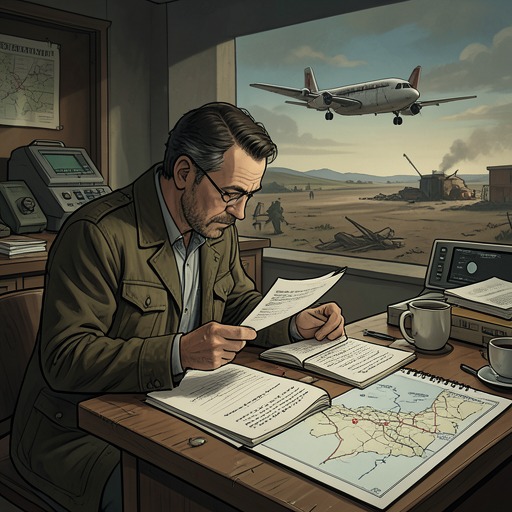
The first written sheet appeared to begin a poorly composed school essay about General Custer. The second began with the words that give the note its name and shifted into a personal grievance: its writer recalled sixth grade and described a teacher who humiliated him by making him write sentences repeatedly as punishment. The writer’s account conveys resentment toward an unnamed man, but neither the teacher’s name nor the writer’s identity appears on the page.
The note’s evidentiary interest rests partly on this specific schoolroom memory and partly on its emotional register. Holes read it as a mixture of anger and self-pity, a grievance preserved in ordinary notebook paper rather than an explicit confession. The book places that mixture beside a broader discussion of violent fantasy and accumulated resentment, while warning that people who fantasize about violence do not necessarily act on it. The note therefore offers material for a hypothesis about a possible offender’s inner life, not a dependable psychological profile or proof of criminal conduct.
The handwritten page was also considered alongside the separate map found in the same collection. The map depicts a residential area, and its reverse bears doodles, including the word punishment written with intensity. Investigators and outside readers considered whether the writing and map might reveal a shared author’s interests or background. Yet their presence in one recovered bundle does not, by itself, establish who made either item or why the materials were at the site.
The Walther Comparison
Holes encountered the bundle while pursuing Jim Walther, a former suspect whose black ski mask he hoped to examine for biological evidence. Walther was not readily traceable: he had failed to appear in court in 2003 on a misdemeanor domestic-violence charge, had an outstanding warrant, and his driver’s license was suspended in 2004. Holes tried to reconstruct his past and obtained school records. They showed that Walther’s sixth-grade teacher was male, an uncommon circumstance for the period that seemed potentially consistent with the note.
Holes contacted the elderly teacher. He did not remember Walther, so the conversation could not confirm that Walther wrote the page or had been punished in the way described. The teacher did say that repeated sentence writing fit a form of classroom discipline he had used. That recollection made the note’s account more recognizable as a possible school experience, but it did not identify its author; the same practice could have been experienced by other pupils.
The teacher also recounted a separate, unsettling contact from about ten years earlier. An unidentified man had telephoned, sung a song the teacher had made unruly pupils sing, told him to remember it, and hung up. The call distressed the teacher enough that he changed his number and kept it unlisted. Holes looked up the song, but the reported call still supplied no confirmed identity. Its resemblance to the teacher’s classroom memory strengthened the sense that someone had deliberately invoked the past, while leaving unresolved whether the caller was Walther, the note’s writer, or the East Area Rapist.
Interpretations and Limits
Readers later proposed additional readings of the handwriting. One noticed that the numeral in the reference to sixth grade could resemble a capital G and that the wording may have been revised, suggesting to that reader that a town name beginning with G had first been written. Others noted that male sixth-grade teachers were relatively unusual in the 1960s, when the writer was presumed to have attended elementary school. These were interpretive possibilities offered by readers, not verified facts about the note’s author.
The map generated its own hypotheses, including whether its paths resembled those in planned residential developments and whether its detail represented barriers a person might encounter while moving around at night. Such suggestions drew attention to features worth examining, but they also multiplied possible explanations. The note’s juxtaposition of an apparently juvenile school grievance with a map regarded as unusually sophisticated sharpened the puzzle without resolving it.
The page’s importance is therefore double-edged. Its mention of punishment and a male teacher gave investigators a concrete lead to compare with Walther’s school history and his former teacher’s recollections. At the same time, the missing scene documentation, the dead criminalist, the teacher’s failure to recognize Walther, and the absence of an identified writer all prevented that comparison from becoming a secure attribution. The note endures in the investigation as a recovered fragment that redirected attention and invited scrutiny, but whose suggestive details never, on their own, settled who wrote it.