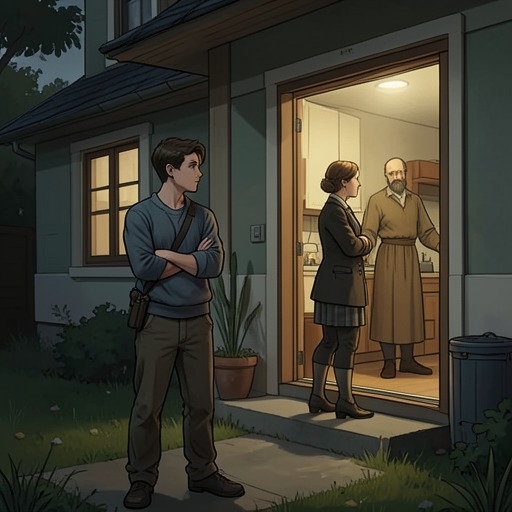
David Witthuhn—Manuela Witthuhn
I'll Be Gone in the DarkDavid Witthuhn and Manuela Witthuhn’s marriage was expressed in the life they built together: steady work, a new home in Irvine, and the ordinary choices of a couple making a future. Manuela’s murder in February 1981 shattered that domestic world. David was in the hospital when she was killed, and the questions surrounding her death followed him into grief, leaving the home they had made together as both a personal loss and an unresolved crime scene.
Marriage and the Home They Built
David and Manuela had been married for five years when they moved into their new house in late 1979. They lived at 35 Columbus, in Shady Hollow, a 137-house development in Northwood, Irvine. Their three-bedroom, 1,523-square-foot home was the Willow plan. It stood amid a landscape changing from the old Irvine ranch into suburban streets: eucalyptus planted decades earlier divided the roads, while construction continued at the edges of the orange groves.
The house represented a shared step into settled adult life. Manuela worked as a loan officer at California First Bank; David sold cars at House of Imports, a Mercedes-Benz dealership. They had steady jobs and spent time discussing improvements to the house, including brickwork for the front yard and where to find good rugs. Its rooms were still sparsely furnished, but that blankness suggested possibility. David kept his guitar in one spare bedroom, while bicycles occupied the other. The house was not simply a purchase; it was a space the couple could gradually shape around their lives.
For David’s younger brother Drew, the home also marked a contrast with the crowded household in which the brothers had grown up. David and Manuela had room, new appliances, and the independence of a household of their own. Drew felt envy as well as admiration. That contrast helps establish the marriage’s visible promise, but it does not reveal everything about the couple’s private life.
Different Temperaments, Shared Ground
Manuela could be brusque and forthright. At work, she was known to tell people when they needed a haircut or had made a mistake, and she kept a private record of coworkers’ errors in German. Drew sometimes came away from her company feeling diminished by the force of her complaints. His account, however, also distinguishes his own difficult response to her from David’s experience: he could see that the marriage worked for his older brother.
David was withdrawn and tentative, inclined to speak indirectly. Manuela’s sharper manner and David’s hesitancy made them different in temperament, but the evidence presents their household as a functioning partnership rather than a simple opposition. The couple’s shared employment and attention to the house supplied its everyday structure; Manuela’s habits and directness were part of that life, not a complete account of their bond.
A small object offered a rarer glimpse of her sentimentality. Her bridal veil hung on the back of the bedroom door. When investigators asked David about it, he explained that she always kept it there. The veil stood apart from the image of Manuela as formidable at work and at home: a lasting, quiet attachment to the wedding that had begun their life together.
The Hospital and the Murder
On Monday, February 2, 1981, Manuela took David to Santa Ana–Tustin Community Hospital, where he was admitted with a severe gastrointestinal virus. For the next several nights she followed a routine of having dinner at her parents’ house and then visiting him in room 320. They spoke by telephone every day, in the morning and evening. Their separation was temporary and shaped by his illness, not by a break in their marriage.
Late Friday morning, David called her workplace because he could not reach her. Her coworkers said she had not come in. He then tried the house, where the telephone rang without the answering machine picking up as expected. Puzzled, he called her mother, Ruth, who agreed to check on her daughter. Manuela was found dead in the couple’s bedroom. David was still away from home, hospitalized; the circumstances meant that the shared house became the place where their ordinary routines and the investigation collided.
The scene raised questions about what had happened and whether it had been staged. A rear sliding door had been forced, a television had been moved into the yard, and the answering-machine tape was missing. When police asked David about the tape, he was stunned and could only speculate that the killer might have left a voice recording. Investigators also asked about a missing lamp from beside the bed, which they believed could have been used in the attack. These details made the bedroom a field of clues, but for David it remained the room he had shared with his wife.
Grief, Suspicion, and What Remained
David’s grief was visible to investigators, though it also made conversation difficult: his answers drifted and he changed subjects. The death had taken place while he was receiving treatment elsewhere, but that circumstance did not spare him the burden of questions. After Manuela’s funeral on February 11, he returned to the house with Drew. They spoke late into the night, and David drank heavily. He told his brother that the police thought he had killed her. Drew, shaken by the possibility that David could be involved, asked him directly. David denied killing his wife, and Drew believed him.
The marriage’s meaning to David reaches further back than the crime. Ten years earlier, their father had died by suicide after a family conflict. David, then eighteen, had broken down the door and shielded the rest of the family from what he saw. The book describes him afterward as having lost some certainty. Then he met Manuela, and, in the account’s concise formulation, he was on solid ground again. Her death therefore removed not only his wife but also the stability their shared life had come to represent.
That stability survives in the details left behind: the house they chose, the routines around David’s hospital stay, and the veil still hanging in the bedroom. None resolves the murder or answers what happened between the couple in private. Instead, these traces make the loss legible through the life interrupted. Their marriage appears not as an idealized portrait, but as a household with distinct temperaments, shared plans, and an attachment whose full measure became clearest only after Manuela was gone.