Golden State Killer
I'll Be Gone in the DarkThe Golden State Killer emerges as both a serial offender and a patient observer of ordinary life: he studied neighborhoods, homes, and routines before attacking, while investigators later struggled to reconstruct his movements from incomplete traces. The book’s account makes the distance between those roles central. His preparation gave him knowledge of his targets; the investigation depended on reports, physical evidence, and geographic patterns that could only partially recover what he had learned.
Identity and Scope
The Golden State Killer is also described in the book’s separate investigative contexts as the East Area Rapist and the Original Night Stalker. The evidence presented here spans the Sacramento attacks, an assault in Davis, and later efforts to interpret materials associated with the case. It does not supply a final identification or resolution. Instead, it portrays an offender whose recurring methods could be recognized across locations even when his identity remained unknown.
The distinction between following individuals and following neighborhoods is important to this portrait. The Sacramento reports suggested that the East Area Rapist repeatedly selected an area, observed it, and prepared more than one possible target. Rather than relying on a single opportunity, he appeared to build options in advance. The account presents this as a deliberate method, not a sudden encounter: he gathered information about residents and their routines, then returned when circumstances favored an attack.
Reconnaissance and Opportunity
Sacramento’s geography figures in the book as part of that method. The city lies where the Sacramento and American rivers meet, and its drainage system carries water toward the California Delta. Police reports repeatedly referenced drainage ditches and cement-lined canals. The author reads those reports as evidence that the East Area Rapist used the underground routes to move through the city and remain out of sight. His movements below street level become an image of how a presence could be close to a neighborhood without being recognized there.
The reports also reveal a pattern in the neighborhoods he selected. He favored single-story houses, often second from a corner and near an open area such as a park, field, or greenbelt. Before an attack, nearby homes might show signs of prowling or illegal entry, and small or personal possessions would sometimes disappear. Reports of hang-up calls increased in the surrounding four- or five-block area shortly before an attack. Taken together, these details suggest reconnaissance: he was testing access, learning who was home, and developing several possible targets rather than depending on one.
The author connects this preparation to the offender’s apparent timing. A Sacramento couple, Kathy and David, were attacked during the final hours before they moved out of their home. Their nearly empty rooms and open drawers made the circumstances immediately visible to the responding deputy. Investigators were left to wonder how the offender had identified the couple and learned about their situation. Kathy and David also told them that he did not approach their three-year-old son’s bedroom. The book notes that other victims with young children observed similar avoidance, while leaving unanswered how the offender acquired such knowledge about households and floor plans.
Neighborhoods and Public Response
Public awareness changed as the attacks accumulated. The early reports reflect little recognition that a serial offender was at large; after media coverage grew, fear and rumor became part of how residents understood what was happening. By about a year into the attacks, some victims recognized the threat as soon as they were awakened. The book also describes neighbors who, after seeing or hearing something suspicious, shut their doors, turned off their lights, and withdrew rather than calling police. The shift was from not knowing to feeling besieged, and fear could make people less likely to act on what they noticed.
The offender’s movements between victims sometimes made the neighborhood itself seem like part of the message. Items taken from one home could turn up outside another: two packs of Winston cigarettes stolen from an early victim were left near a later victim’s home, and jewelry taken from a neighbor appeared at another scene. Pills or bullets stolen from one victim were later found in a neighbor’s yard. The account also notes connections between some victims, including shared surnames or occupations. The author interprets these crossings as a display of reach: neighbors who might not otherwise have seen themselves as connected were linked by the offender’s actions.
Attacks Across Locations
The Davis attack described in the book took place at about 3:50 a.m. on June 7, 1978, two days after the offender’s first attack in Modesto. The victim was a twenty-one-year-old student at the University of California, Davis, living in a multistory apartment building. Investigator Larry Pool later called the building a structural anomaly because it was the only known instance in which the East Area Rapist targeted that kind of residence. The account identifies features that made this attack appear more impulsive than many others, while still placing it within the series on the basis of the offender’s language and a recurring element of his method.
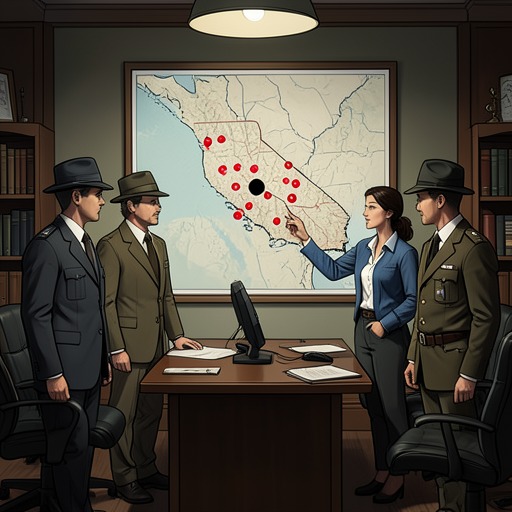
Paul Holes considers the geography of the attacks as a way to test possible connections between places. In conversation with the book’s narrator, he describes Sacramento as the first phase of the series, followed by Modesto and Davis, then the East Bay, and finally Southern California. He points to the early Sacramento attacks’ crisscrossing pattern as evidence of familiarity with the city, and treats the movement between Modesto and Davis as significant. His suggestions about a possible educational or work history are presented as hypotheses, not established facts. The broader point is that mapping the sequence could reveal patterns that individual case files did not make clear.
Evidence and the Limits of Reconstruction
A set of papers found near the Iron Horse Regional Trail became known as the homework evidence. The inventory recorded two sheets of spiral notebook paper with pencil writing, a page with a hand-drawn map, a forty-one-inch length of purple yarn, and an illegible fragment of typed paper. One written page appeared to begin a poorly written school essay about General Custer. Another described a sixth-grade student’s resentment toward a teacher who had made him repeatedly write sentences as punishment. The map depicted a residential development with a business area, cul-de-sacs, trails, and a lake; doodles appeared on its reverse.
Holes was initially unsure what the papers meant. Their possible connection to the East Area Rapist depended partly on where they were found. At the trail, Holes identified an electrical pole near the place where tracking dogs had lost the offender’s scent and where investigators believed he may have entered a vehicle. Three independent bloodhounds indicated that the trail led south along the tracks. Holes considered the location consistent with the distance from a target at which the offender was known to park. He also reasoned that John Patty, a respected criminalist involved in Contra Costa County cases, would not have collected the papers without considering them potentially important. The yarn remained unexplained, and the typed fragment could not be read.
The evidence was difficult to interpret partly because its original context had disappeared. No photograph or scene sketch showed how the items were arranged, and Patty, who had recorded their location, died in 1991. Holes could use touch-DNA technology and high-resolution scans and consult specialists, but those tools could not restore the observations of the person who collected the material. The papers therefore functioned both as a possible lead and as a warning: a clue may survive while the knowledge needed to understand it does not.
Narrative Significance
The book brings together routes, routines, and evidence without treating any one pattern as a complete explanation. Sacramento’s canals offer a way to understand how the offender could move unseen; the rising hang-up calls and missing objects show how a neighborhood could register his presence without recognizing its meaning; and the Davis timeline and geographic phases let investigators compare incidents across distance. Each pattern narrows possibilities, but none by itself establishes the offender’s identity.
That tension shapes the portrait of the Golden State Killer. His preparation appears systematic, yet the surviving evidence is fragmentary and open to competing interpretations. Holes’s work on the homework evidence, like his geographic reasoning, involves revisiting assumptions and seeking outside expertise while recognizing the risk of bias. The book’s focus is therefore not simply on a hidden offender, but on the difficult process of turning traces into knowledge—and on the cost of what investigators can no longer ask, see, or recover.