Kathy
I'll Be Gone in the DarkKathy is the pseudonym of a San Ramon survivor whose account connects the East Area Rapist’s October 1978 attack to failures in emergency service, the long afterlife of trauma, and later investigative reassessment. Her experience also complicates portrayals of victims: she was not merely a subject in old reports, but a person who could provide useful information, challenge how her story had been told, and alter investigators’ understanding of the case.
The attack and its immediate aftermath
Kathy and her husband, David, were attacked in their home on Montclair Place on October 28, just after five in the morning. They were in the final hours of moving out, and the house was nearly empty: drawers stood open, the few pieces of furniture had been disturbed, and the closets were bare. That circumstance made the timing striking. The offender arrived when the couple were about to leave, a detail that joined a broader pattern of attacks associated with real estate changes and raised questions about how he learned the details of people’s lives.
Their three-year-old son was in the house. Kathy and David later told investigators that the East Area Rapist had not opened or approached the child’s bedroom door. Other victims with young children noticed similar restraint around children’s rooms. The detail did not explain how the offender had learned the household’s layout, but it sharpened the question: his apparent knowledge of victims’ homes and routines remained a subject of speculation.
The emergency response revealed a separate vulnerability. For years, residents in unincorporated San Ramon had apparently been charged for 911 service that did not work. When Kathy tried to call, the connection failed; she obtained help by calling the Contra Costa County Sheriff’s Office directly. In an interview published by the Oakland Tribune on December 10, six weeks after the attack, she spoke plainly about her anger toward both the unidentified offender and the phone company. She could at least seek a concrete remedy for the service failure: she had the 911 charge removed from her bill, saving twenty-eight cents a month. The small monthly sum stood in stark contrast to the seriousness of the failure it represented.
Information she brought to the investigation
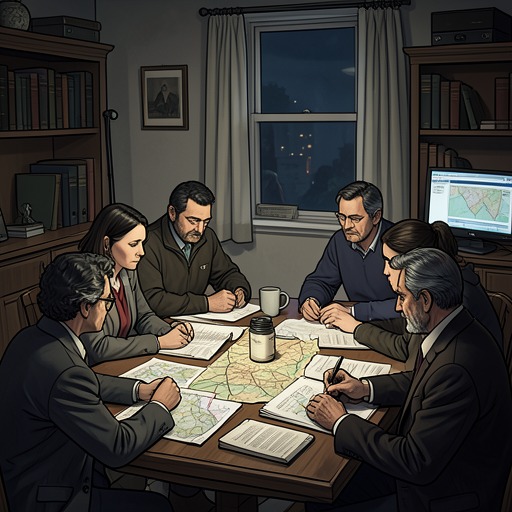
Kathy later proved useful to investigators for reasons beyond her recollection of the attack. When Paul Holes met with her, she could name multiple active construction sites for new subdivisions around her neighborhood at the time. The information mattered because investigators were trying to understand where the offender might have lived and how he moved through the East Bay. Kathy had never seen the geographic profile, so her recollections were not shaped by the map’s proposed home-base area.
That profile placed San Ramon at the center of the East Bay series, despite the county offering no obvious living pattern comparable to Sacramento’s. The map’s most likely home-base zone ran east to west just north of Kathy’s house. San Ramon was also one of the few places in the series where the offender struck only once. Her construction-site memories thus became relevant to a wider inquiry into opportunity, movement, and the possibility that an offender might sometimes attack nearer home than expected. She did not know that her information sat alongside those developing theories; its significance emerged through the investigators’ comparison of her account with other evidence.
The book also describes a broader method of neighborhood reconnaissance: prowling, illegal entries near intended victims’ homes, missing small items, and increased hang-up calls in the surrounding blocks before attacks. This context helps explain why construction and subdivision activity could interest investigators, but it does not establish that Kathy herself witnessed or identified the offender during that surveillance. Her contribution was specific: she recalled the nearby building sites, supplying details that could be considered against the investigation’s larger picture.
A survivor’s account and its retelling
Kathy re-entered the case after reading Larry Crompton’s book Sudden Terror. She sent the Sheriff’s Office an angry email objecting to the way she had been portrayed. Crompton had described her demeanor during a police interview in a manner that implied an inappropriate response to the assault, included unflattering details about her later life, and judged her appearance relative to other victims. The book’s narrator criticizes this treatment as lacking compassion and assuming that there is only one acceptable way for a victim to react.
That criticism also concerns interpretation. A survivor’s manner in an interview cannot, on its own, establish what an experience meant to her; an apparently unusual response may have explanations that an observer has not considered. The account specifically notes that Crompton’s depiction failed to consider whether Kathy’s request for water during the attack could have been a way to delay what the offender demanded. His chosen pseudonym, Sunny, further jarred with the negative portrayal. The problem was not simply an unkind label, but the distance between Kathy’s complex experience and the simplified image imposed on her.
The Sheriff’s Office could not arrange direct contact with Crompton, who had retired. Holes and a female colleague instead invited Kathy to meet with them. At the meeting, she was shaking and made little eye contact, behavior Holes understood in light of her residual trauma. He asked few questions and allowed his colleague to lead. The meeting shows the unusual distance and intimacy of cold-case work: Holes had examined evidence collected from her case long before meeting her, but until then she had been a person on a file rather than someone he had spoken with face to face.
Family consequences and new questions
Kathy told Holes that she and David had divorced. Their separation belonged to a wider pattern among couples affected by the East Area Rapist, whose relationships often did not survive the attacks. The account does not reduce their divorce to a single cause, but places it among the lasting consequences that could continue after the investigation had moved on. Their shared experience also remained important to the case: David had told Kathy after the attack that he thought he recognized the offender’s voice, though he could not identify it.
That recollection acquired significance alongside a recent FBI profiling suggestion that investigators consider whether, in some cases, a male victim might have been the offender’s intended target, perhaps as retaliation for a perceived wrong. Kathy’s account did not prove that this applied to her case, nor did David’s uncertain recognition identify the offender. Together, however, the details reopened questions about target selection and motive rather than treating the presence of a male partner as incidental.
Kathy’s place in the narrative therefore shifts. She first appears as a survivor whose call for help failed because the advertised emergency number was unavailable. Later, her memories of local construction sites assist a renewed inquiry; her objection to Crompton’s portrayal forces attention back onto the ethics of representing victims; and her report of David’s uncertain voice recognition intersects with fresh questions about the offender’s choices. Her story remains connected to unresolved uncertainties, but it also restores her agency within them: she could report, remember, object, and contribute without her experience being exhausted by any single interpretation.