Lyman and Charlene Smith Murders
I'll Be Gone in the DarkThe Lyman and Charlene Smith Murders were a double homicide in Ventura on March 16, 1980, whose first investigation centered on a friend and former business partner of Lyman Smith before forensic testing redirected the case. The discovery that biological evidence from the scene matched profiles associated with the Harrington, Witthuhn, and Cruz murders transformed the case from an apparent local mystery into part of a larger serial investigation—and showed how evidence left behind in a faltering prosecution could later change the meaning of several unsolved killings.
The crime and the first investigation
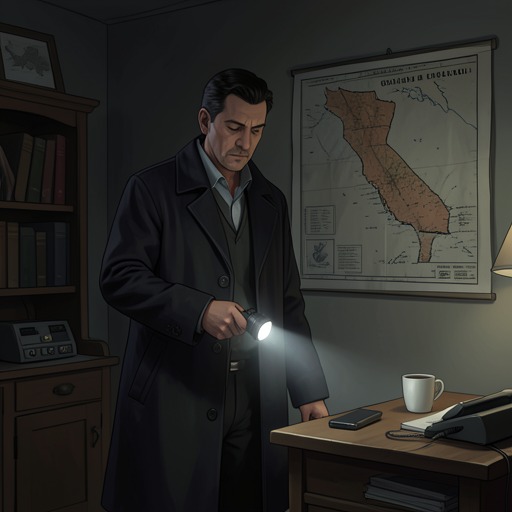
Lyman Smith was a prominent Ventura attorney on the verge of a superior court judgeship. Charlene Smith, his second wife, had once worked as his secretary. On a Sunday morning, Lyman’s twelve-year-old son, Gary Smith, rode his bicycle to his father’s house to mow the lawn. The front door was unlocked. An alarm clock sounded from inside, drawing the boy toward the master bedroom, where he found his father and stepmother dead beneath the covers. Bark fragments were scattered across the carpet, and a narrow piece of wood lay near the bed.
The scene led investigators to consider a friend and former business partner, Joe Alsip, who had visited the Smiths the night before. His fingerprint was found on a wine goblet, and his minister told police that Alsip had essentially confessed to him. Investigators arrested him, and the police and prosecution entered the preliminary hearing expecting their case to hold. The evidence seemed to point toward someone in the couple’s circle, but the apparent strength of that explanation would not survive the hearing.
Alsip’s defense attorney, Richard Hanawalt, was known to the investigators for successfully defending drunk-driving cases and for speaking in mixed metaphors and non sequiturs. In his closing argument, however, he also recast the crime scene as consistent with an unknown intruder. He emphasized the binding, the fatal blows delivered with a piece of wood, and the absence of lights in the house, which left open the possibility that the attack had occurred in darkness. A bathroom window afforded a view into the bedroom; nearby was the woodpile from which the piece of wood could have been taken. These details gave the defense a way to challenge the premise that the killer must have been known to the Smiths.
A case left unresolved
After the preliminary hearing, the Ventura County district attorney released Alsip for lack of evidence. The investigative team returned to the beginning, divided over what the crime meant: some believed the perpetrator knew the Smiths, while others considered it a random, sexually motivated crime. The case file remained in the investigators’ bullpen for years and was eventually moved into the evidence vault. The hearing had not resolved the competing explanations; it had removed the suspect on whom the investigation had concentrated.
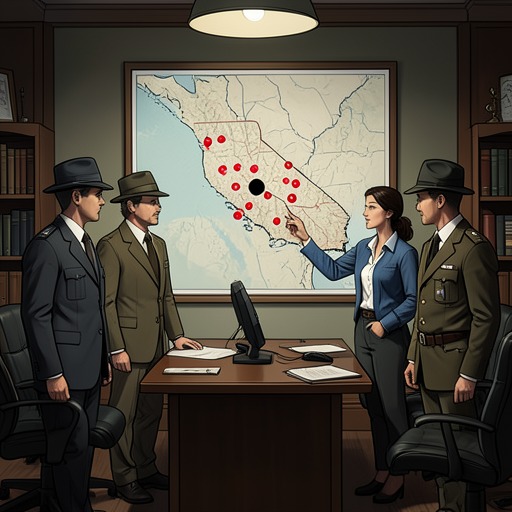
The uncertainty persisted even as investigators explored possible links between separate double homicides. The Santa Barbara Sheriff’s Department had raised the possibility that its cases were connected to other killings, but authorities in Ventura and Orange County were skeptical. The Smith case likewise did not yield an answer through routine review. Its eventual connection to other murders would come not from a new witness or a confession, but from forensic material retained from the investigation.
Glass slides and a DNA connection
When Larry Pool noticed a Ventura Police Department case number in a report in the Harrington file, he followed it up. The number led him to the Smith murders. Pool told Ventura investigators that Orange County had an unsolved serial case involving four homicide victims with similarities to the Smith case, and asked them to send any surviving forensic evidence to the Orange County Crime Lab.
The package Mary Hong opened contained a couple of glass slides. Such slides could be used with swabs collected in a rape kit to help locate sperm under a microscope, but the swabs themselves were usually retained as well. Their absence left the laboratory with less biological material than a criminalist would ideally want. Even so, Hong was able to develop a DNA profile from semen on the slides. On February 17, 1998, Pool received her report: Lyman Smith was excluded as the source, and the profile matched those associated with the Keith and Patty Harrington, Manuela Witthuhn, and Janelle Cruz cases.
The match supplied a forensic connection where earlier suspicions and circumstantial similarities had not been enough. Some investigators in Ventura resisted the result, and Detective Russ Hayes later recalled being astonished and initially unable to believe it. The reaction marked a sharp contrast with the preliminary hearing years earlier: then, investigators had been confident in a suspect they could not substantiate; now, a laboratory result connected the Smith crime to a wider group of killings, though the implications took time to be accepted.
Loss, delay, and reinterpretation
For Roger Harrington, the father of Keith Harrington, the years without an answer had become an all-consuming search. He hired a private investigator, offered a large reward, and arranged for friends and co-workers to be reinterviewed. He revisited what he remembered of Keith and Patty’s lives and deaths, but the details never formed a complete explanation. The discovery of the DNA evidence would bring the investigation closer to an answer, but the news arrived too late for him: Roger died on March 8, 1995, before investigators tested the slides in October and November 1996 or made calls to the families in December.
The later DNA findings also changed how one detail of the Harrington murders could be understood. Roger had believed the killer covered his son and daughter-in-law’s heads out of remorse. The account instead explains that the killer had previously bludgeoned a couple and did not want their blood on him. That correction underscores the distance between a relative’s effort to make sense of a crime and the explanation eventually suggested by the broader case history. For the Smith murders, too, the retained slides outlasted the failed prosecution and the years in storage: they did not immediately identify a killer in court, but they connected the case to other murders and altered the investigative landscape.