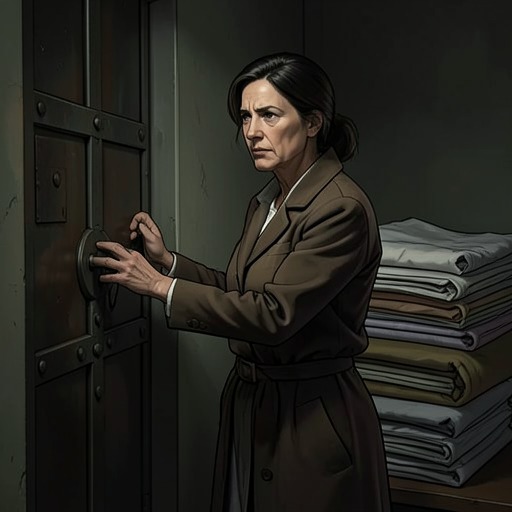
Michelle
I'll Be Gone in the DarkMichelle is presented as a writer who pursues the East Area Rapist case by joining archival work to close attention to place, behavior, and the social consequences of fear. Her reporting moves between the labor of assembling a story and the details in police records: drainage canals, missing household objects, recurring phone calls, and neighbors’ changing responses. That method makes the crimes legible as a pattern of preparation and surveillance, while also leaving Michelle to confront what a community does when danger becomes familiar.
Identity and Investigative Method
In an excerpt from an early draft of her article In the Footsteps of a Killer, Michelle describes meeting The Social Worker in a cramped office at a troubled high school in east Sacramento. They begin talking in the compressed shorthand of people who have spent time studying the same case. The scene conveys Michelle’s way into the subject: not as a detached inventory of incidents, but through conversations with people whose knowledge has accumulated around the still-unresolved crimes.
Her reporting also gives weight to the physical geography recorded in police reports. Sacramento’s canals and drainage ditches recur in evidence and sightings, and Michelle reads them as more than background. She describes the East Area Rapist as moving through this underground network and targeting neighborhoods as well as individuals. In her reconstruction, the preferred setting was often a single-story house near a greenbelt, usually second from a corner. Signs of advance surveillance could include illegal entries nearby, small or personal possessions going missing, and a sharp rise in hang-up calls within a few blocks of an attack.
Michelle interprets those signs as reconnaissance. The offender appeared to select a neighborhood, identify several possible victims, and preserve options for the night he chose to act. This account shifts attention from the isolated crime scene to the preparations around it: the surrounding homes, residents’ schedules, and the landscape through which an intruder could move unnoticed. It also distinguishes what the records show from what remains uncertain about how the offender learned the details of people’s lives.
Neighborhoods Under Pressure
Michelle follows the change in public awareness through victims’ accounts and police reports. At first, awareness of a serial rapist was faint; as news spread, people began interpreting what happened to them through what they had heard about the East Area Rapist. Roughly a year into the attacks, some victims recognized the threat when they awoke. Neighbors’ inaction, in Michelle’s account, also changed character: it was no longer simply a matter of not knowing or not noticing. Some people saw or heard something, then secured their homes, turned off the lights, and withdrew in fear rather than risk going outside or calling the police.
She connects that retreat to a wider failure of mutual protection without treating the fear as imaginary. A scream could be mistaken for teenagers fooling around; someone jumping a fence might appear to be taking a shortcut; a late-night gunshot might be dismissed as a firecracker or a car backfiring. In the passage that follows, the ordinary decision to return to bed becomes part of the account of how a warning can be misread and help delayed. Michelle’s concern is not only that people failed to recognize a pattern, but that, once afraid, they could stop looking out for one another.
Her reading of the offender’s use of stolen objects sharpens that argument. Two packs of Winston cigarettes taken from one victim appeared outside a later victim’s home; jewelry stolen from a neighbor turned up at another house. Pills or bullets taken from one person were later found in a neighbor’s yard, and some victims shared surnames or occupations. Michelle sees these transfers as a deliberate way of making separate households feel connected to the same threat. The objects become clues in an investigation and signals that the offender could reach across the neighborhood, even when residents did not recognize their connections to one another.
Evidence, Uncertainty, and the People at Risk
Michelle does not treat every pattern as proof of a complete explanation. A case involving Kathy and David, who were moving out of their nearly empty house, raises questions about timing and access: the offender came during their final hours there, and the couple told investigators he had not approached their three-year-old son’s bedroom. Other victims with young children reportedly noticed similar avoidance. These details prompted speculation about how the offender selected targets and learned household layouts, but the question remained unresolved. Michelle’s account preserves that uncertainty rather than claiming knowledge the investigations did not establish.
The distinction matters to her larger portrait of preparation. Missing possessions, suspicious sightings, and calls can illuminate a process without identifying every intended victim or explaining precisely how the offender chose among them. Michelle writes of women who may have avoided an attack because a schedule changed or chance intervened. Her approach widens the frame beyond the documented victims, while acknowledging that the evidence cannot name everyone who may have been watched or considered.
Work Left Unfinished
The difficulty of obtaining records shaped Michelle’s treatment of the Ventura investigation. She had planned to cover it at length, but the case file proved elusive. In 2014, she paid the Ventura County Courthouse $1,400 for printed transcripts from the Joe Alsip preliminary hearings. The 2,806 pages had to be reproduced from microfilm. Those transcripts contained references to material more fully documented in official reports, which made the missing file more—not less—important to her research.
In January 2016, Michelle finally obtained the file after borrowing three dozen boxes of Golden State Killer material from the Orange County Sheriff’s Department. Much of the material she had read by the time of her death focused on Joe Alsip, whom the account identifies as a red herring. She did not have time to integrate that research into the narrative. The gap is therefore not a lack of interest or effort: the account records years of pursuit, the cost and scale of the transcripts, and the eventual arrival of the boxes, followed by the fact that the work remained unfinished.
At a Los Angeles Thanksgiving gathering in 2012, that labor presses into domestic life. Michelle was hosting about a dozen adults and four young children while trying to finish the second draft of a seven-thousand-word story due the following Tuesday. She had sent brief requests for help, worried about the deadline, and found herself unusually impatient over Patton Oswalt’s undersized turkey. When the family shared what they were thankful for, she briefly closed her eyes and concentrated on a wish; later, while the children watched The Wizard of Oz, she stayed away from the room, aware that her own emotions needed restraint. The following Saturday, Patton took Alice Oswalt for the day so Michelle could revise upstairs. The scene places the work beside family routine without suggesting that the case displaced every other part of her life. Across the entry, her investigative voice is defined by that sustained effort to make patterns visible—and by the limits of the time and records available to her.