Patton Oswalt
I'll Be Gone in the DarkPatton Oswalt is portrayed as Michelle McNamara’s husband, confidant, and witness to the costs of her work. In the book, his support is practical rather than triumphant: he tries to help her continue after investigative dead ends, describes the effort and strain he saw at close range, and later connects her legacy to their daughter’s curiosity. These scenes make him a domestic counterpoint to the case narrative—not its solver, but someone who shared the uncertainty surrounding McNamara’s pursuit and understood what it demanded of her.
Identity and Place in the Narrative
Oswalt appears chiefly through his relationship with McNamara and through his own account of their life together. He says he was married to a crime fighter for a decade, while another scene places the couple at dinner for their eighth wedding anniversary. The difference in those references reflects the book’s distinct moments of telling: the anniversary scene occurs during the pursuit, while the afterword looks back across their marriage. Together, they frame Oswalt as both a partner in the unfolding story and a retrospective witness to McNamara’s character.
His role is intimate, not investigative. The book does not present him conducting inquiries or claiming credit for discoveries. Instead, it shows him responding to the emotional rhythm of McNamara’s work: periods of hope, leads that fail, and the need to begin again. His perspective gives the reader access to what that cycle looked like within a marriage, beyond the evidence files and public account of the case.
Encouragement in the Face of Dead Ends
At their eighth-anniversary dinner, Oswalt tries to lift McNamara from what he recognizes as a listless defeat after she has been talking about dead ends. He reaches for the example of Rocky: the character struggles through training, is past his prime, and keeps returning to the work despite pain and exhaustion. Oswalt connects that persistence to cold-case investigators, whose labor may mean calling people, digging through boxes, coaxing out stories, and swabbing for evidence, only to receive another negative answer.
The analogy is not a promise that effort guarantees a solution. Oswalt emphasizes the repeated routine after disappointment: rise the next morning, get coffee, clear the desk, and try again. He also recalls that Rocky did not defeat Apollo Creed, but nevertheless astonished him and the wider world by refusing to quit. That distinction matters to the encouragement he offers McNamara. Persistence can have meaning even without the clean victory of a solved case; the immediate aim is to keep the search alive rather than mistake a setback for its ending.
The anniversary setting lends the exchange a private measure of time. They are celebrating eight years together while discussing the possibility that the work may continue through many more failures. Oswalt’s attempt to buoy her spirits is affectionate, but McNamara resists the reassurance when he imagines a future crowded with villains. The moment shows encouragement meeting the limits of what either partner can comfortably promise: he offers a story of endurance, while she pushes back against the thought of more cases ahead.
Witness to the Work and Its Cost
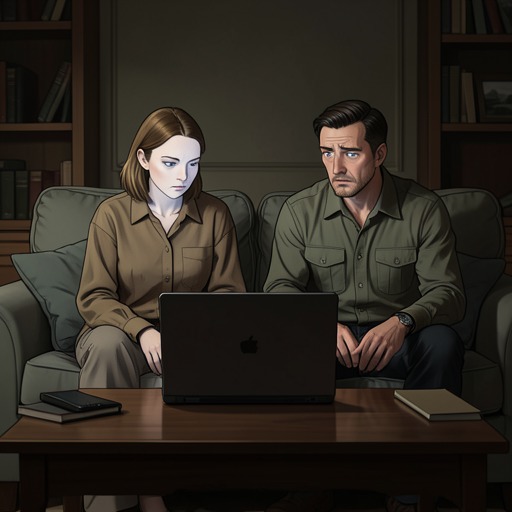
In the afterword, Oswalt describes McNamara’s interest in people, especially detectives and investigators who assembled scattered clues and tried to catch violent offenders. He recalls seeing her anger when she read survivor testimony or interviewed families still affected by a loved one’s death. The account shifts from the public idea of crime solving to its private aftermath: some mornings, he brought her coffee and found her at her laptop, crying and worn down by a lead that had ended in a dead end.
He also describes what followed those moments. After coffee, McNamara wiped her eyes and returned to the keyboard, opening another window, pursuing another link, and making another attempt. The sequence gives concrete form to the persistence he urged at the anniversary dinner. His earlier Rocky comparison becomes, in retrospect, a description of a pattern he had already witnessed at home: exhaustion did not prevent her from starting again, though it did not make the work painless.
Oswalt presents her commitment as directed toward justice rather than personal recognition. He says she did not care whether she was the person who captured the offender; what mattered to her was that he be arrested and imprisoned. In his account, this conviction arose alongside her honesty about her own obsessions and the ways her commitment could endanger her sleep and health. His testimony therefore holds two facts together: he admired her determination, and he saw that the pursuit took a serious toll.
Family, Loss, and Legacy
The afterword’s account of McNamara’s work is framed by her absence. Oswalt continues to hope that the offender will be imprisoned, and expresses the hope that McNamara might somehow hear of it too. His words keep the case unresolved in the narrative even as they make clear what outcome he wants. The ending does not offer a completed investigation; it preserves both the wish for justice and the loss of the person who pursued it.
A later family scene gives that loss a different scale. At Christmas, their daughter Alice opens a present from Santa: a small digital camera, which she happily explores. Later, she notices that Santa and her father have the same handwriting. Oswalt recounts the discovery as an unexpected act of detection, and the book closes by calling Alice a little detective McNamara left behind. The scene links a child’s ordinary curiosity to her mother’s investigative legacy without suggesting that Alice will take up the case itself.
Across these episodes, Oswalt serves as a witness to both sides of McNamara’s pursuit: the repeated labor of beginning again and the life around that labor, including marriage, parenting, fatigue, and grief. His contribution is not a solution to the mystery but a record of what her determination looked like to someone who shared her home. By ending with their daughter’s observation, the book turns that record toward continuity: McNamara is gone, but her attentiveness to clues survives as a possibility within family life.