Paul Holes
I'll Be Gone in the DarkPaul Holes’s significance lies in the way he joined laboratory science to the patient reconstruction of old cases. A criminalist who wanted to investigate, he used DNA to establish links among suspected East Area Rapist attacks and then pursued the questions that the profiles could not answer on their own: how the offender selected neighborhoods, what the surviving records could reveal, and where earlier conclusions might have been wrong.
From the Laboratory to Investigation
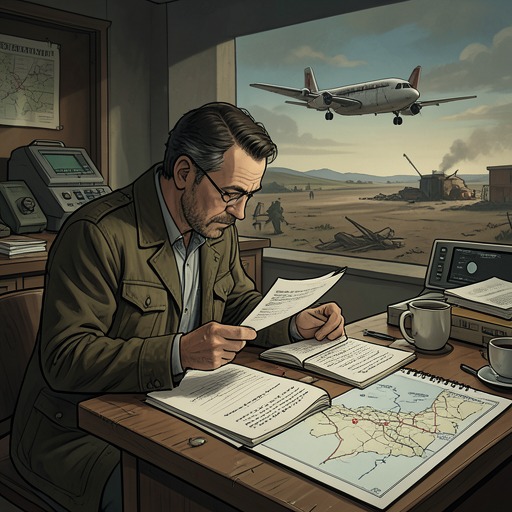
In 1997, Holes was in his late twenties and working as a deputy sheriff criminalist after graduating from the University of California, Davis, with a degree in biochemistry. He had begun in forensic toxicology, but found himself drawn toward crime-scene investigation. His curiosity took him out with investigators and into the Property Room, where boxes of unsolved cases held statements, photographs, and marginal notes left by investigators. The files offered stories and unanswered questions that could not be resolved by laboratory procedure alone.
That impulse sometimes put him at odds with the boundaries of his job. Fellow criminalists told him that investigating was not his responsibility, but he continued to angle for a position in the investigative division. The book characterizes him as convivial and determined: he could remain easygoing while pursuing the work he wanted. His eventual path grew from that combination of scientific training and a willingness to follow a question outside his formal specialty.
A 1997 flight to a California Association of Criminalists conference brought him into conversation with Murdock, recently retired chief of the Contra Costa County Sheriff's crime lab and a specialist in firearms and tool marks. The encounter places Holes among forensic professionals, but his interest was already moving beyond a narrow laboratory role. The cases that held his attention were not merely collections of evidence; they were incomplete accounts whose gaps might be made meaningful by renewed examination.
Reopening the East Area Rapist Evidence
In July 1997, Holes began retrieving sexual-assault kits associated with cases suspected of being the East Area Rapist’s work. The Contra Costa County crime lab had a relatively new DNA program and less advanced equipment than some other California laboratories. Holes believed three kits might yield enough material for a rudimentary profile. The attacks in Northern California appeared connected, but he wanted scientific confirmation that one offender was responsible for the three Contra Costa County cases. A confirmed link could give investigators grounds to revisit old suspects and seek comparison samples.
The amplification process took time. When the results came in, they supported Holes’s prediction: the same man was responsible for all three cases. The profile was basic, but it gave the investigation a new point of reference, one that could become more refined as the laboratory’s equipment improved. The result also changed the order of Holes’s work. After concentrating on the science, he turned back to the case files and began examining the offender’s behavior, including neighborhood selection, telephone calls to victims, and tactical preparation.
Holes carried the profile to investigators in Southern California. In a call to Irvine, he described an unidentified white male known as the East Area Rapist, believed to have committed fifty sexual assaults in Northern California between 1976 and 1979. He outlined a recurring pattern: nighttime entries into single-story homes in middle- and upper-middle-class neighborhoods, sleeping couples, victims restrained, and occasional thefts that favored personally meaningful jewelry over more valuable property. A ski mask made physical identification difficult; the available evidence also indicated a size-nine shoe, type A blood, and nonsecretor status. These details offered investigators a way to compare crimes across jurisdictions without treating resemblance alone as proof.
The Contra Costa County lab’s progress was slower than Orange County’s. When the lab brought short tandem repeat typing into operation in January 2001, Holes asked a colleague, Dave Stockwell, to retest the DNA extracts from the East Area Rapist cases. The repeated analysis again showed the same offender profile across the three cases. That verification mattered because a lead built on older laboratory methods could not simply be assumed to remain reliable; it had to withstand the improved testing now available.
Reading the Crimes as Patterns
For Holes, a DNA match established a connection, not a complete explanation. The case files also described an offender who appeared to study the places where he might attack. Reports indicated prowling and illegal entries in homes near later victims, missing small items, and increases in hang-up calls within a few blocks before attacks. The East Area Rapist favored single-story houses, often near open space such as a park or field. The pattern suggested reconnaissance across a neighborhood, with several possible targets considered before an attack. Holes’s file review thus widened the investigation from the individual victim to the surrounding streets and the offender’s preparation.
On a tour of Contra Costa County crime scenes with Michelle McNamara, Holes discussed why single-story homes appeared so frequently in the cases. He reasoned that a two-story house could leave residents with limited routes between floors and make them more vulnerable to being cornered. A single-story layout also made it easier for a prowler to look through windows and assess what was happening inside. The surrounding architecture mattered too: someone moving through yards and over fences could be more visible from an upper-floor vantage point. His explanation treated house design not as proof of an offender’s identity, but as one part of how he assessed opportunities and exposure.
That spatial attention extended to the offender’s movements after an attack. In one case, three bloodhounds worked the area. Their handlers cautioned that time and small changes in wind could alter scent patterns, but agreed that the dogs’ movements suggested prolonged prowling. The reported path led from a north-side fence into the victim’s backyard, then out over the southwest corner of the back fence. The trail continued south along railroad tracks before reaching a cross street where the suspect likely entered a vehicle. The account supplied a possible route, while its qualifications preserved the limits of scent evidence.
A separate scene showed how even the surrounding development could matter. At the time, an open field and a school stood across the street, and the neighboring house was vacant and listed for lease. Dogs tracked the East Area Rapist’s scent around a corner, where he appeared to have entered a vehicle parked in front of a house under construction for a pool. Such details connected the attack to an environment with empty property, construction activity, and potential escape routes, without establishing by themselves why the offender chose that location.
Evidence, Uncertainty, and the Investigator’s Limits
Holes’s work repeatedly returned to the distinction between a promising clue and a settled conclusion. A piece of evidence associated with the tracks had no scene photograph or sketch to show whether the items were together or scattered. A brief notation by Patty was the only record of where along the tracks the evidence had been found. Holes could subject the paper to touch-DNA testing and high-resolution scanning and ask multiple experts to examine the map, but he could not recover the context known to John Patty, who had died of cancer in 1991. The episode makes the cost of incomplete documentation concrete: later technology can extract new information from an old record, but it cannot restore knowledge that was never preserved.
He nevertheless followed leads that others might regard as too uncertain or unusual. The book describes him cold-calling experts, reconsidering clues, and developing interpretations that differed from those of fellow investigators. An observation from a real-estate developer altered his thinking about who might have made a piece of evidence combining juvenile writing with evident design skill. When Holes showed a map to a friend who worked in development, the friend considered it professional drafting. Holes did not present every such possibility as a confirmed answer; rather, he continued asking questions while recognizing the danger of allowing an appealing theory to dictate what the evidence meant.
That caution also informed his reassessment of suspect eliminations. More than thirty years after earlier testing, Holes questioned whether exclusions based on secretor status were dependable. The method used in the 1980s had known quality-control problems, and later research had identified aberrant secretors who might express ABO type in some bodily fluids but not others. For Holes, an old exclusion could not be treated as permanent merely because it had once been recorded as scientific. The methods and assumptions behind it also required review.
His work on Jim Walther shows another point at which investigative and forensic strands met. The Sacramento Sheriff’s Office eventually contacted Holes after approaching Walther’s brother with a mobile fingerprint device. The brother confessed, and a thumbprint confirmed that the homeless man was Jim Walther. Investigators swabbed him and rushed the DNA sample to the laboratory. The account establishes Holes’s involvement in the call and the subsequent testing process, while the confirmation and sample collection mark the steps that followed the brother’s response.
Method and Narrative Role
Holes appears as both a scientist and a reader of records: he looks for matches that can be tested, then returns to reports, maps, and environments for the context a profile cannot supply. The repeated checks on the Contra Costa County DNA results demonstrate the value of verification; the missing scene documentation and the reconsideration of secretor-status exclusions show why verification cannot eliminate every uncertainty. His investigative method advances through that tension rather than resolving it by confidence alone.
The book also places his technical work within a wider landscape of fear and incomplete public response. Reports chart increasing awareness of the East Area Rapist, from early uncertainty to growing media attention and neighborhood paranoia. Some residents, after hearing stories about the offender, were afraid but did not call police; the narrative contrasts that retreat with the difficult choice to leave a bedroom and risk reporting something that might lead nowhere. This context does not make Holes responsible for neighbors’ decisions. It clarifies the human environment in which he later read the reports: the crimes left not only forensic traces but also altered expectations about what a sound, a stranger, or a darkened house might mean.
Holes’s defining contribution in these episodes is therefore not a single decisive revelation. It is a way of keeping old cases open to disciplined revision: connecting attacks through DNA, testing those connections again when methods improve, examining the geography of preparation and escape, and questioning exclusions whose scientific basis may have weakened. The surviving records could be incomplete, and a compelling interpretation could still be wrong. His persistence lay in working at that boundary—where a new test might clarify the past, but where careful investigation still had to acknowledge what the evidence could not recover.