Richard Shelby
I'll Be Gone in the DarkRichard Shelby was among the first investigators to recognize that Sacramento was facing a serial rapist, and his work gave particular weight to the quiet, easily dismissed signs of prowling around a neighborhood. His account of the case combines close observation with an unvarnished awareness of failure: the offender was not always brilliant, Shelby believed, and the investigation did not always make the most of what people had seen.
Identity and Background
Shelby came to the case as a seasoned local officer. He had become a detective in 1972 under Lieutenant Ray Root, whose approach favored initiative: cultivating informants, uncovering crimes that might otherwise go unreported, and developing cases rather than waiting for assignments. That approach suited Shelby’s instincts. Deference to supervisors’ ideas did not come as naturally, and the distinction would shape his career as well as his place in the investigation.
His route onto the force had itself been uncertain. A left ring-finger injury had nearly kept him from becoming a police officer. Decades later, he was tall and wary, with a conspicuous nose and half of that finger missing. The portrait is not simply of a hardened former detective: in a lunch meeting, he responded gently when the waitress said there was no lemonade, accepting iced tea without irritation. The book sets that softness beside his bluntness, suggesting a man whose directness did not erase his sensitivity.
Work on the East Area Rapist Case
Shelby joined the investigation in fall 1976 and was among the first to connect the crimes as the work of a serial rapist. The offender’s appearance remained uncertain. Investigators developed sharply different mental pictures: a blond young man in an army jacket, a Mormon riding a bicycle, or a polished Realtor with olive-toned skin. Repeated stops of young white men did not resolve the problem; the right person might have been stopped, or might never have been. In a case built around partial sightings, even the basic image of the suspect would not settle into a shared description.
What stayed with Shelby were credible reports of a prowler who, when noticed, walked away at an unhurried pace. The calmness of those accounts troubled him. The offender was not always caught running or behaving in a way that made danger unmistakable; he could appear to be an ordinary person moving through the dark. The investigative challenge was therefore not only to find a suspect, but to recognize the significance of behavior that neighbors could interpret as inconsequential.
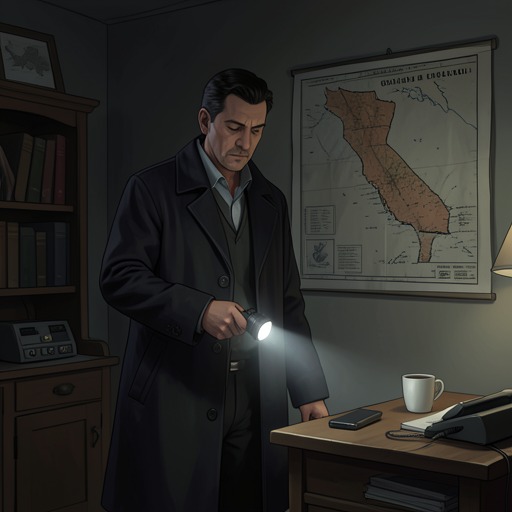
The book locates Shelby’s patrol work in Sacramento’s river-side streets. Thirty-six years later, he returned with the author to the neighborhood where he had once driven with his dashboard lights dimmed, following radio reports and hoping his headlights would reveal a young man, about five feet nine, wearing a ski mask. Roofs sometimes yielded small objects stolen from victims. At first, the objects seemed to have been thrown up there; after residents reported strange thumps, Shelby realized they were likely falling from the offender’s pocket as he moved across the rooftops. The detail turns an apparent scattering of clues into evidence of a route and a method.
Reading the Neighborhood
Shelby’s casework gives significance to spaces between houses as well as to the houses themselves. The East Area Rapist favored single-story homes near greenbelts, open fields, or parks, and reports described prowling, unlawful entries nearby, missing small possessions, and a rise in hang-up calls within a few blocks before attacks. Taken together, these signs suggested reconnaissance: the offender was learning residents’ routines and keeping several possible targets in view. The crimes were not isolated appearances at front doors; they were preceded by attention to the surrounding neighborhood.
Shelby’s recollection of the offender’s rooftop movements adds a physical dimension to that pattern. He once found what appeared to be a secluded observation spot beneath a dense tree off Northwood Drive, marked by cigarette butts and zigzagging shoe tracks. Neighbors had noticed a vague presence but had not reported it. The place was not a dramatic hideout so much as an overlooked piece of the residential landscape, a reminder that the offender could exploit spaces people saw without recognizing what they meant.
The lack of calls from neighbors was a question the author put directly to Shelby. He did not offer a sweeping explanation for their reluctance. At night, a person dressed in black and moving along hedges might be difficult to see clearly, much less identify as a threat. By the time the attacks had become widely known, the book describes a change from simple unawareness to defensive withdrawal: some residents noticed suspicious activity, secured their homes, and stayed inside rather than contacting police. Shelby’s work thus sits within a case where observation alone did not guarantee warning or intervention.
Friction, Failure, and the End of His Assignment
Shelby’s relationship with the department grew more difficult as the case attracted scrutiny. After an attack on Fiona and Phillip, the East Area Rapist disappeared from Sacramento for the summer. Before the offender returned in October, Shelby had been reassigned to patrol. Shelby said the transfer itself did not upset him, but he was exhausted by the manhunt and the internal conflict; he also bristled at the surveillance and attention directed at the investigation. His clashes with superiors had become more open, while the political demands of a high-profile case sat uneasily with his temperament.
He did not present the failures as belonging only to other people. Looking back, he described the investigation as damaged by several kinds of error: superiors absorbed in departmental politics, wrong turns he had made in his own patrol car, and a dispatcher’s instruction to discard a hidden bag containing a flashlight, ski mask, and gloves. That candor complicates the image of Shelby as a detective thwarted solely by bureaucracy. He could identify the institutional failures and still acknowledge his own part in a case where a missed turn or mishandled report might matter.
Retrospective Assessment
Shelby’s most pointed judgment concerned the offender’s reputation for intelligence. He questioned the idea that the East Area Rapist had always needed exceptional cleverness. That skepticism does not minimize the offender’s planning; the evidence of surveillance and repeated prowling indicates careful preparation. Instead, Shelby’s view draws attention to the ordinary failures that could make an offender seem more formidable than he was: vague sightings went unreported, information was sometimes mishandled, and investigators themselves pursued mistaken leads.
The book presents Shelby as both a practical observer and a figure shaped by frustration. His career had been rocky, his assignment ended amid conflict, and the face he sought never became clear. Yet the lasting force of his contribution lies in the small details he took seriously: an unhurried prowler, objects falling from a rooftop, tracks beneath a tree, and reports that appeared too indistinct to act upon. His account resists the tidy legend of an impossibly clever criminal. It leaves instead a harder lesson about how a case can be visible in fragments and still remain unsolved.