Buffalo, New York
I'm Still Here- What didn't kill me made me stronger and sharperBuffalo, New York, functions as the book’s first major field of judgment: a city where Janae Morrison’s relationship with Robert Walters becomes a public scandal, where the media and social elite decide whose testimony is credible, and where truth ultimately forces the person who reveals it to leave. It is not merely a setting abandoned for another destination. Buffalo is the place in which Janae’s past, body, addiction, sexuality, and social position are assembled into a punitive identity, until escape becomes necessary for survival and renewal.
A City of Public Exposure
Buffalo first appears through Janae’s experience of the news cycle. WIVB News broadcasts her image beside Councilman Robert Walters while reporting on the alleged affair and a drug bust in which she was shown naked with cocaine. The coverage revisits her troubled past and addiction, presenting her as a horrible person before the public has access to the evidence surrounding Walters’s conduct. Robert, by contrast, presents himself as a respectable man attempting to help a damaged young woman. His public statement reduces their relationship to business and claims that his only interest was her artwork, while he denies sleeping with her and describes her as a distorted soul he was trying to save.
The city’s judgment depends on an unequal distribution of credibility. Janae is described through the stigmas of obesity, drug use, sexual misconduct, and instability, while Robert’s position as a councilman and community figure gives his denial the appearance of authority. The contrast is sharpened by the public image of his wife, Elizabeth Mourning-Walters, whose education, beauty, and popularity make the alleged affair seem implausible to the community. Buffalo therefore becomes a social system that treats reputation as evidence: Robert is imagined as the humanitarian, Elizabeth as the admired wife, and Janae as the disreputable woman whose account can be dismissed without examination.
The Affair and Its Hidden Record
Janae’s account reveals that the relationship was not a single misunderstanding but an extended affair. Robert first approached her while she was trying to sell her artwork, bought art supplies, paid for art classes, and took her to New York to see work by artists associated with the Harlem Renaissance, including Aaron Douglas, Jacob Lawrence, Romare Beardan, Leslie Boiling, and Augusta Savage. He told her that she was beautiful, that he loved big women, and that he could not live without her. He also made promises about leaving his wife, then returned to Elizabeth while continuing to call, text, and ask Janae to forgive him.
The affair connected intimacy to cultural ambition. Robert’s gifts and invitations opened doors that Buffalo’s social hierarchy had kept closed to Janae, while Janae’s artwork gave him a way to describe his interest as respectable. She painted the portrait that hung in his office, and Elizabeth even befriended her, bought her clothes and shoes, and introduced her to a high-society circle. That apparent inclusion made the later betrayal more severe: Janae was not simply excluded from Buffalo’s elite but briefly drawn into its orbit, where affection, patronage, marriage, and social power became impossible to separate.
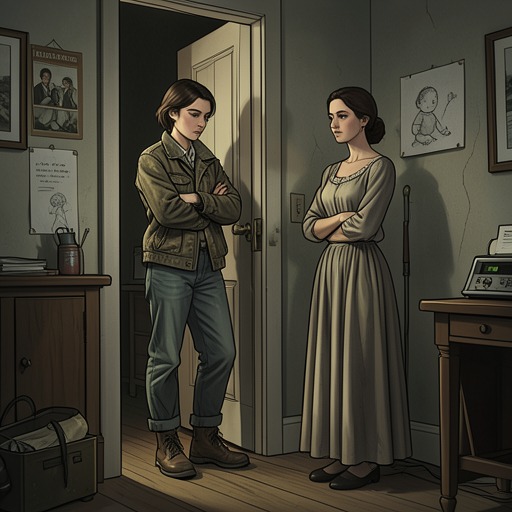
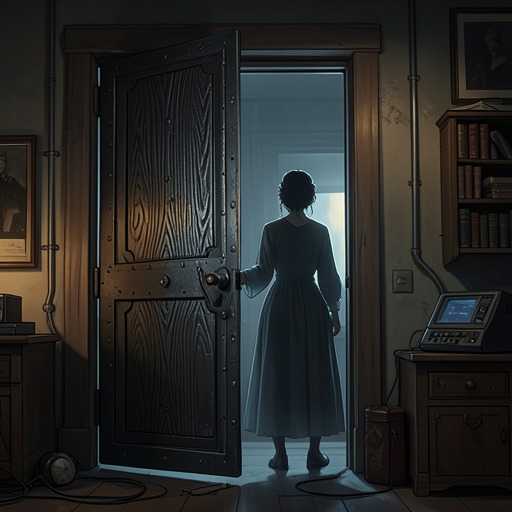
Janae eventually broke off the relationship after discovering the full reality of Robert’s marriage, but he pursued her and insisted that she was the woman he wanted. When she confronted him and accused him of promising to leave Elizabeth, he answered by weaponizing the very labels already circulating through Buffalo. He called her a druggie and a fat misfit, told her that no one would believe her without proof, and ordered her out of his apartment. The slammed door turns private rejection into a decisive reversal: love gives way to anger, and Janae begins to preserve the evidence that can challenge his public story.
Truth, Media, and Exile
Janae meets Jessica Brown, an executive producer at YNN News, over lunch and gives her an SD card containing videos, text messages, emails, and love notes on Robert’s stationery. The material records the relationship and Robert’s illegal acts. Jessica recognizes that the evidence could restore her program’s position and reacts with visible excitement, treating Janae’s private archive as a story capable of returning the station to the number-one spot. In Buffalo, truth is therefore both testimony and media currency: Janae seeks vindication, while the news organization sees a professionally valuable scandal.
Jessica nevertheless warns Janae that exposure will not make Buffalo safe. She tells her that the city’s elite Black women protect one another like wolves and that harming Elizabeth means harming the entire group. According to Jessica, Janae will be unable to find work, sell artwork, or remain socially accepted; she advises her to move to the West Coast, lose weight, dye her hair, and change her name. The warning makes clear that the scandal’s consequences extend beyond Robert. Even when the evidence supports Janae, the city can punish her through employment, reputation, and collective exclusion.
The public response confirms Jessica’s assessment. People stare, whisper, and point at Janae because her face has become recognizable through the coverage. One woman openly insults her for being too fat and ugly to have slept with Robert and calls her a disgrace. The comment reduces the question of Robert’s conduct to Janae’s body, showing how Buffalo’s social judgment makes physical stigma a substitute for investigation. Janae’s own account also records how she has internalized that judgment: after hearing the insults and watching the scandal unfold, she cuts herself with a razor, imagining that blood can remove the hurt and the ugliness imposed upon her.
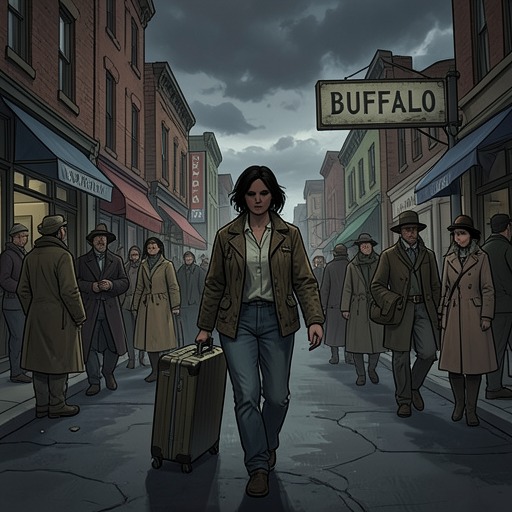
The broadcast intensifies the city’s spectacle by showing photographs of Robert using cocaine, blindfolded and naked, as well as images of him with Janae. Audio recordings include his promises that he loved her body, would leave his wife, and would marry her. The revelations expose the contradiction between his press-conference denial and the private record, but they do not restore Janae’s belonging. Threatening messages arrive, Elizabeth leaves an abusive voicemail, and Janae concludes that the truth has freed her while also placing a price on her head. She puts on a hoodie, leaves for a waiting Liberty taxi, and chooses California without knowing exactly why, except that Buffalo is no longer a place where she can remain.
Buffalo as the Past to Be Escaped
The city’s power over Janae is not limited to the affair. Her history includes running wild at sixteen, lying, smoking marijuana, engaging in risky behavior, and being disowned by her parents. She has already learned that a damaged past can become a permanent public identity. In Buffalo, that history is revived and amplified by television coverage, so the present scandal appears to confirm every accusation that preceded it. The city’s version of Janae is cumulative: addict, seducer, obese woman, homewrecker, and unreliable witness.
This accumulated stigma parallels the book’s broader treatment of Jensen Brick McCall, who later describes sleeping on library steps, being raped, living in uninhabitable conditions, moving through foster homes, and being dismissed as “the foster kid.” Although their trajectories differ, Buffalo belongs to the same world of labels that turns survival into evidence against the survivor. Jensen’s later understanding of his birth and abandonment also shows how family wounds are converted into names such as “my murderer,” while therapy and recognition begin to separate a person from the injury that defined him.
Buffalo consequently serves as the origin point of a larger movement from imposed identity toward chosen identity. Janae leaves with cash, a bus ticket, and the evidence that has made her unwelcome. On the journey away from the city, she encounters Jensen, draws him in her sketchpad while YNN News flashes her face nearby, and begins a new chapter shaped by art rather than by Buffalo’s verdict. The city remains the place of scandal and danger, but its exclusion also initiates the movement through which Janae can seek recovery, love, and a life no longer governed by Robert’s lies.
The City’s Wider Network of Judgment
Buffalo’s punitive atmosphere is reinforced by institutions and relationships beyond the television studio. Robert’s public identity depends on his position as a councilman, his marriage to the respected Elizabeth Mourning-Walters, and the confidence of a community prepared to believe that a powerful man is rescuing a troubled woman. Janae’s identity is assembled from the opposite materials: a visible body that the public mocks, a history of addiction, self-harm, and sexual vulnerability, and the assumption that a woman already marked as unstable cannot also be a reliable witness. The city does not merely hear competing stories; it ranks the speakers before their evidence is considered.
That ranking is also economic and cultural. Robert can pay for art supplies and tuition, invite Janae to New York museums, and display her work in his office, converting his resources into the appearance of benevolence. Janae possesses artistic ability and a private record of the affair, but neither gives her the social protection enjoyed by Robert and Elizabeth. Her artwork briefly brings her into elite spaces, while the same spaces later become the terrain from which she is expelled. Buffalo thus joins cultural recognition to social obedience: Janae may be useful as an artist, but she is not permitted to challenge the people who control the city’s reputations.
Departure and Narrative Reversal
The exposure of Robert’s photographs, recordings, messages, and emails produces a reversal in the public story, yet it does not create a secure victory for Janae. The evidence proves that Robert pursued her, used drugs with her, promised a future with her, and lied during the press conference. At the same time, its circulation turns her private suffering into a spectacle that attracts threats and intensifies the hostility directed at her. Buffalo can be forced to see the truth without becoming willing to shelter the person who revealed it.
Janae’s departure is therefore both flight and self-preservation. Jessica gives her an envelope of cash and a bus ticket, while warning that she has been blacklisted from employment and the sale of her artwork. Janae hides the money in her clothing, cuts herself in the bathroom after the public insults, watches Robert’s scandal break across the television, and then leaves in a hoodie for the taxi waiting outside. The sequence binds bodily pain, media exposure, and geographic movement together: the city has made her feel contaminated, but leaving is the first practical act by which she refuses to remain inside its definition of her.
The choice of California is initially uncertain rather than triumphant. Janae does not possess a clear plan or a guaranteed welcome; she only knows that Buffalo has become unsafe and that another life must be attempted elsewhere. At the station, with her face still appearing on YNN News, she begins drawing the man who will become Jensen Brick McCall. Her sketch gives him two tears even though she sees none on his face, transferring her own grief into an image before either of them can explain the sorrow connecting them. The first movement away from Buffalo therefore carries its judgment with it, but art creates a different form of attention—one based on seeing rather than condemning.
From Exile to Reinterpretation
Buffalo remains important after Janae leaves because later recovery depends on revising the meanings produced there. In the city, she is called a druggie, a fat misfit, a disgrace, and a bad woman; outside it, her pain can be named without being treated as her entire nature. Inya offers help while Janae fears judgment, and later tells her to repeat that she is not bad energy until she believes it. This therapeutic language directly contests the social vocabulary that Buffalo imposed on her. The movement is not a simple erasure of the past but an effort to prevent the past from functioning as a permanent verdict.
The same pattern appears in Jensen’s account of survival. He describes being abandoned after a failed attempt to abort him, left on a table to die, and rescued by Grace, the nurse who first cared for him. He calls the woman who refused to save him his murderer, a name that expresses the force of his wound but does not finally contain his life. His later reconciliation with his family and his decision to understand survival as a purpose place Buffalo’s culture of labeling within a larger moral contrast: the city and its institutions declare people ruined, while recovery allows them to become witnesses, artists, partners, parents, and sources of care.
The eventual family future gives Buffalo a final counter-image. On Christmas Day, Janae gives birth to Grace Pearl McCall; her artwork sells for six figures and reaches the White House, while Jensen sits at the head of a loving family and describes his former murderer as his mother. The ending does not repair Buffalo or retract the violence of its judgment. Instead, it demonstrates that the identities produced there are provisional. The woman whom Buffalo tried to reduce to scandal becomes a successful artist, wife, and mother, and the man formed by abandonment becomes a husband, father, son, and kidney donor. Buffalo’s decisive narrative function is thus double: it is the place where stigma appears most powerful, and the place whose verdict the survivors ultimately outlive.