Chosen Family and Family Reconstruction
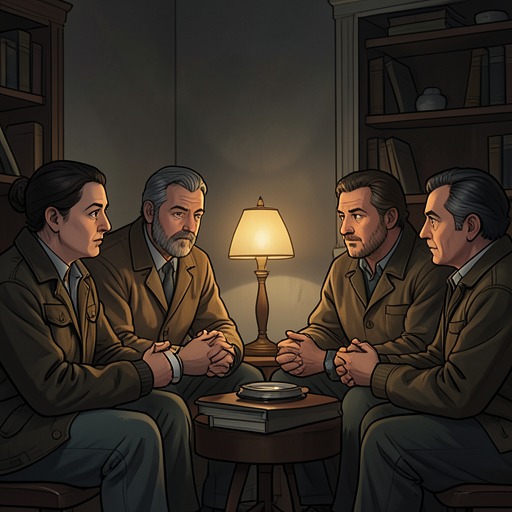
I'm Still Here- What didn't kill me made me stronger and sharperChosen family and family reconstruction name the story’s gradual answer to Jensen Brick McCall’s defining fear that he is unwanted and does not belong. His eventual family is neither simply recovered through blood nor built by forgetting past harm. Instead, recognition, practical care, and promises of continued presence turn biological ties and chosen bonds into relationships he can inhabit. The final image of a family gathered around him gives visible form to a belonging that once seemed impossible.
From Abandonment to the Search for Belonging
Jensen’s search begins in a wound bound up with his own survival. Gloria Simpson Picou tried to abort him at twenty-six weeks; after the procedure failed, he was left on a table in a dark room to die. Grace McCall, the nurse who first cared for him, saved him, while Gloria insisted that he should be allowed to die. Jensen consequently names his birth mother as his murderer: the word expresses how he understands both the attempted abortion and the rejection that followed. His account makes family reconstruction more than a reunion plot. Before he can accept a place among relatives, the story must acknowledge the terrible circumstances that made family feel dangerous.
His history with Grace offers an earlier, imperfect form of family care. At the house that had once been his home, Jensen remembers that she chose him and protected him from Rick’s racist abuse. Yet she would not let him call her Mom, because she considered that disrespectful to his birth mother. The relationship thus gave Jensen sustained maternal care while also preserving a boundary around his place in the family. His later longing to be welcomed without qualification is shaped by this contrast: he was loved and protected, but he still experienced himself as someone whose belonging had limits.
The story also gives Jensen’s search a purpose beyond his own family. He describes the man who tried to kill him as the subject of a quest that led him to investigate why he had survived. He hopes the story will help another young man who wonders why he is still alive. The movement from being regarded as a dead man walking to understanding survival as a mission reframes family as one part of a wider effort to find a reason to live. The personal search for his origins becomes inseparable from the effort to make a life in which he can be recognized and useful.
Recognition, Care, and the First Repaired Bonds
The truth about Jensen’s birth reaches Ginger Pearl through his account of the attempted abortion and the nurse who saved him. As he speaks, Ginger Pearl holds her cross to her heart and cries; Janae Morrison takes Jensen’s hand, and he does not pull away. Ginger Pearl recognizes him as her grandson, seeing the resemblance to the woman in the photograph. The scene joins recognition to physical gestures of care: Ginger Pearl’s tears and cross, Janae’s hand around Jensen’s, and Jensen’s willingness to remain in contact. Family connection arrives not as an abstract fact but as an emotional encounter that others witness with him.
Ginger Pearl’s recognition is followed by care in both directions. When Jensen finds her unwell, he helps her stand, reads the medication bottles, gives her the pills with water, and props her legs on a pillow. She calls him her grandson, and he kisses her cheek. The exchange reverses the familiar direction of family caregiving: the newly recognized grandson becomes a caregiver, while Ginger Pearl names the relationship that makes his care meaningful. Her need is concrete, and his response gives their newly acknowledged bond a daily, practical form.
Thomas also helps make the family’s history intelligible. He explains that Gloria had hidden her pregnancy and that the family did not learn Jensen was alive until two years earlier, when Ginger Pearl found photographs and made it her business to find him. His account clarifies both the long absence and the later search: the family’s failure to know Jensen’s fate was tied to concealed information, while Ginger Pearl’s response to learning of him was active pursuit. Thomas invites Jensen to spend time with him, barbecue, and get to know his brother and sister. The invitation does not claim that all distance has vanished; it offers ordinary shared life as a way to begin crossing it.
Chosen Bonds and the Uneven Work of Reunion
Jensen’s reunion with Gloria remains more difficult than his recognition by Ginger Pearl. He arrives at Gloria’s house, sees her distress, and must face the woman he has understood as both his mother and his murderer. His anger conflicts with a deep hunger for her love. That divided response matters: family reconstruction does not require Jensen to deny the injury or instantly forgive it. The possibility of connection exists alongside the pain of having been unwanted, and the story allows both to remain present.
Janae’s support gives Jensen another kind of kinship, one founded on commitment rather than shared blood. At a family gathering, Ginger Pearl takes his hand and reminds him that these are his family. Jensen still feels like a guest around his mother, despite being born from her. Janae recognizes the feeling and promises not to leave his side, even when he gets on her nerves; she also asks him not to push her out of his life when she insists that he do right. Their exchange makes belonging reciprocal. Janae does not offer a cure for Jensen’s history; she offers persistence, while asking him to sustain the relationship in return.
The gathering itself stages inclusion without making it effortless. Jensen hesitates to enter the house and sits alone under an umbrella while other people move toward the backyard. Janae joins him and holds his hand. His discomfort makes clear that being told he has relatives is not the same as feeling at home among them. The scene’s movement is modest but significant: he enters the family space, remains present through his unease, and receives companionship rather than being pressed to pretend that the estrangement has disappeared.
Conflict, Crisis, and Family in Practice
Ginger Pearl’s medical emergency tests whether this emerging family can remain together under pressure. When paramedics arrive, Jensen presses on her chest and breathes into her mouth, pleading for her to live until police officers pull him away so that medical responders can help. In the waiting period that follows, anger threatens to take over. Jensen interrupts a quarrel between Gloria and Thomas and insists that they stop fighting, pray for Ginger Pearl, and love one another despite their problems. His intervention is not a declaration that the family is free of conflict; it is an attempt to keep conflict from displacing care when Ginger Pearl’s life is at stake.
Thomas later tells Jensen that Gloria is not an easy person but that Jensen belongs to the family. He invites him to visit, talk, share barbecues, and get to know his siblings. That offer makes family reconstruction concrete through repeated future encounters rather than a single emotional reconciliation. The eventual family meal carries the same meaning. Jensen is surrounded by relatives, and Gloria urges him to embrace Thomas. He has waited all his life to hear the words that name her as his mother and him as her son. What matters is not that the old injuries are rewritten, but that the family now performs a welcome that had once been withheld.
A Reconstructed Family and a Changed Future
The one-year-later Christmas scene shows how far the story’s idea of family has traveled. Janae, now Jensen’s wife, gives birth to their daughter, Grace Pearl McCall. Jensen sits at the head of a family table and describes having a family of his own. Gloria, once the mother he called his murderer, is now his mother; the change in name registers a hard-won alteration in their relationship, not the erasure of its origin. He has also donated a kidney to her, a consequential act of care that allows her to watch her other children grow up.
Ginger Pearl holds her great-granddaughter and places a small piece of crystal around the baby’s neck, continuing a tradition for each grandchild. This detail links the new generation to an established family practice, while the child’s name joins Grace McCall and Ginger Pearl in the life Jensen is building. Janae’s success as an artist, whose work sells for six figures and whose portraits have been painted for the White House, is also part of the family’s shared future. The ending does not reduce belonging to biological descent: it brings together a rescued child, a searching grandmother, a difficult mother-son reconciliation, a committed partner, and a new baby.
The final family photograph turns that reconstruction into a visible collective image. Jensen says that he is still here because he had to grow through hardship to reach this moment, and that he has learned he is meant to be here. The movement from unwanted guest to husband, father, caregiver, and recognized relative completes the concept’s emotional arc. Family is recovered where ties can be repaired, chosen where commitment is freely offered, and rebuilt through acts that make welcome tangible.