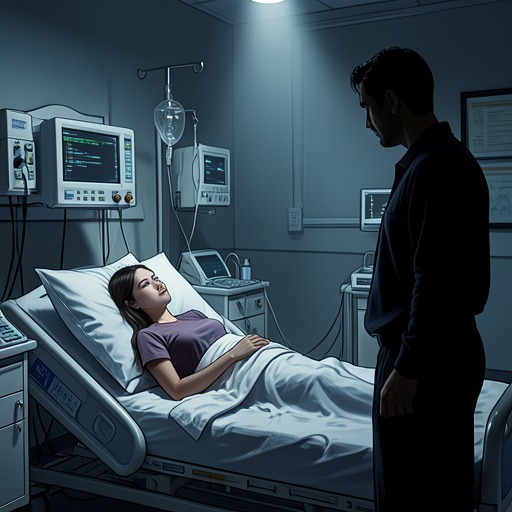
Janae Receives Addiction and Psychological Treatment
I'm Still Here- What didn't kill me made me stronger and sharperJanae Morrison’s treatment is a continuing effort to address self-harm and cocaine addiction without reducing her to either crisis. It begins in the aftermath of a suicide attempt, with a hospital discharge tied to an offer of free therapy, and develops through counseling with Inya and peer support that makes recovery a repeated, practical choice rather than a single cure.
Crisis, Discharge, and the Offer of Care
After Janae Morrison’s suicide attempt, a hospital staff member explains that the usual policy is a three-day admission to the mental-health department for evaluation. But Janae Morrison has no insurance, and the hospital does not participate in Medicaid; the staff member says these circumstances leave the hospital with no choice but to release her. The discharge is therefore not presented as the end of the crisis. It comes with a strong recommendation for counseling and an offer of enrollment in a free, intensive dialectical behavior therapy program for people who cut themselves.
The program is described as combining group and individual counseling. Janae Morrison must agree to participate and sign a contract before she can be released; otherwise, she would be sent to the county facility, which the staff member warns her she would not want. Janae Morrison agrees. The condition makes treatment part of the immediate passage out of the hospital, but the offered care also gives her a route beyond mere containment: she is invited into continuing support for the behavior that brought her into crisis.
Naming What Recovery Must Address
In a later session, Inya introduces herself as someone available to help if Janae Morrison wants help. Janae Morrison is wary of being judged or criticized, a concern she voices before identifying what she hopes counseling will change. Her goals are specific: healing, stopping drug use, and stopping self-harm. The exchange sets the work in Janae Morrison’s own terms rather than treating recovery as an abstract demand for good behavior.
Inya’s office offers a contrasting atmosphere to the emergency of the hospital. Degrees hang on the wall beside a photograph of Inya with Maya Angelou; the room’s details and calm inspire Janae Morrison, who is an artist. Janae Morrison notices Inya’s unusual manner and resists the idea that she is a typical counselor. The relationship takes shape through that attention as well as through formal treatment: the office is a place where Janae Morrison can consider healing and creativity together, not simply be assessed for symptoms.
A central part of Inya’s counsel is a direct challenge to the belief that Janae Morrison carries bad energy. Inya tells her that she does not, and asks her to repeat that she is not bad energy until she believes it. The affirmation counters a damaging judgment that has become part of how Janae Morrison understands herself. It does not erase the pain behind that belief; it offers a different account of her identity to practice saying and, eventually, to inhabit.
The Counselor as a Witness to Recovery
Inya does not present recovery as a flawless accomplishment. She tells Janae Morrison that she regrets her own past mistakes, but has forgiven herself, found God and love, and now helps others stay clean. Rather than asking Janae Morrison to apologize for Inya’s history, she redirects attention to the suffering Janae Morrison needs to address and asks her to return the following week. Her disclosure makes counseling less like judgment from an untouched authority and more like guidance from someone who understands that healing can follow serious mistakes.
In a later conversation about relapse, Inya describes having relapsed three times before getting clean. She identifies practices that help her maintain sobriety: calling her sponsor, attending Narcotics Anonymous meetings, meditating, and responding to urges without using. Her account does not suggest that an urge disappears or that recovery becomes effortless. Instead, it models a set of actions and a daily struggle, giving Janae Morrison both a witness to relapse and a living example of continued recovery.
Inya also makes herself available as Janae Morrison’s sponsor. When an urge to use or cut arises, Janae Morrison can call or visit her; the two have made a plan intended to help her avoid both behaviors. Inya invites her to Narcotics Anonymous meetings held at the office on Thursdays at six in the evening, which she facilitates with Miguel. Attendees are asked to bring a dish, and the gathering is described as a nonjudgmental space. These specific arrangements extend care beyond the individual session into a recurring community practice.
Relapse, Shame, and Renewed Support
Janae Morrison’s progress is not linear. She later describes relapsing twice and taking a ten-thousand-dollar cash advance on Jensen Brick McCall’s credit card. At the time, she was passing her classes with A grades, making the honor roll, and beginning to look and feel good. She says she was frightened by the possibility that the good in her life would collapse, and deliberately acted in a way that she thought would make Jensen Brick McCall hate her. The relapse thus arrives not in the absence of improvement, but amid it: success itself has become difficult for her to trust.
Janae Morrison says Jensen Brick McCall took her out of the place of despair and put her in rehabilitation. She recalls his reassurance that she could not dismiss him or the good happening in her life. Her account of his response is significant to treatment, but it does not make him the sole remedy: Inya continues to identify Janae Morrison’s recovery as her own decision, built step by step, with a sponsor, meetings, and an agreed plan. When Janae Morrison breaks down over repeated mistakes, Inya answers that recovery is difficult and urges her to take it one day at a time.
The treatment framework also acknowledges how Janae Morrison’s past remains attached to present experience. At an art festival, a memory returns of attending a festival with Robert Walters, where she first tried cocaine and lost her virginity to him; she understands that encounter not as love but as being used. Elsewhere, while resting beside Jensen Brick McCall, the sting of cuts on her arm accompanies the memory of her sister revealing that Robert Walters fathered the child Janae Morrison is carrying. These recollections connect her addiction and self-harm to painful relationships and grief, rather than presenting either as an isolated habit. The recovery plan has to meet urges and injuries in the present while Janae Morrison continues to encounter the memories bound to them.
A Continuing, Not Finished, Recovery
Inya’s insistence on daily effort, her own history of relapse, and the standing invitation to call, visit, and attend meetings make Janae Morrison’s treatment a sustained structure of support. Its measures are concrete—individual and group counseling, Narcotics Anonymous, a sponsor, and a plan for moments of risk—while its deeper task is to help Janae Morrison imagine a life not organized by shame, self-harm, or cocaine. The narrative does not imply that relapse vanishes once support is available; it shows that support can remain present after a setback.
The longer account places this treatment within a future that includes family and creative work. One year later, on Christmas Day, Janae Morrison gives birth to Grace Pearl McCall; she is described as Jensen Brick McCall’s wife and best friend, and her art is selling for six figures, with portraits painted for the White House. These later facts do not establish that counseling alone produced those outcomes, nor do they declare recovery finished. They do show how far the story’s horizon has widened from the hospital’s crisis: Janae Morrison’s life includes art, partnership, and parenthood, alongside the ongoing work of staying well.